Volatile Ember Spirit

medium elemental, chaotic neutral

D&D 5.5 / SRD 5.2

Challenge 6 (2,300 XP)

Available with DM subscription
STR
14 (+2)
DEX
18 (+4)
CON
18 (+4)
INT
6 (-2)
WIS
12 (+1)
CHA
10

Defense

Armor Class
15 (natural armor)
Hit Points
85 (10d8+40 +4)
Speed
30 ft., fly 30 ft., (hover)

Proficiencies & Senses

Saving Throws dexterity, constitution
Skills
Stealth +7, Survival +4, Perception +4
Senses
darkvision 60 ft.
passive Perception 14

Characteristics

Damage Vulnerabilities
cold
Damage Resistances
bludgeoning, piercing, slashing
Damage Immunities
fire, poison
Condition Immunities
exhaustion, grappled, paralyzed, petrified, poisoned, prone, restrained, unconscious
Languages Ignan

Traits and Actions

Explosive Volatility

Trait
When the spirit takes bludgeoning, piercing, or slashing damage, it swells with unstable heat. It gains one Volatile Charge (maximum 3). At the start of its next turn, it can use its action to Self-Destruct. If it has 3 charges, it must Self-Destruct at the start of its next turn.

Fire Aura

Trait
A creature that starts its turn within 5 feet of the spirit takes 1d6 fire damage, or half as much if it is immune to fire damage.

Illumination

Trait
The spirit sheds bright light in a 10-foot radius and dim light for an additional 10 feet.

Touch

Action
Melee Weapon Attack: +7 to hit, reach 5 ft., one target. Hit: 11 (2d6 + 4) fire damage.

Ember Burst

Action
Ranged Spell Attack: +7 to hit, range 60 ft., one target. Hit: 13 (2d8 + 4) fire damage.

Self-Destruct

Action
The spirit explodes in a 20-foot radius sphere centered on itself. Each creature in the area must make a DC 15 Dexterity saving throw, taking 28 (8d6) fire damage on a failed save, or half as much on a successful one. The spirit is destroyed.

Swelling Retort

Reaction
When hit by a melee attack, the spirit can immediately gain one Volatile Charge (maximum 3) and deal 5 (1d6 + 2) fire damage to the attacker.

Running the encounter

Combat Behavior

Tactics

  • Seeks groups of enemies to maximize Self-Destruct damage.
  • Uses Ember Burst from range until it can close in.
  • When swelling from physical hits, retreats toward the largest cluster of foes.

Combat Style

Aggressive, suicidal fire spirit that seeks to explode among enemies.

Morale

Fights until destroyed; its volatile nature makes retreat unlikely.

Appearance & presence

Monster Description

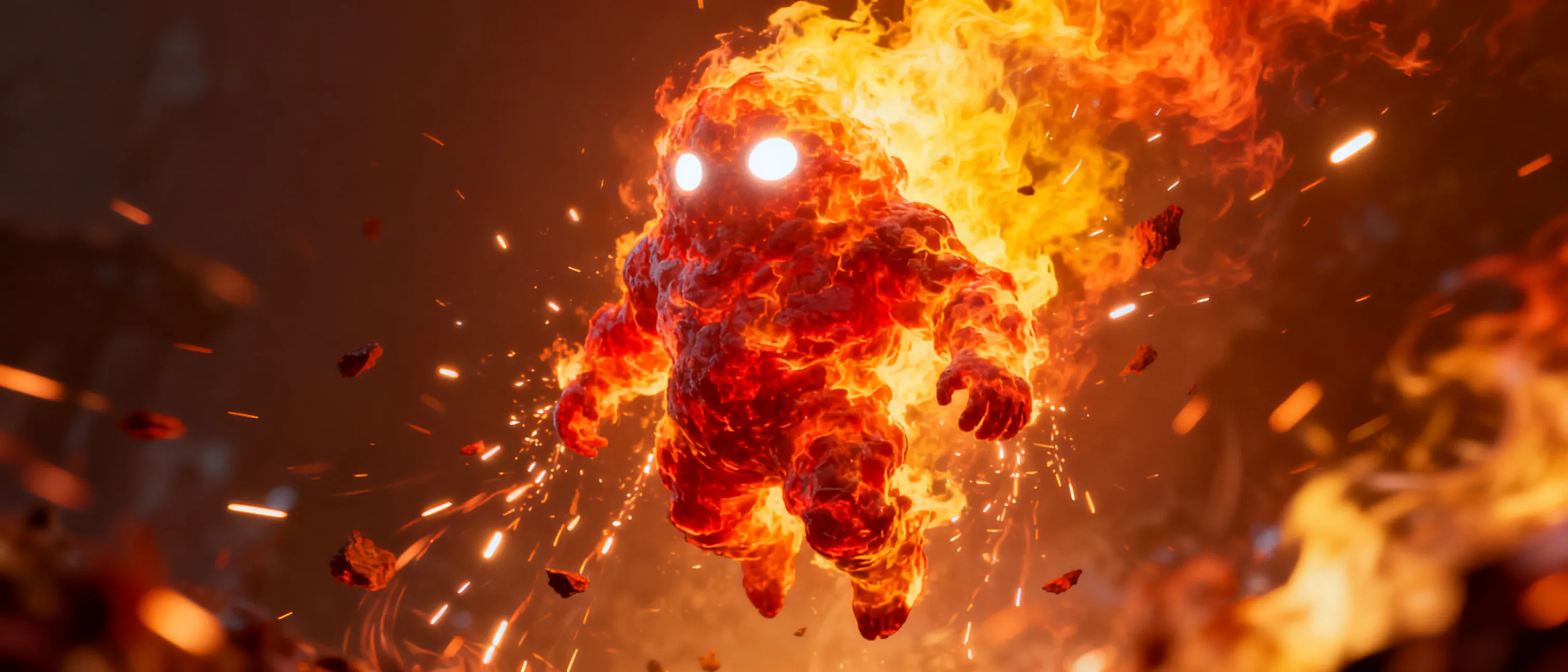
A volatile ember spirit resembles a humanoid-shaped mass of living flame, roughly the size of a grown person, though its outline is never still. Its body is a churning column of orange, yellow, and white-hot fire, with no solid core—only a denser knot of brightness near the center that pulses like a heartbeat. Sparks and embers trail from its limbs in lazy spirals, and its passage leaves faint scorch marks on stone and a smell of hot iron and burnt sage.

Two eyes, white-hot and pupil-less, glow from the upper portion of the mass, and when the spirit is agitated, they narrow into blazing slits. Its movements are fluid and unsettlingly smooth; it glides through the air with a hovering, serpentine grace, its lower body tapering into a flickering tail of flame rather than legs. When it swells with volatile energy, its form expands unevenly, bulging outward in lopsided spheres of compressed heat, and the air around it shimmers with distortion.

The sound it makes is a low, resonant crackle, like a bonfire breathing, punctuated by sharp pops and hisses when it is struck. In darkness, it sheds a flickering light that dances across nearby surfaces, and its presence raises the temperature of a room by several degrees. The spirit casts no shadow of its own but throws wild, shifting shadows from surrounding objects. When it speaks, which is rare, its voice is a dry, crackling whisper in Ignan, carrying the weight of something ancient and impatient.
Instincts & motives

Monster behavior

Volatile ember spirits are creatures of restless, chaotic energy, driven by an instinct to burn and to burst. They do not hunt for sustenance but are drawn to heat, conflict, and the presence of living creatures, whose warmth they find irresistible. In their natural state, they drift through volcanic vents and ruined forges, idly scorching whatever they touch, but they become fiercely aggressive when they sense intruders. Their motivations are simple: to grow hotter, to find fuel, and to release their accumulated energy in a spectacular explosion.

They have no interest in negotiation or mercy, though they can be temporarily placated by offerings of flammable material, which they consume with greedy crackles. Socially, they are solitary but tolerate others of their kind at a distance; when several gather, they engage in brief, harmless flare-displays that resemble a conversation of light and heat. When threatened, they do not retreat—instead, they seek to close distance and detonate among as many foes as possible, often ignoring individual attackers to reach a larger group.

They are cunning enough to feint and reposition, using their hover speed to glide over obstacles, and they will deliberately provoke physical attacks to accelerate their swelling. Their reactions to intruders are immediate and violent, but they can be distracted by sudden blazes or large quantities of combustible material, which they will investigate before attacking.

Habitat & life cycle

Ecology

Volatile ember spirits are native to places of intense heat and magical fire: volcanic calderas, elemental rifts, the ruins of arcane forges, and the hearts of ancient wildfires. They do not eat in the conventional sense; they absorb ambient heat and combustible matter, growing brighter and more unstable as they feed. Their life cycle is a cycle of accumulation and release—an ember spirit drifts and feeds until its internal pressure becomes unbearable, at which point it self-destructs in a fiery bloom, leaving behind a scattering of hot cinders.

From these cinders, after days or weeks, a new spirit may coalesce if the ambient magic is strong enough. They are thus both mortal and renewable, a dangerous part of any fire-aligned ecosystem. They have no natural predators, though cold-based creatures and water elementals can extinguish them, and they are often enslaved or bound by fire giants, efreet, and wizards who value them as living bombs. In the wild, they are avoided by most creatures, and their presence is often a sign of deeper elemental instability. They occasionally serve as guardians for fire-aligned treasures or as living traps in ancient vaults.

Origins & legends

History

The first volatile ember spirits are said to have been born from the death throes of a primordial fire elemental that was shattered by a cold-iron spear in an ancient war between elemental lords. Its scattered essence ignited the air and coalesced into these unstable beings, each carrying a fragment of that original, furious death. Local accounts in volcanic regions describe them as 'the burning sighs' of the mountain, and miners and travelers tell of will-o'-wisp-like lights that grow brighter and larger before vanishing in a thunderous blast.

In the town of Cinderhold, a story is told of a forge that was haunted by an ember spirit; the smith learned to feed it slag and scraps, and it became a useful, if dangerous, assistant until it exploded during a particularly large commission, destroying the workshop. Adventure hooks involving ember spirits often center on their use as living weapons: a warlord might seek to harvest their volatile cores, a wizard might need one captured for research, or a village might be plagued by a spirit that has taken up residence in a granary and refuses to leave. Their origins as fragments of a primordial being also make them targets for those seeking to reforge that ancient entity.

Ready to Unleash Your Dungeon Master Potential?

Join thousands of DMs and turbocharge your campaign preparation with Fable Fiesta!

Register, and get access to monster abilities, combat behaviour and lore!

Sign Up Now - It's Free!

No credit card required. Start writing in minutes!