Spine Gnasher

medium monstrosity, unaligned

D&D 5.5 / SRD 5.2

Challenge 6 (2,300 XP)

Available with DM subscription
Register to save this monster forever!

This monster will be deleted in 2 days. Create a free account to claim all your generated content.

STR
18 (+4)
DEX
12 (+1)
CON
14 (+2)
INT
6 (-2)
WIS
12 (+1)
CHA
8 (-1)

Defense

Armor Class
15 (natural armor)
Hit Points
85 (10d8+40 +2)
Speed
30 ft.

Proficiencies & Senses

Saving Throws strength, constitution
Skills
Stealth +4, Athletics +7, Perception +4
Senses
darkvision 60 ft.
passive Perception 14

Characteristics

Damage Vulnerabilities
—
Damage Resistances
piercing
Damage Immunities
—
Condition Immunities
prone
Languages understands Common but can't speak

Traits and Actions

Spiny Hide

Trait
The Spine Gnasher's back is covered in sharp, barbed spines. When a creature hits it with a melee attack while within 5 feet of it, the attacker takes 5 piercing damage.

Ferocious Appetite

Trait
If the Spine Gnasher reduces a creature to 0 Hit Points with a Bite attack, it can use its reaction to eat the corpse, regaining 10 Hit Points.

Multiattack

Action
The Spine Gnasher makes two attacks: one with its Bite and one with its Tail Swipe.

Bite

Action
Melee Weapon Attack: +7 to hit, reach 5 ft., one target. Hit: 12 (2d8+3) piercing damage plus 3 (1d6) acid damage.

Tail Swipe

Action
Melee Weapon Attack: +7 to hit, reach 10 ft., one target. Hit: 11 (2d6+4) slashing damage, and the target must succeed on a DC 15 Strength saving throw or be knocked prone.

Running the encounter

Combat Behavior

Tactics

  • Uses Tail Swipe to keep enemies at distance before closing in with Bite.
  • Relies on Spiny Hide to punish melee attackers.
  • Targets isolated foes to trigger Ferocious Appetite.

Combat Style

Aggressive frontline bruiser that punishes close contact and controls space with its tail.

Appearance & presence

Monster Description

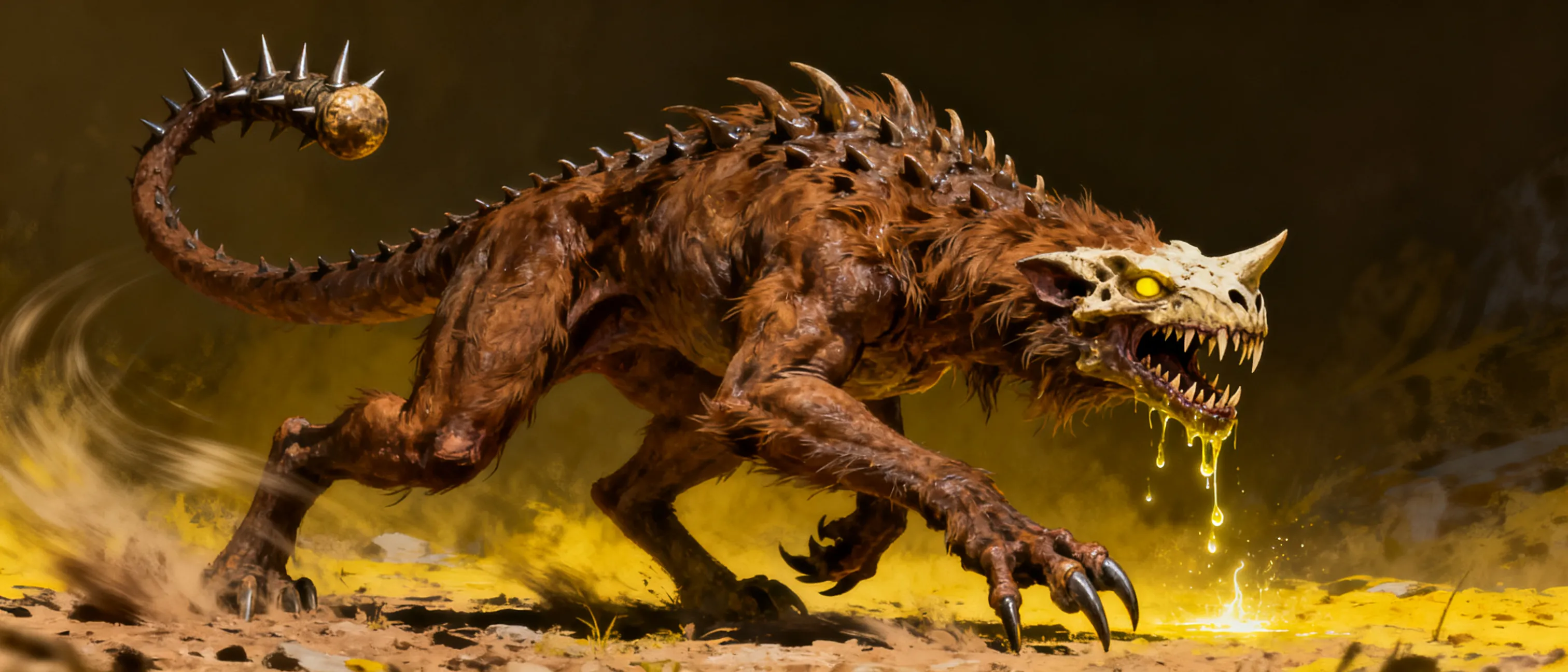
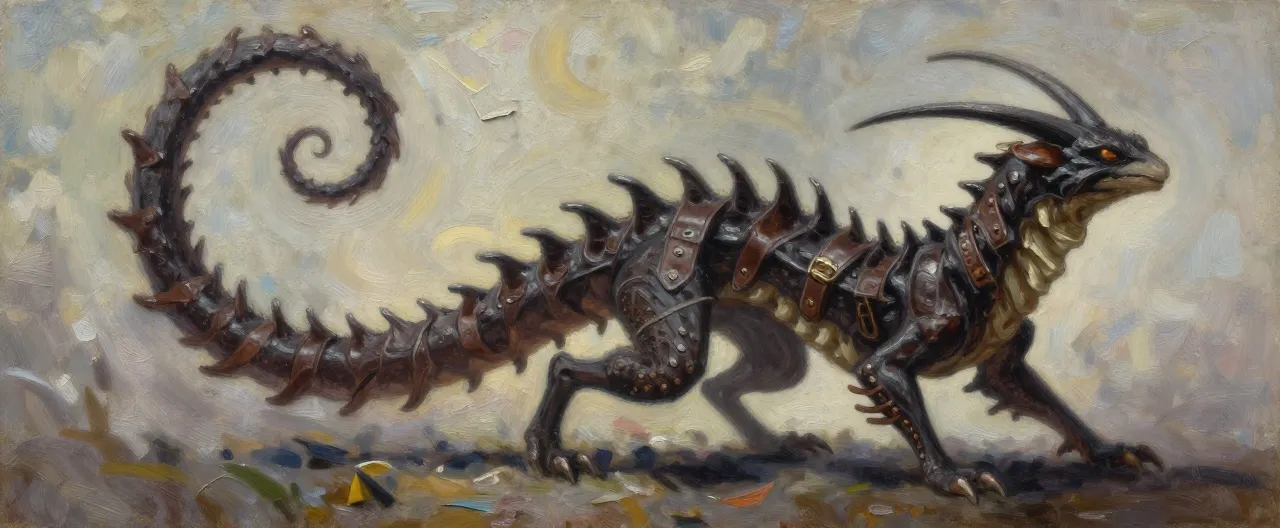
The Spine Gnasher is a hulking, quadrupedal monstrosity that exudes an aura of primal aggression and biological hazard. Standing roughly four feet at the shoulder but hunching forward to appear larger, its body is encased in matted, coarse brown fur that clumps together with dirt and dried gore. The most striking feature is the dense forest of rigid, blackened spines protruding from its back and shoulders, resembling a porcupine’s quills scaled up to the size of dagger blades.

These spines are barbed near the tips, designed to tear flesh upon withdrawal. Its head is broad and flat, dominated by a jaw lined with jagged, uneven teeth that constantly gnash against one another, producing a wet, grinding sound akin to stones crushing bone. Thick, viscous saliva drips from these jaws, sizzling faintly when it hits the ground due to its acidic nature. The creature moves with a loping, predatory gait, its powerful hind legs propelling it forward in sudden bursts of speed.

Its tail is thick and muscular, ending in a natural bony club adorned with smaller spikes, which it swings with lethal precision. Yellow, feral eyes sit deep within a heavy brow ridge, scanning for threats with intelligent malice. When threatened, it emits a low, guttural growl that vibrates in the chest of nearby listeners, accompanied by the sharp click-clack of its spines rubbing together as it tenses for combat.
Instincts & motives

Monster behavior

Spine Gnashers are solitary hunters driven by an insatiable need for protein and territory dominance. They exhibit high intelligence despite their beastial appearance, often setting ambushes along game trails or near water sources. Their primary motivation is survival through consumption; they do not fight for honor or sport but strictly to eliminate threats that stand between them and their next meal. In social interactions, they are largely anti-social, viewing other creatures either as prey or competitors.

If intruders enter their claimed territory, Gnashers will first attempt to intimidate with vocalizations and displays of their spiny backs. If ignored, they become aggressively territorial, utilizing hit-and-run tactics to wear down opponents before committing to a full assault. They show particular hatred toward those who wound them, targeting isolated individuals to trigger their regenerative feeding habit. Unlike mindless beasts, they can be distracted by shiny objects or strong scents, allowing clever adventurers to bypass them if they act quickly. However, once engaged, they fight with terrifying tenacity, refusing to retreat unless severely incapacitated.

Habitat & life cycle

Ecology

These creatures thrive in temperate forests, rocky badlands, and swampy edges where cover is abundant. As apex predators in their niche, they feed on medium-sized mammals, livestock, and occasionally unwary travelers. Their digestive systems are highly acidic, allowing them to consume bones and tough hides, which contributes to the hardness of their own skeletal structure. Reproduction occurs infrequently, with females laying a clutch of leathery eggs protected by thorny vegetation.

Hatchlings are precocial and covered in soft spines that harden over time. Ecologically, they serve as population control for herbivores, though their aggressive nature often leads to conflicts with local farming communities. Their resistance to piercing damage stems from the dense layer of muscle and cartilage beneath their hide, evolved to withstand attacks from rival predators. Magical equivalents might include constructs made of ironwood and stone, mimicking their form to guard dungeons without the need for sustenance.

Origins & legends

History

Local legends suggest the Spine Gnasher was originally bred by ancient druids as guardians of sacred groves, intended to protect rare herbs from poachers. Over centuries, the breeding programs failed, and the creatures escaped into the wild, mutating and adapting to survive without magical support. Farmers in border villages have long feared them, attributing unexplained livestock deaths and missing persons to their gnashing jaws. A notable incident occurred thirty years ago when a pack of Gnashers drove settlers out of the Thornridge Valley, leading to the abandonment of several mines now rumored to be haunted by their descendants.

Adventure hooks often involve clearing a nest blocking a trade route, investigating a village plagued by nightly raids, or recovering a lost heirloom swallowed by a particularly large specimen. Scholars debate whether their current ferocity is purely instinctual or if residual druidic magic still influences their protective behaviors toward specific plants.

Ready to Unleash Your Dungeon Master Potential?

Join thousands of DMs and turbocharge your campaign preparation with Fable Fiesta!

Register, and get access to monster abilities, combat behaviour and lore!

Sign Up Now - It's Free!

No credit card required. Start writing in minutes!