Nib Cobb was born in Saltport, the second child of a halfling fishing family whose small blue boat, the Kindly Gull, was a familiar sight in the harbor. His mother wrote letters from her long fishing voyages up and down the coast — careful, slanted handwriting that Nib practiced copying until he could read it better than any book. His father mended nets on the dock and told him the mine hills were hollow as bread rolls and best left alone. When Nib was nine, a winter storm took both parents' boat, and neither came home. Barbrey, his older sister, became his whole family in a single terrible night.
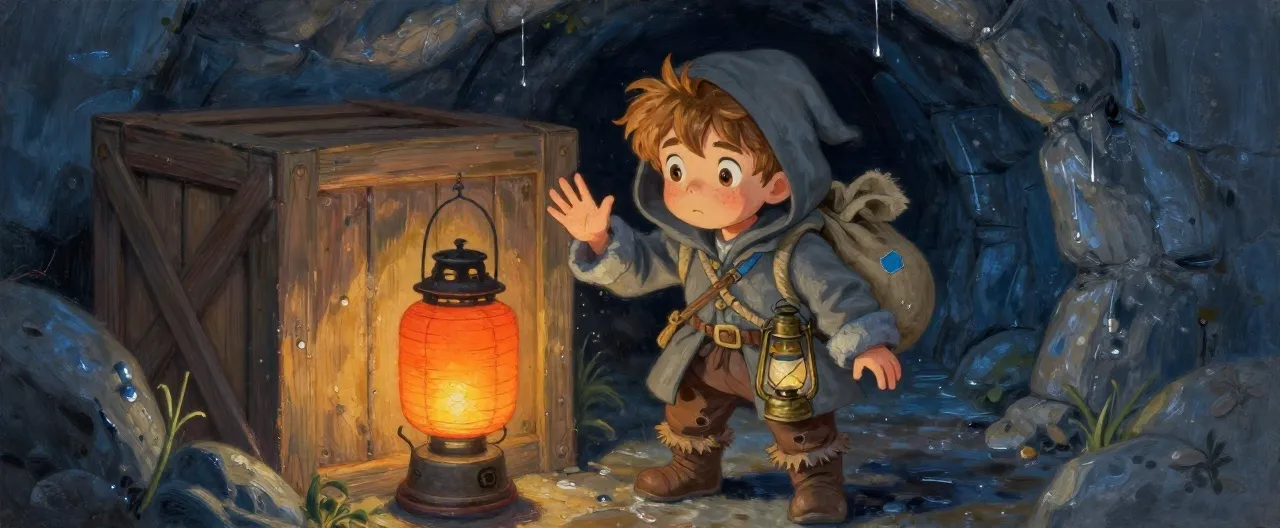
Barbrey worked the upper galleries of the old tin mine to keep them fed, and Nib — too small for a pick and too restless for a net — ran messages along the docks for the harbor runners, the loose smugglers' guild that paid in copper and biscuit ends. They taught him thieves' cant: the hand signs, the chalk marks on pilings, the hidden meanings in ordinary chatter. They called him 'Little Lantern' for the battered brass lantern at his hip, a keepsake from his father's boat.
He was good at the work — unnaturally good at not being seen, at lifting a lantern off its hook without a sound, at slipping between grown men's legs like a cat through fence rails. The runners said he was the best little ears on the coast. What they didn't know was that every job ended the same way: Nib running home to Barbrey, lighting every candle in the house, and sleeping in the middle of them like a kitten in a pile.
Then the sea broke into the mine. The flood drowned the lower tunnels, the runners' sea-cave routes, and half the work, and the town sealed the entrance with a warning sign Jeor Finch carved himself. The runners drifted to bigger ports. Barbrey took net-mending work in Saltport. And Nib discovered what he was when nobody needed him: small, quick, and invisible — and lonelier than he knew how to say.
He moved into the coast's sea caves 'just for a while,' telling Barbrey he was sleeping at a runner's dockhouse. The caves were dry enough but black as tar, and Nib learned that he was afraid of the dark in a way he had never been afraid of anything — not the dark of night, but the wet, breathing dark of tunnels where water makes shadows and shadows make shapes.
So he began borrowing lanterns. Just borrowing, he told himself. Pretty paper ones from Saltport's eaves, one a night, carried north along the cliff path past Jeor Finch's cave while the hermit slept. He counted them like friends: seven lanterns, eight lanterns, nine.
Three weeks ago, everything changed. A tall figure in a grey hood found him in the sea caves and did not yell or chase — which frightened Nib more than either would have. The stranger crouched down, said 'You're very good at not being seen,' and slid thirty silver pieces across the wet rock. The payments kept coming on the dark of the moon, left in a gull's nest on the cliff path, always with notes in a careful, slanted hand: gather lanterns, watch the water, the door sleeps, the eye stays closed until the festival, do not open it.
The stranger left a brass key and told Nib there was a door under the water in the old mine, and that Nib would watch it. Nib told himself he could stop any time. He never stopped. He was too scared of what would happen if he did — too scared, though he'd never admit it, of what might happen to Barbrey.
In the mine, Nib built a hideout at the rowboat landing: crates for furniture, a bedroll, his sack of glowing lanterns arranged in a ring around it like a fort against the dark. He found two crabs in a tide pool during his first starving week, fed them scraps from his tin cup, and named them Pinch and Paddle. They are his family now, or so he tells them every night.
He talks to them about the lanterns, the dark shapes in the water, and the sister he misses — and they go utterly still whenever the grey stranger's footsteps sound on the mine rails, which Nib has noticed and dreads.
Barbrey, meanwhile, noticed her little brother had stopped coming home. She searched the coast for three nights, following muddy footprints and lantern glow, until she climbed down into the flooded mine herself — and a partial cave-in trapped her in a side tunnel near the old sealed door. She has been shouting through the rocks ever since, half-furious and half-terrified, seeing pale light move in the water through the cracks and hearing something on the other side of the underwater door turn over like a sleeper changing position.
Now the Lantern Festival is three days away, Saltport's lanterns are vanishing one by one, and a mayor has hired adventurers to find her thief. Nib is hiding in his lantern fort with a brass key he wishes he didn't have, a note with a closed eye he can't throw away, two crabs, a rowboat, and a terrible suspicion that the dark behind the underwater door has started knocking back.