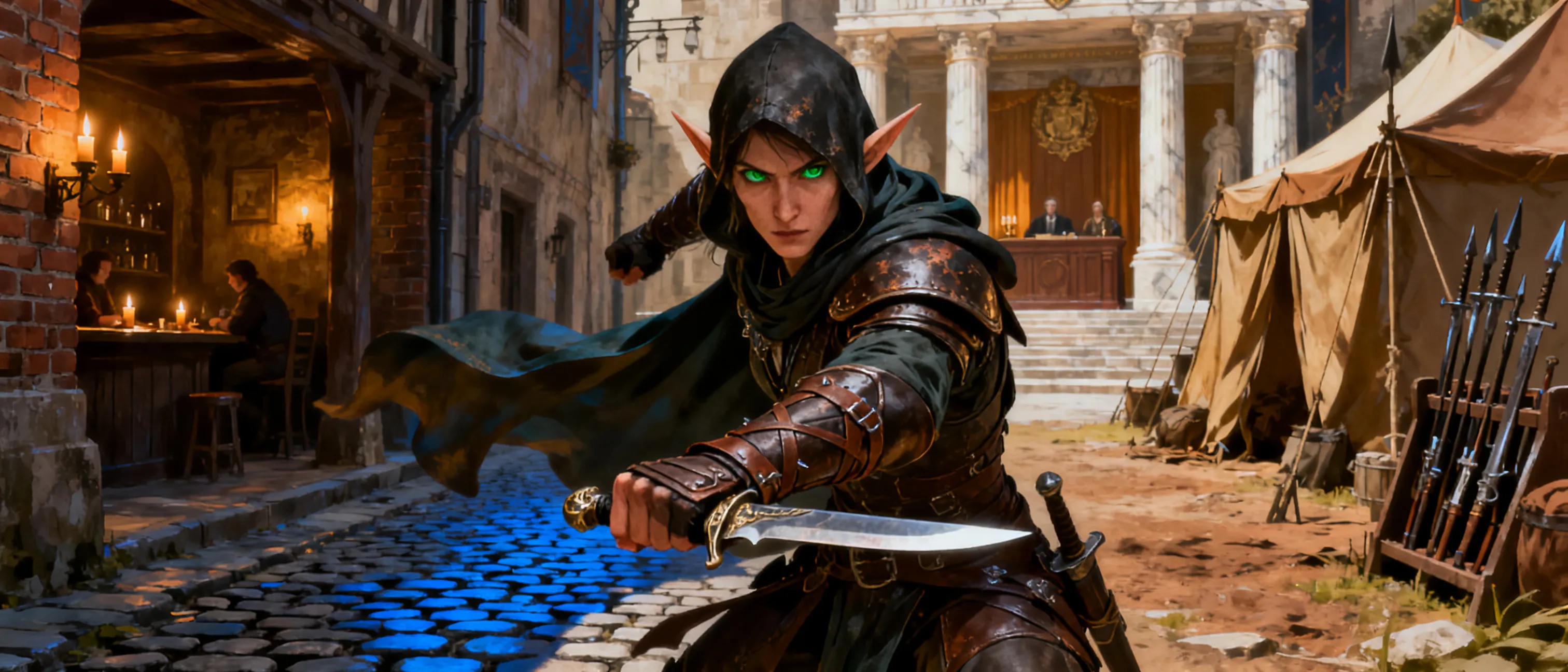
Character Background
Cael Verdan was born beneath a roof that valued lineage almost as much as food. His family was not the greatest house in the region, but it was respected enough to stand in the outer rings of local politics, and that meant Cael grew up hearing the language of obligation long before he understood the meaning of freedom. He was taught to bow properly, to keep his hands steady, to speak only when addressed, and to never embarrass the family name in public. As a child, he absorbed all of it with a quiet seriousness that made adults think him obedient when in truth he was simply observant.
The first real rebellion in Cael’s life was not loud. It came in the form of an affection he was not meant to have. A young noblewoman from a neighboring estate visited often enough that the two became companions, then confidants, then something more dangerous than either family would have tolerated. She was bright, stubborn, and amused by his habit of pretending he did not care what people thought. Cael, in turn, admired how easily she could challenge the world without lowering her voice. Their bond grew in stolen moments: walks beyond the orchard walls, shared books, promises whispered where servants could not hear. It was a foolish love, but genuine, and like many sincere things in the lives of the young, it was doomed by the older generation’s calculations.
When a nobleman of higher rank sought to marry her, the matter became political. Cael was told, in courteous language, that he should be grateful for the attention of fate and step aside. He did not. Pride, love, and a sense of humiliation all sharpened together into a single terrible decision: he challenged the nobleman to a duel. He fought for honor, for love, and for the illusion that a single act of courage could force the world to respect someone it had already decided to dismiss. He lost. The defeat itself was bad enough, but the social consequences were worse. He was mocked, his family was pressured into silence, and the noble circles that had once tolerated him closed their doors. The woman he loved was taken from his reach by wealth, rank, and arrangement. Whether she was also forced to forget him was a question he never let himself ask.
There was no place left for him at home. Too much shame clung to him, and even if his family had wanted to shield him, they lacked the power to stand against the noble house that had humiliated him. So Cael took the only path that would accept him without asking questions: he enlisted in the army. The army stripped away the remains of his old life. It replaced silk and ceremony with mud, fatigue, and command voices that made no allowances for wounded pride. He learned to march until his feet blistered, to clean his gear before dawn, to follow orders, and to watch the men around him die for ground that changed hands again by nightfall. He also learned useful things. A soldier sees how camps are laid out, where supplies are stored, who can be bribed, who is desperate, and who lies badly. Cael watched everything. He was not the strongest recruit, but he was quick, quiet, and good at reading people. Those talents kept him alive.
Yet military discipline did not make him loyal. It taught him instead that authority often wears honor like a mask. He saw officers send exhausted men into needless danger, watched supplies vanish into private hands, and realized that the difference between legality and theft was often just who carried the seal. The final break came when he was ordered to participate in an act he judged cowardly or senseless—one of those grim errands that commanders justify with strategy and leave the dead to explain. Cael deserted. He did not leave with a grand speech. He simply vanished before dawn, carrying what he could, and from that moment became a hunted man.
Living outside the law did not surprise him as much as it might have once. He had already lost the life of a son and gentleman; now he learned how to survive as a criminal. At first he took whatever work would keep him fed: moving goods under false names, stealing horses, carrying messages, breaking into locked places for people who preferred not to ask for official help. Over time, he refined those skills. His hands became steadier. His footwork became softer. He learned to cut purses without feeling the cloth, to read a room for the richest target, and to disappear before suspicion could harden into accusation. He discovered that some doors open more easily when the right lie is spoken by the right face, and that the difference between a thief and a con artist is often just confidence.
His talents eventually drew darker work. Someone who can enter unnoticed can also leave a message, plant evidence, overhear a conversation, or learn where a rival sleeps. Cael became a spy because he could blend into crowds and a thief because he needed coin, but the role of assassin came from the same cold practicality that kept him alive in the army. If someone wanted another person dead and could not risk direct violence, Cael was the sort of man who could be paid to solve the problem. He did not take every job, and he is not mindlessly cruel, but he no longer pretends that there is a clean line between survival and sin. He knows exactly what he is becoming and chooses it anyway when the alternative is starvation or surrender.
Still, he has not become hollow. Cael keeps a few private rules. He does not betray the helpless for convenience. He does not kill for sport. He hates bullies, especially those wrapped in titles or uniforms. He is suspicious of promises but honors the few he makes. Beneath his cynicism lies a stubborn idealism: the belief that dignity should not belong only to the powerful. This belief is one of the few pieces of his old self that has survived every fall.
His bonds are complicated. He remembers the woman he loved with a mixture of grief and fury, and he does not know whether he hopes she escaped the life chosen for her or whether he fears she did not. He still thinks of his family, not with hatred, but with the ache of a door that was never truly closed, only barred from the outside. His ideal is freedom, though he has learned how costly freedom can be. His flaw is pride: once Cael decides he has been wronged, he finds it hard to let the matter rest, even when restraint would serve him better. He can also be reckless when someone he cares about is threatened, because the memory of losing everything once makes him unwilling to watch it happen again.
Now he moves through cities, camps, and border roads as a man with too many names and too few safe places. To common folk he may be a helpful courier, a gambler, a discreet problem-solver, or just another face in a crowd. To the law he is a deserter, a thief, and likely worse. To himself, he is still trying to decide whether the person who ran from home in shame is gone forever or simply waiting for the right moment to stand up again.