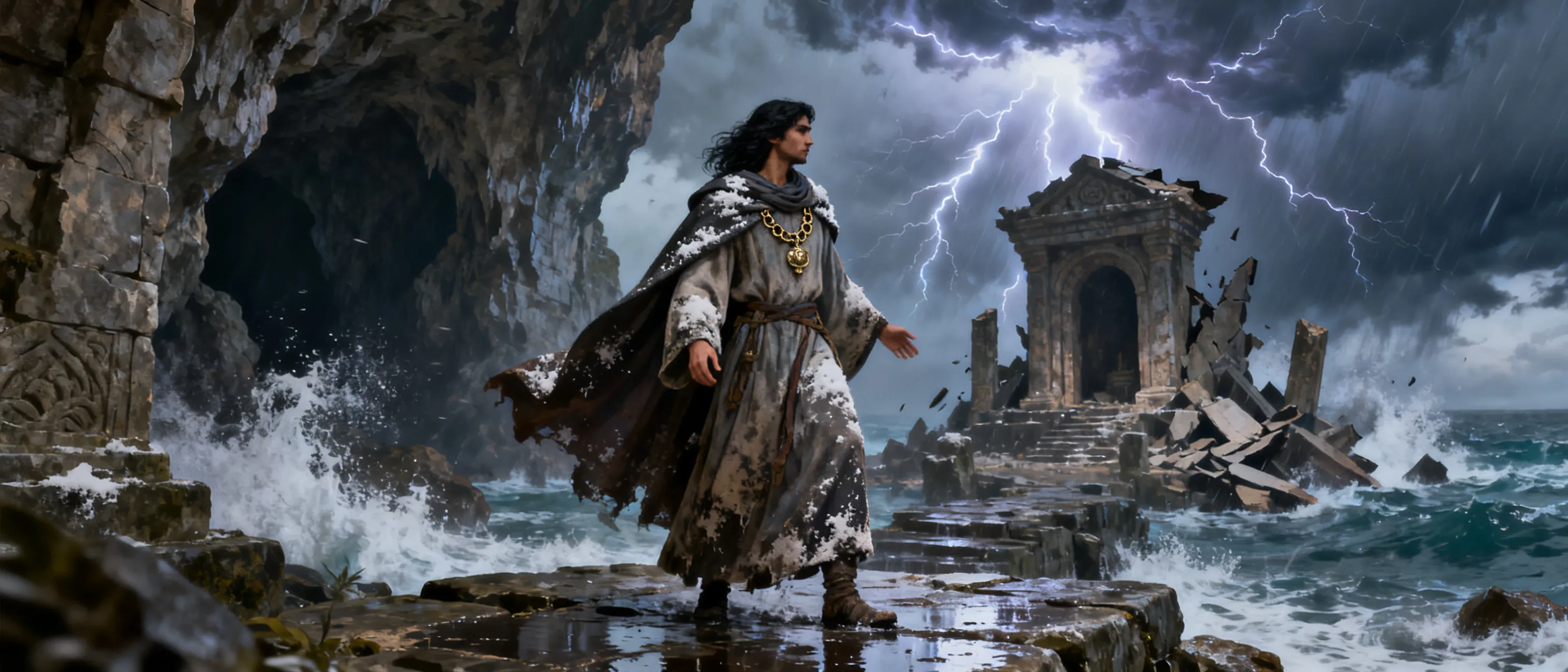
Character Background
Myron was not born into power. He grew up in a harbor district where temple bells marked the hours as reliably as the tide, where cargo moved faster than truth, and where the difference between a blessed ship and a cursed one could mean the difference between a full table and an empty one. He learned early that priests, merchants, and dockmasters all spoke about order, but only one of them seemed able to make it pay. As a child, he ran messages, carried rope, and listened to sailors tell stories of storms that appeared without warning and vanished before dawn. Those stories fascinated him less as tales of wonder than as proof that the world was full of forces people did not understand but still had to obey.
He had a sharp memory and an even sharper tongue. When he was old enough to work the quays, he became useful in the way dangerous men often are: he could read schedules, overhear arguments, and predict who would panic first when a shipment went missing. He was never the strongest worker, but he was the one people sent when they needed a dispute settled quietly or a foreman distracted. He discovered he had a gift for speaking in ways that made people feel seen, even when he was lying through his teeth. A few generous laborers taught him how the docks really worked: who paid whom, which temple ledgers were padded, which shrine attendants looked the other way for coin, and how much a frightened crowd could be steered by a single shouted accusation.
His life might have stayed small and crooked if not for the shrine. There was a day of public prayer after a bad storm season, when the harbor people gathered to beg for calm seas and the temple fire guttered blue in the brazier, even though the wind was still. Myron saw the priests hesitate. He saw the people notice the hesitation. He saw, in that suspended moment, that faith could be shaken not by proof of divine cruelty, but by the absence of an answer. He never forgot it. When the gods did not immediately smite the world, his mind did what bitter minds do: it built a doctrine from the silence. Maybe the gods were absent. Maybe they were weak. Maybe mortals had mistaken habit for holiness.
From then on, he started collecting old rites, shrine customs, and timing patterns with obsessive care. He learned when offerings were carried, how processions were arranged, what signs made a priest change pace, and which taboos caused public alarm. He also learned something else: most people do not need truth, they need a reason to believe that someone else has broken the sacred order. Myron became very good at giving them that reason. He organized dock workers and festival laborers into a hidden cell not because he loved them in a simple way, but because they were the perfect cover for movement, rumor, and access. They moved crates, lanterns, cloth, and bodies through the city without attracting notice. He moved among them like a fire hidden in an oil lamp.
His bitterness did not come from simple hatred of the gods. It came from devotion that had curdled. He wanted proof the heavens were still listening. He wanted a miracle so undeniable that no priest could polish it into routine. Yet each step he took toward that proof made him more willing to hurt the very people whose belief he claimed to defend. That contradiction is the heart of his character. He can sound holy because part of him still is. He can sound monstrous because he is willing to make a public wound and call it revelation.
Myron’s personality is theatrical because he believes the world understands symbols better than arguments. He carries himself like a performer preparing a final speech, even when he is exhausted or afraid. He is also bitter enough to destroy the stage if it fails to produce the audience he wants. He can be surprisingly courteous to enemies, especially priests, because he thinks contempt is wasted on people who have already been frightened. Yet he can turn cruel in a heartbeat if he thinks someone is trying to reduce his beliefs to mere criminality.
His bonds are tangled. He values the laborers and dock workers who help him, but he is always testing whether they admire him or merely use him. He believes the shrine robbed the people of direct divine relationship by turning worship into routine. He wants to expose that lie, even if it takes theft, fear, and sacrilege. His ideal is not chaos for its own sake; it is compelled attention. His flaw is that he cannot tell the difference between being answered and being punished.
If the heroes meet him in the campaign, they should see a man who might have become a reformer, a priest, or a prophet, but instead became a danger to the city’s peace because he mistook provocation for proof. If he is defeated, he should not simply vanish. He should have things to say. He should know names, routes, ritual sequences, and possibly the shape of a larger divine conspiracy. If spared, he should not become harmless overnight. Redemption for Myron should be hard-earned, public, and humiliating, because only by losing the stage can he begin to learn what honest faith costs.