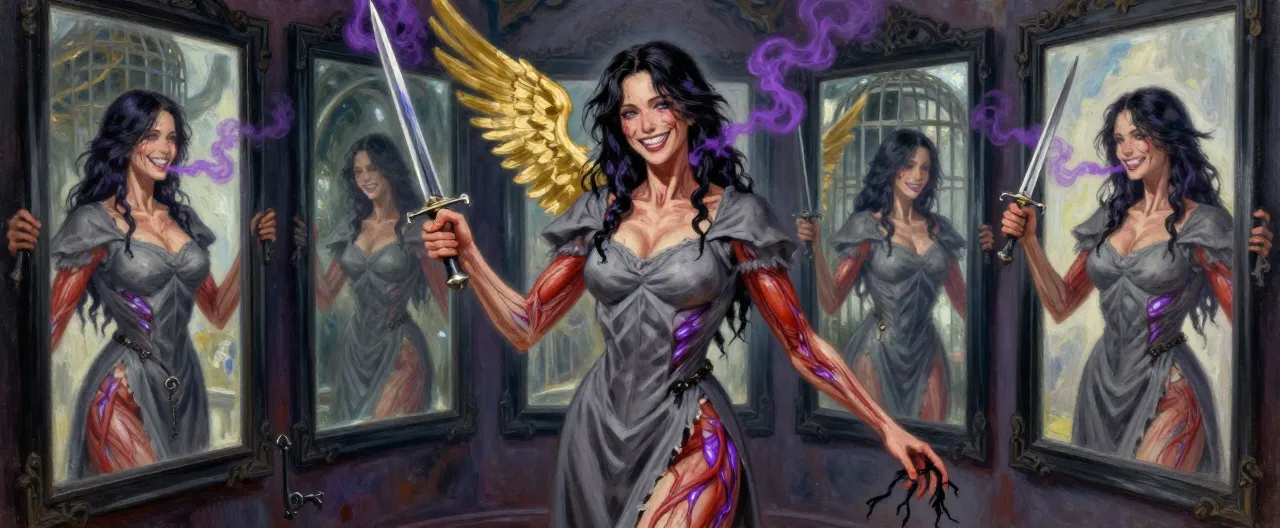
Nira was born Nira Ashfen, daughter of a peat-cutter's widow who sang her a lullaby every night of her short childhood. Ashfen is a village that trusts no one, and Nira trusted no one harder than most—until the winter the Choir came recruiting and a young scout named Riven sat across from her at the Drowned Bell and said her name like it was worth saying. She joined for him, though she told the Void it was for truth.
For two years she was the Choir's best recruit: quiet, observant, cruel only when ordered. Then Riven wavered, then she wavered, and the Choir's law is simple about wavering: flaying, public, at Gallows Ford. Nira was strapped to the gallows frame and Brother Kaelen had taken his first strip of her back when Magister Vaelen Mor arrived and stayed the blade. Why he saved her, she has never asked. She suspects he saw in her a vessel of useful emptiness—a woman with nothing left to lose and everything to prove.
He was right. She rebuilt herself in the Choir's image with a fanaticism that alarmed even her instructors: she volunteered for the first void-skin graft, she flayed the deserters at Gallows Ford without flinching (and hanged Riven herself, and kept his feather), and she delivered Ashfen's missing villagers to Matron Vela's needles at the Gilded Asylum. The Choir gave her a new name—Sister Nira, no surname, because surnames are doors the Void should not have keys to—and she gave the Choir everything else.
Five years of service have made her the Choir's iron hand: she runs the courier network of gray-robed feather-bearers, commands the ford ambushes, and serves as the Fane's enforcer beneath Highwatch. Mor dangles the apostlehood before her—the promise of total transformation, of a body the Void cannot take because the Void will own it wholly—and she has organized her entire existence around earning it. But the flaying left seams. She visits the Drowned Bell under a false name to watch Marla Fen, sister of the man she unmade, pour her ale.
She keeps Riven's feather beneath her own. She hums her mother's lullaby on quiet nights and watches the void-veins pulse to its rhythm, and she tells herself this is corruption being burned away rather than something being kept alive. In the Hall of Mirrors of the Rift of Flayed Sky, where she guards the last door before Mor's throne, she fights amid mirrors that reflect not the present but corrupted possibilities—and one of them shows her whole, unflayed, smiling, the woman she would have been if Riven had never sat down at her table.
She carries the iron key to the throne room on a cord of braided hair, and she has begun to suspect that the golden wing beating in the mirror that will not reflect her is keeping time with her heart. She is, by every measure the Choir uses, its most faithful servant. The truth she cannot speak is that faith, for Nira, has always been indistinguishable from terror—and that the Void Beyond is not the only thing that has ever promised to consume her completely.
Mor promised it first, with kindness. She chose him because he was gentler. She has never forgiven herself for the arithmetic of that choice, and she hunts the party across the Reach not because they carry a page, but because they are the first people in five years who might say her name forward and mean it—and she cannot afford to let anyone mean anything to her again.