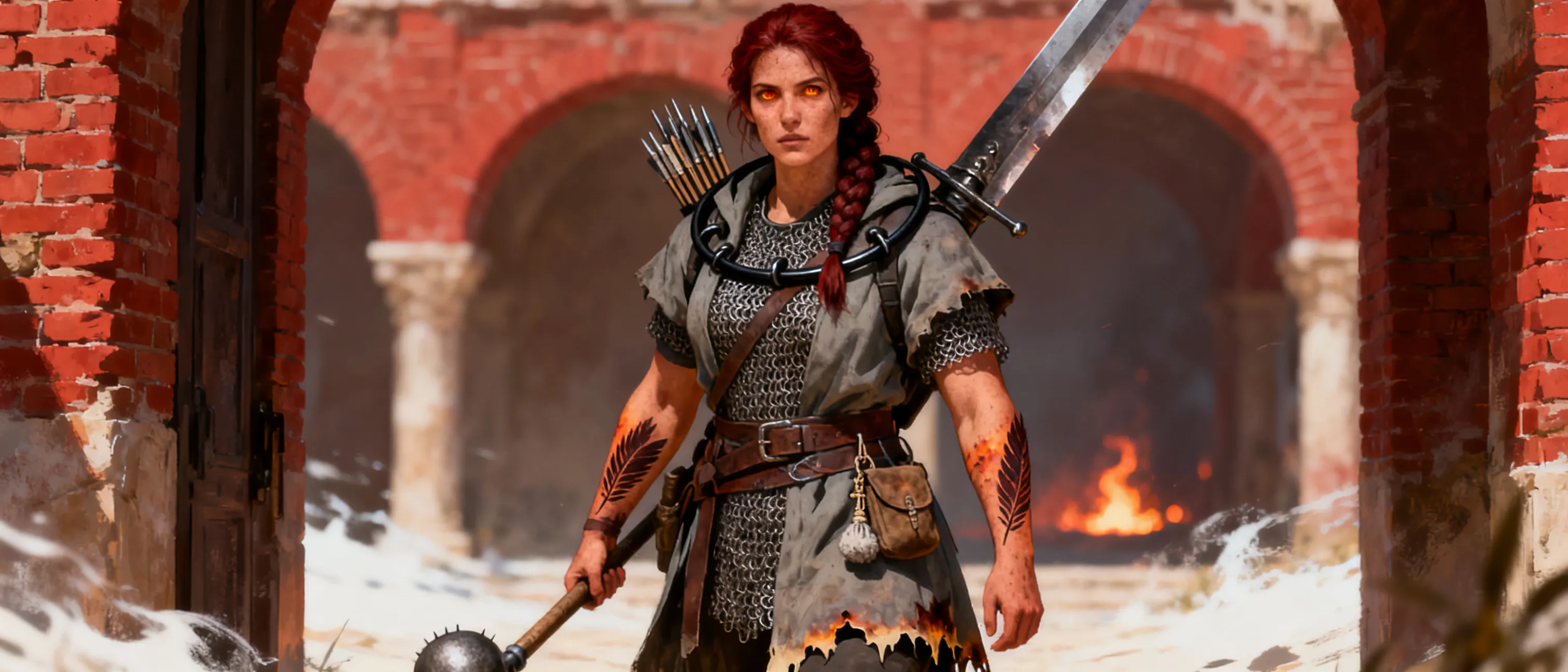
Brenna Salt was born in a waystation shrine on the coast road north of Neol, the third child of a pilgrim-warden named Halda Salt and a barge-carpenter father she barely remembers. The waystations of Peinebol are an old institution, older than the republic: low stone shelters strung along the ancient shrine-roads, each with a brazier that must never go fully dark, a keeper who tends it, and a duty to anyone walking between the great shrines. Halda kept one of these — a small one, three days' walk south of the Ember Roost — and Brenna grew up carrying kindling before she could carry a sword.
Her childhood was salt air, ember light, and the constant traffic of pilgrims. She learned to read from way-marker stones, to swim in the surf below the headlands, and to sing the cycle of first-fire songs that every warden's child learns by rote: the verses that tell where the old routes run, which shrines welcome strangers, and which customs keep a hearth-luck honest. She learned, too, the harder lessons of the roads — that the law thins out past the last farms, that bandits take tolls in the beech woods, and that a warden's family stands between travellers and both.
She was seventeen the year the feather shadows burned into her arms. A grass fire, driven up the coast by an ill wind, caught the waystation's thatch while a party of pilgrims was sheltering inside. Halda held the door-beam; Brenna dragged the pilgrims out through the smoke, one and then another, until her arms were scorched through her sleeves. Her mother lived. The waystation did not. The wardens' circle judged the fire an accident, but Brenna never quite believed it — the wind had changed too neatly, and a burnt feather was found in the ash that no one could account for. She has carried that feather's memory ever since, and it is one reason the burnt-feather mark will stop her cold when she sees it again.
After the fire, mother and daughter rebuilt on charity and pilgrimage-tolls, and Brenna took up the sword with a purpose: a warden who cannot fight is only a witness. She trained with a retired watch-sergeant in a fishing village, learned the greatsword because it kept the worst of the road at a distance, and learned the flail and javelin because not every fight waits for distance. She walked the full circuit of the shrine-roads twice before her twenty-fifth year — once south to north, once back — and can still recite the way-markers between Neol and the Roost in her sleep.
She is not a priest and has never claimed to be. The wardens keep the roads; the Keepers keep the fires; the difference matters to her. But she has stood at the back of the Ember Steps terrace on a dozen Ember Fairs, watching the phoenix burn, and she believes — plainly, without theology — that the fire is the republic's debt being paid, and that someone who quenches it owes a debt of a different kind.
She came to Neol this season for ordinary reasons: to deliver winter toll-coin to a warden's circle, to resupply, to see the Fair. She was in the harbour crowd when the fire on the Ember Steps drank down to a red thread, and she heard the Keeper's voice crack. Everything in her that was raised to keep a brazier lit — the songs, the scars, the arithmetic of who stands in front of the door — told her the same thing: the trail runs north, and someone must follow it.
When Maren Ashvale's call for competent swords went out, Brenna did not hesitate. She has been following cold trails ever since, greatsword on her back, shrine ash at her belt, keeping her watch on the road north.