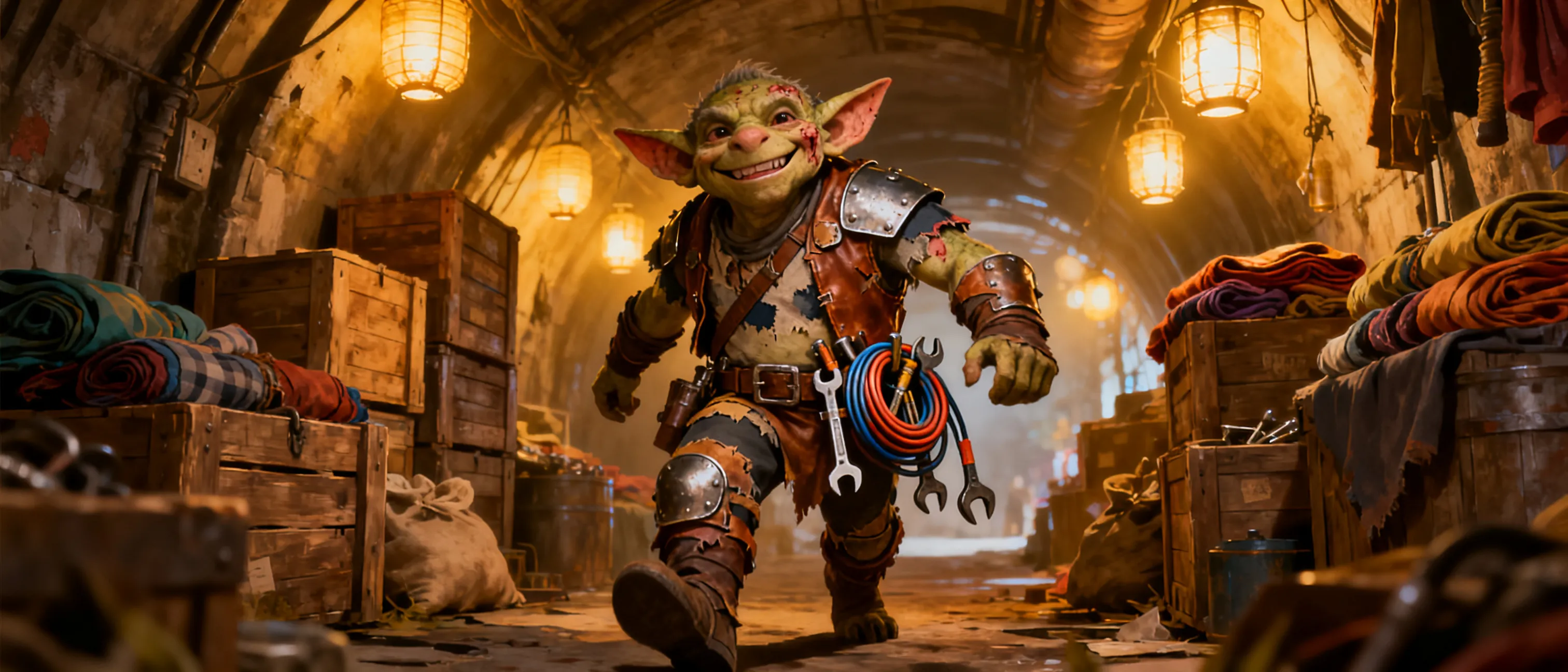
Character Background
Tarn Coiltooth was hatched in a narrow storage niche near a freight lift, under a ceiling of pipes that sweated in the dark and rattled whenever the market shifted its shelves. The first sounds Tarn remembers are not lullabies but the clatter of wheels, the snap of clipped tags, and the sharp voices of workers calling out inventory numbers to one another. Tarn grew up in the hidden spine of the bazaar, where the clean public aisles gave way to service ladders, repair chutes, crawlspaces, and the long tunnel veins that keep the whole strange market alive. While other hatchlings were kept close to the tally desks or taught to sort bolts and cloth scraps, Tarn was always slipping away to watch the runners come and go. The runners moved like they understood a secret language no one bothered to write down: a tug on a hood, two taps on a pipe, a chalk mark on a crate, and suddenly a whole route appeared in their heads.
Tarn learned early that the underworks were full of two kinds of people: those who planned every step and still got trapped, and those who trusted their feet to make up for the lack of planning. Tarn belonged firmly to the second kind. That did not mean careless. It meant practical. Tarn learned to count doors, listen for lifts before they moved, carry a coil of line, and check a crawlspace before committing body weight to it. If a route looked bad, Tarn found another one. If a job required talking, Tarn did just enough to get back to moving. Tarn’s grin became a kind of armor, an expression that said the problem could be handled if everyone stopped standing in the way. The scar across Tarn’s tail came from a tunnel incident when a maintenance gate dropped too early and pinned Tarn against a bent rail. Tarn got free, but the memory never left; neither did the understanding that the market’s machinery was only friendly when it was maintained by people who cared.
As Tarn grew older, the kobold swap meet started treating Tarn as a runner worth using. Tarn was not the most eloquent courier, but Tarn was reliable. If someone needed a sealed tube moved through the service routes, Tarn did it. If a vendor lost a crate under three carts and a tarp, Tarn found it. If a hidden chute led from the public aisles to the underworks, Tarn probably already knew where it opened and how badly it smelled. Tarn’s reputation came from recovery work: finding lost stock, moving trapped workers, and rescuing things buried under much larger things. That last skill made Tarn useful in the bazaar, where every stall seemed to be stacked on a catastrophe waiting for someone to pry it loose.
The alliance between the gnomes and kobolds gave Tarn a place to belong, but it also taught Tarn how quickly cooperation can slip into suspicion. The gnomes trusted systems, repair logs, and good intentions backed by careful notes. The kobolds trusted routes, survival, and the right to say no to a bad deal. Tarn liked both sides, but liked neither side’s bad habits. Tarn saw gnomes who assumed the tunnels were simple because they had not crawled them, and kobolds who assumed the public aisles were easy because they had not had to keep them open. Tarn became a bridge between those attitudes in the only way Tarn knew how: by going where others hesitated and bringing back proof.
The trouble that shapes Tarn’s current life began when runners started disappearing on ordinary jobs. Not dramatic disappearances, at least not at first. A delayed message. A route mark erased. A freight tube returned empty. Then came the black iron tags, the strange labels that seemed to send inventory where it should never go. Tarn noticed because Tarn notices the weight of a crate on a bad wheel and the smell of oil on a door hinge. The tags were wrong. The routes were wrong. The silence where runners should have been talking was wrong. Tarn started following the trail with increasing irritation and a growing sense that the market was not simply losing stock; it was being rewired.
That is why Tarn prefers action to discussion. Discussion has its place, but discussion does not pull a frightened courier out of a tunnel before the air runs out. Discussion does not stop a cart from rolling over a trapped worker. Discussion does not tell you who put the wrong tag on a crate. Tarn’s philosophy is simple: get there, assess the route, move fast, and bring back what can still be saved. Yet the bazaar is teaching Tarn something harder. Speed matters, but so does deciding what is worth risking speed for. Tarn is not becoming a softer person or some hidden genius waiting to bloom. Tarn is becoming a more complete one: a runner who can read danger, a guide who can make choices for other people’s survival, and a kobold who understands that the market is only as strong as the people willing to carry each other through the dark.
At the table, Tarn fits best as a guide NPC who can lead the party through service tunnels if they earn the trust that comes from helping trapped runners first. Tarn’s loyalty is to the people under the market, the workers who keep the bazaar from collapsing into pure greed and panic. Tarn does not want to be a hero, but the campaign keeps handing Tarn reasons to become one anyway. Over time, Tarn can grow from a competent salvage runner into a true protector of the underworks, someone whose practical grin hides a very clear moral line: if the route endangers the helpless, the route is wrong.