Character Background
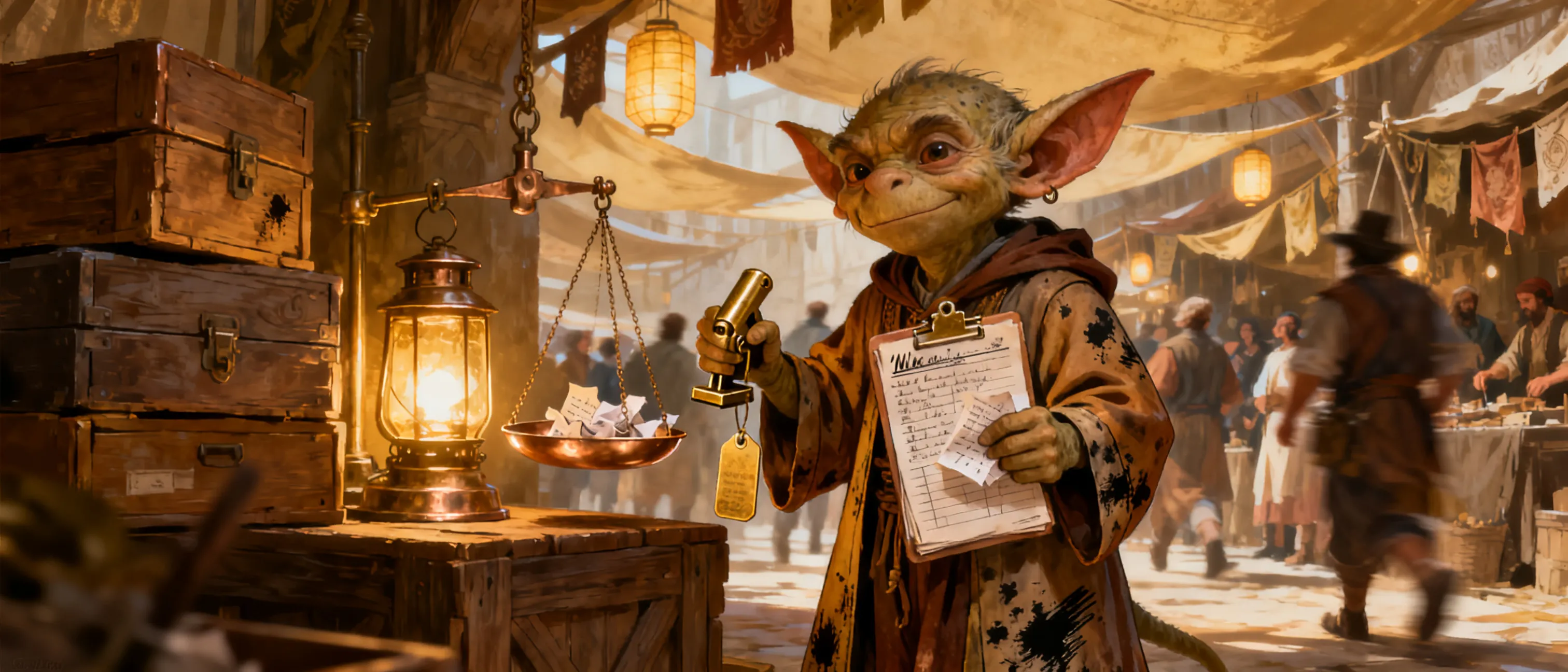
Skrik was hatched in the humming edge-work of the Bazaar of Misplaced Things, somewhere between a repair bench and a ledger cabinet, where the air always smelled faintly of lamp oil, wet rope, and stamped paper. As a hatchling, they learned early that the market did not reward the loudest voice; it rewarded the clearest claim. The older kobolds who ran the underworks did not offer affection freely, but they did offer structure. Every pallet had a number. Every damaged tool had a destination. Every dispute needed a witness, a seal, or both. Skrik grew into that system as if it were a second skeleton.
Their childhood was shaped by the bazaar’s constant motion. Gnomes argued over repairs in bright public aisles while kobold runners slipped through service tunnels below, carrying messages, keys, and rolled receipts. Skrik found comfort in repetition: counting stock, checking tags, copying names, and comparing one list against another until the truth emerged. They were not the strongest hatchling, nor the most charming, but they were the one who noticed when a crate had been moved twice and relabeled once. That skill saved their life more than once. A mislabeled return might have been cursed. A misplaced key might have opened the wrong door. In the market, noticing first often meant surviving first.
As Skrik grew older, they were assigned to the Third Ledger, a record stream that covered disputed goods, emergency reroutes, and sensitive transfers between the gnome depot and kobold swap meet. The name sounded ceremonial, but the work was grinding and exacting. Skrik learned how trust really functioned in the bazaar: not as a feeling, but as a chain of verifiable steps. If a lamp went missing, the paper trail mattered. If a vendor swore innocence, the route stamps mattered. If a black tag appeared where it did not belong, Skrik could trace the damage before panic spread. That diligence earned them respect from some and resentment from others. People who benefited from chaos did not enjoy being seen clearly.
The current crisis began with small irregularities. A few inventory tags vanished. Some returned goods arrived with the wrong marks. A route stamp appeared where only a tunnel key should have been used. Others in the market dismissed it as clerical noise, but Skrik knew better. The market survived on layers of bookkeeping as much as on walls and wards. Break the paper system, and the physical one soon follows. Skrik’s investigation revealed black iron tags tied to restricted movement and a pattern of entries that seemed designed to lead dangerous stock toward the underworks. It was not simple theft. It was orchestration.
That realization changed Skrik. Before, they believed the market was imperfect but basically honest if enough hands kept it labeled. Now they understand that records can be weaponized. A false receipt can become a lockpick. A forged seal can move curses like cargo. The deeper they dug, the more they learned that the bazaar’s hidden machinery—the Price Engine, the debt routes, the old emergency seals—was being used by someone who understood the value of paper as well as coin. Skrik did not like that knowledge. It made them feel seen in a way they never wanted to be seen.
Still, Skrik kept working. They began to carry spare receipts in neat bundles, not because they distrusted everyone, but because they distrusted laziness, panic, and unchecked assumption. They spoke in efficient phrases because every extra word was a chance for someone to twist a claim. They kept receipts for insults because insult, in the bazaar, often preceded threat, and threat needed documentation. Over time, their habit became legend among the kobolds: if Skrik had your words in writing, they could prove what happened. If Skrik did not have your words in writing, they still probably remembered them exactly.
Skrik’s goals are simple to state and hard to achieve. They want the stolen tags recovered. They want the saboteur named correctly. They want the market’s hidden systems made legible enough that no one can use them to gut the underworks again. Yet beneath those practical aims is a quieter fear: that order is not enough. The bazaar is full of bargains, compromises, and necessary half-truths. Skrik has spent a lifetime believing that the right record would keep everyone safe, but the sabotage has shown them that even perfect records can be used by cruel hands. If the party helps them, Skrik may begin to learn a difficult lesson—that proof matters, but so does judgment, and that sometimes a good ally is worth more than a flawless archive.
Their bonds are strongest with workers who keep the market running despite the noise. Their ideals are clear: if a deal is made, it should be traceable; if a claim is made, it should be tested; if a person is blamed, the evidence should be clean. Their flaw is equally clear: Skrik can become so devoted to verification that they hesitate when swift action is needed. They would rather be certain than early, and that can be dangerous in a place where moving merchandise can become moving doom. The party who earns Skrik’s trust gains more than a guide. They gain a meticulous witness who can see the pattern beneath the clutter and who, once convinced, will defend the truth with a kobold’s stubborn, exacting devotion.