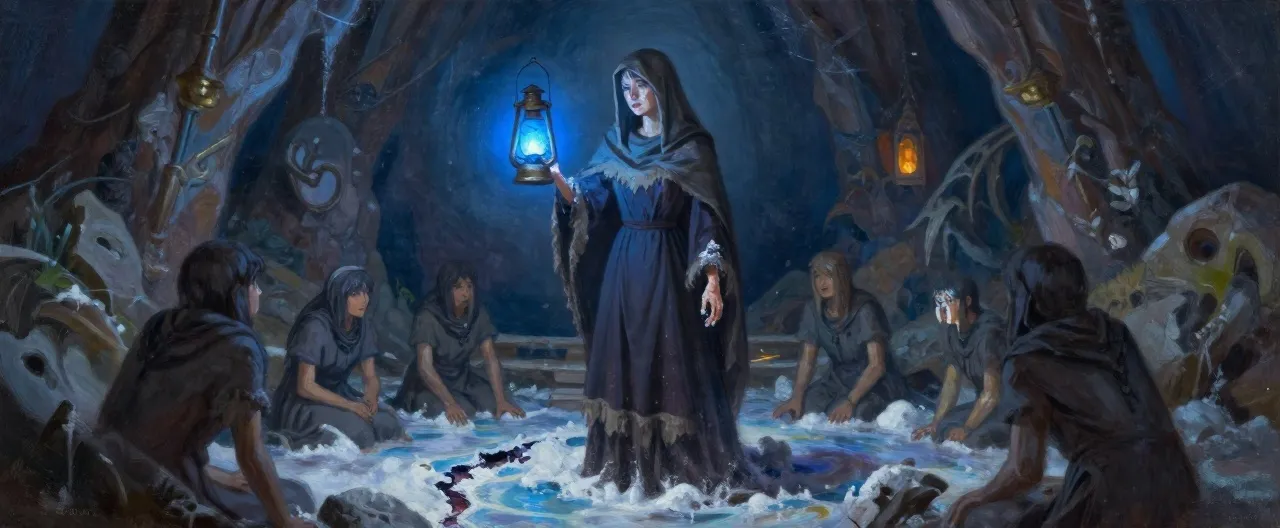
Veska Mourn was born Maren Coul, the wife of a silver digger in the hill town that became Hollowrest Camp, and for the first half of her life she was unremarkable in every way the camp valued: she mended canvas, kept a clean tent, and lit her husband's lantern each dusk before he went below. Aldous Coul was a careful miner, the kind who tapped the rock twice before every swing, and for eleven years he came back up.
Then the mine broke into something older than the hill — a drowned shrine, a salt-crusted fissure, a dark that hummed — and the company sealed the shafts and called it done. Aldous went down one last time with a survey crew to map what they had found. Only his lantern came back, burning blue.
Maren did not accept the camp's verdict of cave-in. For a season she sat at the camp shrine, weeping, and it was there that Sister Ivel — then a young novice — made the mistake that would define two lives: she read to the grieving widow from the sealed verses kept beneath the Lantern Saint's statue, verses that whispered of a choir beneath the world, of salt that remembers, of light that dreams.
Maren heard the verses and then, nights later, heard something else: her husband's voice, answering her weeping from below in her own cadence, telling her he had not died but gone down where the singing was. She followed a lantern into the flooded shafts to find him. What she found instead was the Deep Choir, and it spoke to her the way she now speaks to everyone — softly, maternally, offering work before it offered a grave.
She took the name Veska Mourn because grief was the only honest thing left to wear. Over twelve years she rebuilt herself in the Deeps' image: she learned the old mine roads from her husband's survey notes, learned which shafts the company had sealed and which it had merely forgotten, and learned to harvest echo-salt — the blue mineral that hums with bad dreams and burns lanterns without heat. She gathered a congregation the way she had once gathered neighbors for a funeral: not with sermons but with casseroles, kind words, and patient attention to the grieving.
The Deeps produce grief the way the mine once produced silver, and Veska harvests it. Miners who lost brothers, widows who lost husbands, children who lost parents — all of them hear the same soft voice offering meaning in exchange for lantern-lighting. She genuinely believes she is saving them. She gave Tam Weller his father's voice the way someone hands a child a warm meal, and she has never once examined whether the two acts differ.
Her ritual is the work of years: reopen the drowned shrine, drain the Sunken Vault with a pump her cultists tend, ring the salt-crusted fissure with blue lanterns, and sing the waking hymn for one final night. The echo-salt vein beneath Hollowrest is the largest known, and when it ignites, the Deep Choir — not a god but a dreaming collective, older than the hill — will stir toward wakefulness, and Veska believes she will take her place beside it as its first light, its lantern-keeper, its good mother.
What she does not let herself believe is the question she writes in the ledger's margins with a shakier hand each year: will it remember her? The Choir is collective. It does not keep names. It keeps lanterns.
Her habits are meticulous and maternal in equal measure. She relights every lantern in her congregation's section of the Deeps personally each night. She keeps Spare the Dying prepared not for mercy but for questioning — her people are resources, and she keeps them alive the way a housekeeper keeps linens. She knows every escape route, keeps a hidden skiff in the flooded lower galleries, and has never yet fought to the death, because retreat is not cowardice to her; it is tidying in reverse, putting herself away to be useful another night.
Her one inconsistency is Sister Ivel, the only person who knew her before the veil, and her one blind spot is Tam Weller, the boy whose father's death she caused and whose faith she cannot bear to examine. Between those two threads, the Lantern Widow's whole story can be unraveled — or wound tighter.