The Caretaker

Level 2 Human Wizard (School of Necromancy)

Available with DM subscription
Register to save this character forever!

This character will be deleted in 5 days. Create a free account to claim all your generated content.

STR
8 (-1)
DEX
14 (+2)
CON
12 (+1)
INT
17 (+3)
WIS
10
CHA
13 (+1)

Defense

Armor Class 13 (Unarmored Defense via Mage Armor)
Hit Points 12 (2d6 +1)
Speed 30 ft.

Proficiencies & Skills

Saving Throws Intelligence, Wisdom
Skills Arcana +5, History +5, Insight +2, Religion +5

Features

Manor-Bound Undead

Custom

The Caretaker is an undead creature bound to Crescent Manor. He does not naturally age, needs no food or drink, and leaves no normal breath, though holy wards, the destruction of his binding relic, or severing his anchor can force him into retreat or true death.

Power Drain

Custom Level 2
once per turn

When The Caretaker hits a creature with a spell attack or an attack that deals necrotic damage, he can force the target to subtract 1d4 from its next ability check or saving throw before the end of its next turn. This is a custom villain trait for the module.

Grim Harvest

Subclass Level 2
once per turn when you cast a spell of level 1 or higher that kills one or more creatures

When a creature dies from one of your spells, you regain hit points equal to twice the spell's level, or three times if the spell belongs to the school of Necromancy. The Caretaker uses this to feed himself on the last breath of the house’s victims.

School of Necromancy

Subclass Level 2

Your necromantic studies sharpen your ability to sap life and command shadowed power. When the Caretaker casts spells that deal necrotic damage, his presence becomes unnaturally cold and oppressive.

Wizard Spellcasting

Class Level 1

You can cast wizard spells using Intelligence as your spellcasting ability. You prepare a number of spells from the wizard spell list equal to your Intelligence modifier plus your Wizard level.

Human Skill Versatility

Species Level 1

Gain proficiency in one skill of your choice. The Caretaker has used this adaptability to learn the old rites of the house and the habits of the living.

Human

Species Level 1

A determined, adaptable human who retained enough will to bind his own soul to the manor and continue his duties beyond death.

Arcane Recovery

Class Level 1
once per long rest

Once per day after a Short Rest, you can recover expended spell slots whose combined level is no more than 1.

Spellcasting

Intelligence DC 13 +5 to hit Level 1: 3 slots

Prepared spells assume Intelligence 17, Wizard 2, and a villain focused on concealment, fear, and life-draining control. The Caretaker typically begins encounters with False Life already active if given warning.

Chill Touch

Cantrip official
necromancy 1 action 120 feet V, S

A skeletal hand of grave-cold force lashes a target, dealing necrotic damage and preventing it from regaining hit points until the start of your next turn.

Mage Hand

Cantrip official
conjuration 1 action 30 feet V, S

Creates a spectral hand that can manipulate objects at range.

Minor Illusion

Cantrip official
illusion 1 action 30 feet S, M

Creates a sound or image to mislead, frighten, or lure intruders through the manor.

False Life

Level 1 official
necromancy 1 action Self V, S, M

Grants temporary hit points as necrotic vitality knits together the body’s deadened shell.

Mage Armor

Level 1 official
abjuration 1 action Touch V, S, M

A protective ward surrounds a willing creature, setting its AC to 13 + Dexterity modifier while unarmored.

Ray of Sickness

Level 1 official
necromancy 1 action 60 feet V, S

A sickly ray of poison strikes a target; on a hit it takes poison damage and may be poisoned until the end of its next turn.

Character Information

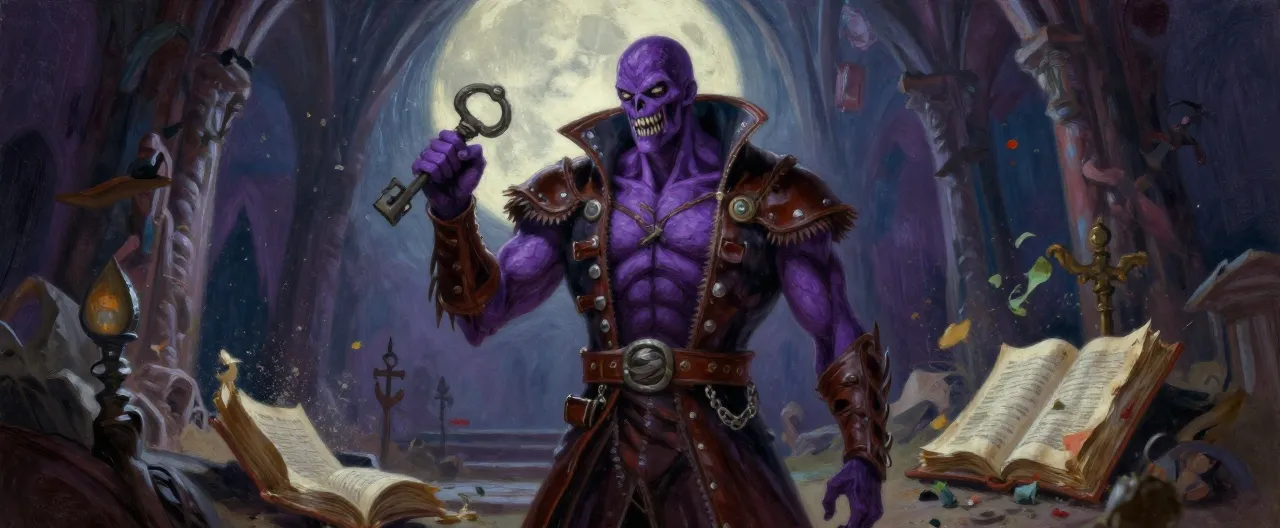
The Caretaker is the lingering mouth of Crescent Manor’s grief: an undead servant preserved by obsession, magic, and the stubborn refusal to let the house become only ruins. He carries himself with the bleak dignity of someone who believes duty survived death, and his deep purple skin, leather-like scales, and cadaver-thin posture make him look less like a living man than a relic the house forgot to bury. He does not rage in the wild way of a feral dead thing. He plans, whispers, waits, and arranges the world so that frightened children, old memories, and locked doors all point in the same direction.

His entire purpose is to lure Richard, the boy at the heart of the manor’s sadness, toward a hidden reality beneath the house so the gate can be opened. He does not see this as cruelty. In his mind, he is preserving a final chance to make the loss mean something. That single-minded ambition is what makes him dangerous: every room is a trap, every shadow is a messenger, and every peaceful moment is only a pause before he appears with a spell on his tongue and an accusation in his eyes.

The Caretaker is not a random monster. He is a broken custodian, a failed occultist, and perhaps once a real servant who loved the household too much to let it die. If confronted carefully, he can be understood; if confronted carelessly, he becomes the house’s sharpest weapon. Defeat him, and the party uncovers the truth of the manor. Redeem him, and they must first prove that loyalty need not be chained to ruin.

Character Background

Before he was The Caretaker, he was simply the man who knew which staircase squeaked, which portrait hid a draft, and which candle had to be lit first when storms rolled in from the east. He served Crescent Manor in the old years, when the windows still held bright glass and the floors had not yet learned the language of dust. He was not born noble, nor gifted, nor chosen by prophecy. He was a practical soul with a careful hand, a memory for schedules, and enough humility to remain invisible in a house that belonged to others.

That invisibility became his greatest strength and his greatest wound. He saw everything: the arguments behind closed doors, the child who wandered hallways after midnight, the father who trusted rituals more than people, the mother who covered fear with ceremony, the servants who knew something was wrong but said nothing because saying nothing kept them employed. In time, he became the one person who remembered the house as a living thing. He repaired hinges, catalogued keys, copied instructions, and watched the family’s anxieties deepen into superstition. When the first strange signs appeared—cold spots, whispers in the walls, children laughing where no children stood—he was the one sent to investigate.

His undoing began with loyalty. The household’s master, a man obsessed with hidden doors and forbidden thresholds, convinced him that the manor could be protected if its heart were bound to a proper ward. The ritual was never meant to create an undead caretaker. It was meant to preserve the estate, to seal away what waited beneath it, and to keep the family safe from a truth that had already begun to rot through the foundations. But magic is cruel to the desperate. The rite failed in the way such rites always fail: with partial success, catastrophic cost, and just enough power to keep the mistake alive. When the smoke cleared, the master was gone or changed, the house was infected with memory, and the servant who had performed the work found that his soul no longer moved with the ease of the living.

He should have died. Instead, he endured.

What remained of him was a will wrapped around duty so tightly that death could not easily pry it loose. He continued tending the manor, though the tasks warped. Dust became ash. Candles became beacons. Keys became tokens of command. He learned to use necromancy because the house responded to it, and because the dead seemed more obedient than the living ever had. Over time, his flesh took on a strange, leathery texture, darkening into deep purple tones as if shadow had soaked into his skin. Scales, rough as old varnished leather, emerged along his body like the house itself was growing over him. He became less a man and more a function: the thing that keeps the doors shut, the thing that preserves the corridors, the thing that knows where the bodies are kept.

Then came Richard.

The boy was not supposed to matter. He was just another visitor, another child with an invitation and a curious heart. But the manor remembered the boy in a different way, and The Caretaker saw in him something dangerous: warmth. Richard’s laughter, his birthday memory, his instinct to trust even when frightened—these things resonated with the old hidden room, the sealed threshold, the unfinished rite. The Caretaker understood at once that Richard might be the final key. Not because he was special in some grand cosmic sense, but because the house still contained a small surviving fragment of innocence, and innocence can unlock things that terror cannot.

From that moment, every decision became a step toward the gate. He lured the boy with false comfort, with puzzles disguised as games, with servants’ whispers and ghost-light promises. He told himself he was guiding Richard toward destiny, but the truth was harsher: he was using a child to complete the one task that would justify his own continued existence. This is the heart of his tragedy. He is not ignorant of the harm he causes. He simply believes the harm is acceptable if it results in meaning.

He is desperate, and that desperation has become ritualized. He claims he is trapped by the same spirit the party seeks to defeat, and in a sense he is telling the truth. The house binds him. The old master’s skull or relic binds him. The memory of failure binds him. He cannot imagine a self that is not defined by service to the manor’s darkest secret. That is why he appears so calm when the party is at peace; it is not patience, it is predation. He waits for quiet moments because fear is easier to harvest after a false sense of safety.

Yet there is still something human in him. It surfaces in his fixation on order, in the care with which he arranges rooms, in the way he reacts to broken birthday symbols and childish song. He can be reasoned with, but only at the edge of collapse. He can be redeemed, but only if the party is willing to address what he truly is: not a master of death, but a servant who refused to let go of grief. If the players destroy the relic tied to his soul, he may finally be released from the house that used him. If they trap him in a vault, the manor may fall silent but leave his story unfinished, a warning that devotion without mercy becomes a prison. And if they destroy the master’s skull or the source of his binding, they may discover that even monsters are sometimes what remains when a promise outlives the person who made it.
Unresolved Plots

  • The hidden gate beneath Crescent Manor answers to a ritual phrase that no one in the village remembers correctly, leaving the exact method of opening it unresolved.
  • Willie’s loyalty is fragile, and the boy-spirit may either aid the party or shatter under pressure if the villain pushes too hard.
  • The binding relic at the heart of the manor’s curse has not been fully identified, only hinted at through old drawings, portraits, and the master’s skull.
  • The Caretaker’s past life as a servant, mage’s assistant, or sworn household keeper is only partly visible, leaving his true name and original identity unclear.
  • A larger necromantic power is implied by his notes and behavior, but the nature of that master remains hidden beyond the adventure.
  • The hidden room may contain not merely a trap, but a buried memory, shrine, or alternate reality linked to the boy’s birthday and the manor’s tragedy.

Secrets

  • The Caretaker once tried to save the household by binding himself to the manor, and the ritual corrupted both his body and his purpose.
  • He does not fully understand the thing he wants to open; he only knows that his master promised it would make the loss stop.
  • The purple skin and leather-like scales are not natural traits but the result of long exposure to necromantic resonance and the manor’s curse.

Fears

  • Being forgotten after all the years of faithful service.
  • The hidden gate opening and revealing that he was used rather than chosen.
  • The sound of joyful children’s voices, because they remind him of what he failed to preserve.

Aspirations

  • To open the gate and prove his master’s teachings were true.
  • To keep Crescent Manor from falling into ordinary ruin before his work is complete.
  • To be seen, even for one moment, as indispensable rather than broken.

QUEST -- Open the Hidden Gate

The Caretaker believes Richard’s bright, frightened imagination is the last key needed to open a sealed reality buried beneath Crescent Manor. He has spent years studying symbols, lullabies, and old family rites, chasing a single obsession: to make the boy speak the phrase that will unlock the gate. This quest is not about conquest alone; it is the final proof that his long-dead master was right, that the world of the house can be peeled open like rotten wallpaper and turned into a corridor to something greater. He will risk his own dissolution to complete the ritual, because failure would mean admitting his entire unliving existence is a lie.

Current Stage

Gather the old household keys, ritual notes, and the emotional triggers tied to Richard’s birthday memory.

Choice

Use servants, shadows, and lies to keep Richard calm and cooperative.

This path keeps the boy nearby but weakens his trust and increases his terror in small, compounding ways. Each scene becomes more haunted, and the manor itself grows more unstable as Richard’s resistance turns the hidden room into a pressure point. The Caretaker becomes harder to read, but more desperate, revealing glimpses of the grief that originally bound him to the house.
Alternative

Reveal the truth to Richard and try to use sorrow instead of fear.

The Caretaker risks losing control over the child, but the ritual becomes less dependent on brute coercion. If the truth is spoken, he may force a final confrontation in the hidden room earlier than planned, making the climax more dangerous but also more emotionally charged. This can create a sliver of mercy in the story, exposing that he is not only a predator but also a ruined servant who once believed he was protecting the household.
Mechanical Rewards
  • If completed, the Caretaker gains a one-time ritual boon that allows him to cast a custom Gaze-like fear effect in the final fight
  • If interrupted, he permanently loses access to one of his necromantic tricks until restored by dark magic
  • The hidden gate can alter his statistics by granting one extra spell slot or by imposing a curse that reduces his speed to 20 feet
Narrative Rewards
  • Access to the hidden room beneath Crescent Manor
  • A clue pointing toward the larger necromantic power behind the manor’s curse
  • A horrifying truth about Richard’s role in the ritual

QUEST -- Bind the House More Tightly

The Caretaker fears dissolution more than death. His unliving form is bound to Crescent Manor, but he senses the bond fraying whenever the party uncovers old truths, breaks wards, or brings light into rooms long sealed. This quest is his attempt to reinforce the manor’s bones with necromancy, relics, and whispers taken from the dead. He scavenges portraits, bones, silver, and memory, turning the home into a trap that thinks. Each nail he drives into the house is also a nail in his own coffin, because every reinforcement reminds him that the manor is not truly his; it is merely where he was left behind.

Current Stage

Reinforce the mansion’s weak points with bone-charms, funeral ash, and shadow wards.

Choice

Use the trapped spirits as anchors for the wards.

The manor becomes more hostile, and the spirits in it grow quieter, dimmer, and more afraid. This makes the house feel like a living tomb and deepens the moral stain on The Caretaker’s existence. He gains durability, but at the cost of making redemption almost impossible.
Alternative

Use his own essence as the anchor and risk weakening himself.

He retains control over the manor, but the house feeds more heavily on him. This path preserves the possibility that he can be confronted, bargained with, or even freed, because it acknowledges that the manor and the villain are not the same thing. He is still dangerous, but now visibly dependent on the house’s continued corruption.
Mechanical Rewards
  • Gain a custom manor ward that can impose disadvantage on one intruder’s ability check per scene
  • Unlock a defensive reaction that adds +1 AC against the first attack each round while in the manor
  • If the ward is disrupted, the Caretaker suffers a backlash that prevents spellcasting for 1 round
Narrative Rewards
  • The manor becomes a more personalized dungeon with moving walls, locked memory-doors, and ghostly echoes
  • The party learns The Caretaker is afraid of being unmade, not merely defeated
  • A route to the burial vault or binding relic is exposed

QUEST -- Secure the Binding Relic

At the center of The Caretaker’s power is the object that anchors his soul to the house, the relic linked to the master’s remains and the manor’s oldest rites. The villain’s final private obsession is to protect, repair, or reclaim that relic before it can be destroyed. He fears the party finding it not just because it can weaken him, but because it proves he was never truly master of himself. Every cryptic command, every guarded hallway, and every undead servant exists to keep the relic hidden. He wants to be remembered as a loyal keeper, not as a failure who rotted into a ghost of a servant.

Current Stage

Identify the relic, reach its vault, and decide whether to claim it, destroy it, or use it as leverage.

Choice

Hide the relic deeper in the manor and set undead guardians over it.

This makes the final confrontation slower and more methodical, but also more claustrophobic and deadly. The Caretaker becomes increasingly paranoid, communicating through whispers and trapped sensations rather than direct appearances. He is buying time, not peace.
Alternative

Carry the relic personally and risk the party striking it down.

The Caretaker becomes more dangerous in direct combat because he will not retreat from the relic’s protection. This choice is the closest he gets to bravery, though it is born from fear and possessiveness rather than honor. If the party destroys the relic, the villain’s entire purpose collapses in an instant.
Mechanical Rewards
  • If he secures the relic, he can return from defeat once with 1 hit point if not properly exorcised
  • If the relic is destroyed, he loses access to his custom Power Drain trait
  • If the relic is stolen, the party can gain a one-use ward against undead influence
Narrative Rewards
  • The truth behind the master’s death becomes available
  • The party gains a decisive route to defeating or redeeming The Caretaker
  • A final clue indicates that his power is only one thread in a larger necromantic web

Major Decision

Context

The party first learns that Richard is being lured deeper into the manor.

Choice Made

Continue the deception and force the boy toward the hidden gate.

Impact

The Caretaker becomes more openly villainous, sharpening his control over the house and making the encounter harsher. Mechanically, he gains stronger control effects, but any chance at redemption diminishes.

Major Decision

Context

The heroes uncover evidence that the manor and the boy’s fear are connected to a binding rite.

Choice Made

Reveal the truth and try to make Richard participate willingly.

Impact

This creates an unstable but more human confrontation. Mechanically, it can lower puzzle or ritual DCs, but it also weakens the villain’s emotional leverage and may force him into a less prepared final battle.

Major Decision

Context

The binding relic is found in the crypt or hidden vault.

Choice Made

Protect the relic, destroy it, or surrender it.

Impact

This choice determines whether The Caretaker remains bound, is exorcised, or briefly freed from the manor’s curse. Mechanically, it can strip him of custom traits or create a one-time survival trigger.

Transformative Moment

Trigger

The moment Richard speaks a happy birthday phrase despite the terror around him.

Transformation

The Caretaker is forced to remember that the house once held ordinary joy, not just duty and dread. His obsession sharpens into rage because joy proves what he has lost. He begins to use harsher magic and more direct threats, becoming less subtle and more desperate.

Mechanical Changes

spellcasting

Gain disadvantage on the next concentration check after Richard’s positive memory is invoked

The emotional memory disrupts the necromantic focus sustaining his control.
save_dc

Increase by 1 for one encounter if he responds with fury instead of retreat

His desperation makes his magic more forceful but less stable.

Transformative Moment

Trigger

The party discovers the relic that anchors his soul to the manor.

Transformation

He realizes he is not the master of Crescent Manor, only its most faithful prisoner. This does not make him kind, but it can crack his certainty. Whether he doubles down or falters, his identity is permanently altered by the knowledge that his loyalty was exploited.

Mechanical Changes

custom features

Lose access to Manor-Bound Undead if the relic is destroyed

The binding anchor sustaining his undead tether is severed.
hit_points

Maximum hit points reduced by 2 until he completes a long rest or is re-bound

The relic’s destruction destabilizes his physical form.

Transformative Moment

Trigger

The hidden room opens and the gate begins to answer.

Transformation

This is his final point of no return. He can either become a full monster, sacrificing the last traces of his former self to the gate, or accept that the dead cannot command the living forever. In play, this is the moment where his role as a caretaker becomes either that of a jailer or a broken servant begging the house to keep him.

Mechanical Changes

speed

Increase to 35 feet for the final confrontation if the gate opens

The surge of ritual energy drives him into a frantic, relentless state.
mechanics

Once per encounter, gain a bonus action to move through dim light or darkness without provoking opportunity attacks

The opening gate stains the area with shadow and empowers his movement.

Ally: Willie, the Frightened Spirit

Relationship Bound companion and unwilling ward
Influence 8/10
Loyalty 3/10

Shared History

Willie was once a small, frightened spirit the household failed to notice until it was too late. The Caretaker discovered the boy’s presence in the dark corners of the manor and decided that fear made Willie useful. He wrapped that fear into a leash, treating the spirit as both proof that the house still answered him and as bait for more powerful souls. Their relationship is not friendship; it is custodianship twisted into predation. Willie’s trembling obedience keeps The Caretaker anchored to the manor, while the Caretaker’s harsh certainty gives Willie a shape to cling to. Each knows the other is damaged, but only one of them is making the damage intentional.

Potential Breaking Points

  • If the party offers Willie safety, he may reveal the location of the hidden room
  • If The Caretaker becomes too cruel, Willie may resist the next command
  • Destroying the binding relic may free Willie and break his loyalty instantly

Enemy: Richard, the Boy Drawn to the Gate

Threat Level 4/10
Conflict Type Moral and ritual opposition

Personal Stakes

Richard is the final key to the Caretaker’s plan, but also the most dangerous reminder of what the house once was. The boy’s memory, innocence, and stubborn hope can unravel the villain’s ritual and expose the lie at the center of his obsession.

Possible Resolutions

  • Use fear and illusion to force Richard deeper into the manor
  • Attempt to persuade him that opening the gate is necessary
  • Lose control of the ritual if the party restores Richard’s courage

Faction: Crescent Manor Household Remnants

Standing -8/10
Influence The manor’s surviving spirits, curses, and old wards obey him unevenly, responding to ritual commands but not true trust.

Obligations

  • Keep the hidden room sealed until the proper phrase is spoken
  • Preserve the binding relic and prevent intruders from reaching the crypt
  • Maintain the illusion that the manor is still under orderly care

Benefits

  • Access to old hidden passages
  • Occasional command over lesser spirits or shadows
  • Knowledge of the manor’s layout and emotional triggers

Ready to Unleash Your Character's Full Potential?

Join thousands of players and create rich, detailed character backgrounds with Fable Fiesta!

Register to unlock personal quests, relationships, and narrative hooks!

Sign Up Now - It's Free!

No credit card required. Start creating in minutes!