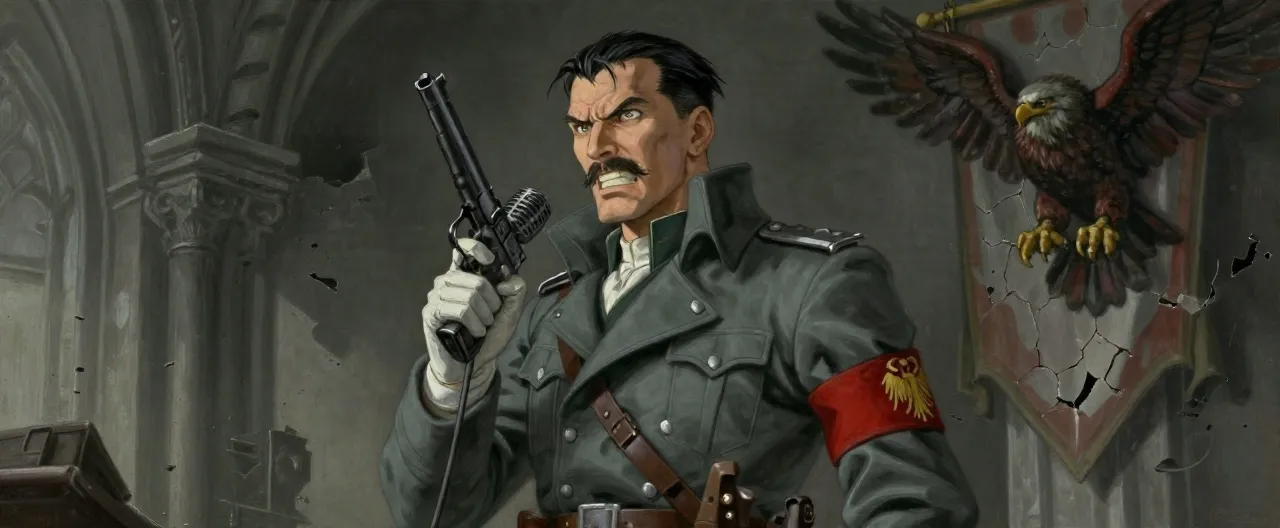
Adolf Hitme was born in the wreckage of the last war, in a border town that changed hands three times before he was old enough to remember which flag flew over it. His father was a minor customs clerk who beat him; his mother died of a sickness the occupying authorities refused to treat. He grew up fluent in grievance, learning early that blame was more powerful than merit and that a crowd, once ignited, would follow a voice anywhere.
As a young man he applied to an academy and was rejected — a humiliation he never forgave and never mentions. He drifted through the postwar years as a failed artist, a messenger, and finally a street agitator whose rants in beer halls and ruined squares began to draw the bitter, the beaten, and the bored. The Naki party was born in one such cellar: a handful of veterans, a stolen printing press, and a symbol — the eagle — that Hitme himself sketched.
His genius was not organization but broadcast. When radio technology matured, he understood before anyone else that a voice could conquer what armies could not. He cultivated the Iron Broadcast: a network of microphones, transmitters, and loudspeakers that carried his tirades into every home and harbor. By the time the old government collapsed, the people had already sworn loyalty to the voice in the box. He took the Chancellery with barely a shot fired, and the world watched in horror as Germany declared war on all of it.
But Hitme's rise has a shadow he does not discuss. In the years before the coup, a stranger's messages began to reach him — coded, unsigned, bearing a sigil he had never seen. The messages contained strategy, technology decades beyond the era, and flattery calibrated to his vanity. He told himself he was the master of the arrangement; the shipments of impossible weapons told a more troubling story. He signed orders he did not fully read, including one authorizing intelligence-enhancement experiments in a facility dug directly beneath his own throne room — experiments that produced, among other things, a talking squirrel that escaped and now guides his enemies through Berlin's ruins.
Hitme rules from the Chancellery, a blackened fortress at the heart of a city he has half-destroyed in the name of rebuilding. He rehearses his speeches obsessively, keeps a secret journal of doubts, and trusts almost no one — least of all the patron whose voice now comes through the bunker radio with increasing frequency and increasing demands. His paranoia has begun to consume him: he has compiled lists of 'cowards' and 'traitors' within his own officer corps, and the purges grow wider each week.
The soldiers who once idolized him are learning to fear him, and fear is a poorer fuel than faith. When the party finally breaches his throne room, they will find a man performing to a microphone, flanked by two elite guards, ranting about destiny — and behind the throne, a hidden door to a tunnel that leads down to the bunker, the records, and the sigil of the real power already here.