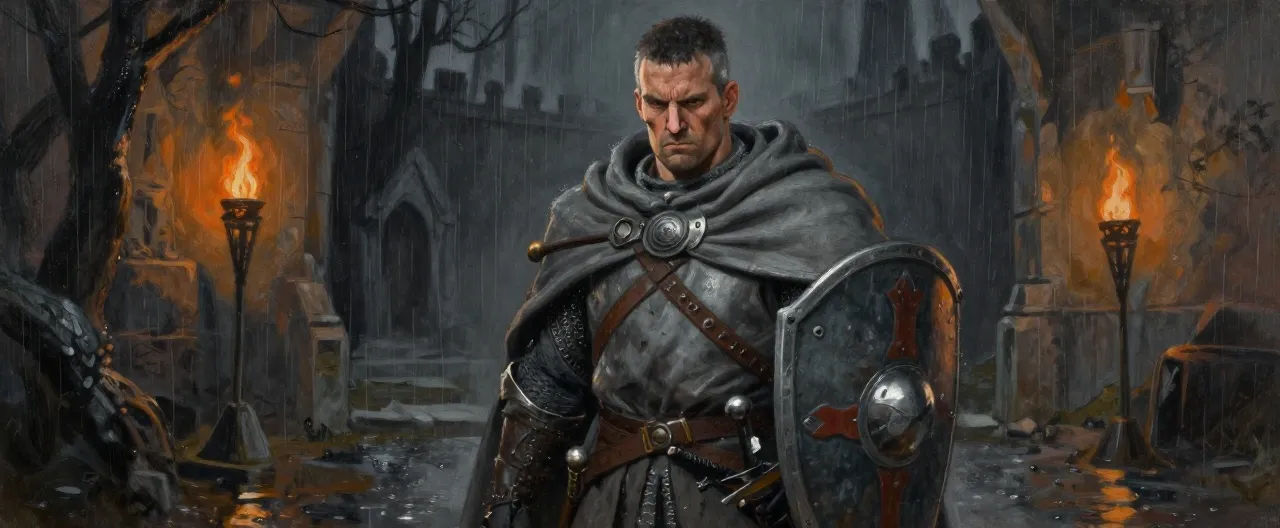
Sergeant Holt is a broad-shouldered human man in his forties, built like the barricades he mans: wide, weathered, and impossible to move without cost. His nose has been broken at least twice and set slightly crooked, giving his face a permanent, lopsided scowl that strangers mistake for hostility and his men know as simply his face. His dark hair is cropped short and going grey at the temples, and deep frown lines carve permanent grooves from the corners of his eyes to his jaw.
He wears the ash-grey cloak of the Ash Watch over a battered chain hauberk that has been patched more times than he can count, a dented kite shield slung across his back and a notched longsword at his hip — a blade he refuses to replace because of whose it was. He stands in the rain-slick keep courtyard at night, torchlight behind him, jaw set with grim, weary obedience.
Holt enforces the quarantine without question, and that is precisely the tragedy of him. He is not cruel. He speaks to prisoners gently, hands water to the families he turns away from the walls, and stands watch over the bodies of the executed so the crows do not get them before their kin can. But when the order comes, he carries it out, every time, because twenty years of service have taught him that the alternative is chaos, and chaos in a plague city kills faster than any sickness. His obedience is not cowardice or ambition — it is the only structure holding him upright in a city that is falling down around him.
Those who work with him long enough notice the cracks. He hesitates a half-second before enforcing the harshest orders. He drills recruits with a fury that seems aimed at something other than the recruits. He asks careful, oblique questions about the temple row that he has no official reason to ask. And he has a sister, Maren, trapped in the plague ward of the Temple of Mercy, whom he has not been able to see since the wards were sealed.
Holt follows orders because following orders is all he has left — but he hates them, and every order he enforces takes something from him that he does not get back. He is a good man being used as an instrument of a bad policy, and somewhere deep down, he knows it.