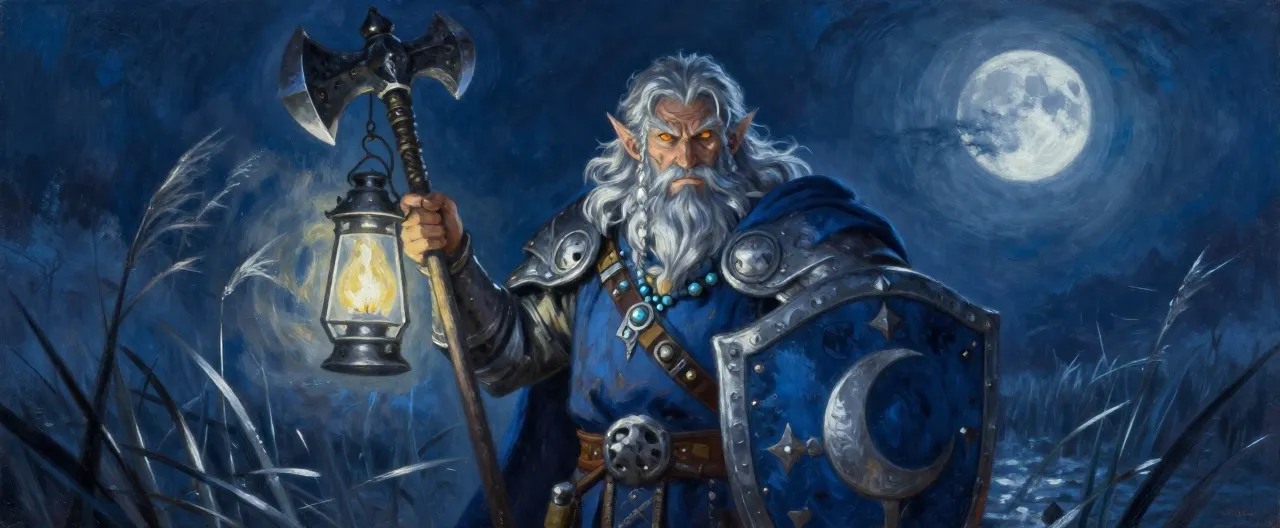
Halvard Crane was born in a fishing village on the Silvercourt Reach, the third son of a clammer who could not feed a third mouth and a grandmother who had once been a lay sister of the Lunar Concord. At twelve he was apprenticed to the cliff crypts, the terrace of tombs cut into the white chalk cliffs south of Silvercourt where the old families of the Reach kept their dead.
The crypt-priests were a quiet order within the Concord: they did not preach, did not fight, and rarely left the cliffs. Their work was memory. They lit the lamps at dusk, recited the names of the dead each dawn, and kept the ward-anchors, moonstone grave-beads laid in the deepest vaults, whose combined light held the lunar wards of the Reach steady.
He was good at the work in a way that surprised his teachers. He memorized every name, learned the genealogies of families whose last living members had died three generations before his birth, and sat with dying parishioners who had no one else, holding their hands while they confessed things they had told no one living. His mentor, the crypt-priestess Aldra Crane, no relation but a namesake he cherished, taught him the old prayers and, in violation of crypt custom, taught him to fight: a dwarf with a mace and a shield, she said, should know how to use both, because the dead deserve a defender too.
The fever came in his nineteenth year of service. It moved through the remaining crypt families like tide through a channel, and Halvard buried forty-one people in eleven months, performing rites for children whose parents he had buried the season before. The last living member of his congregation, a bedridden great-aunt named Sigrun, died on a gray morning with Halvard's hand in hers, and her last words were a question he has carried ever since: 'Who will remember us when you are gone too?'
The Concord sent a form letter and a reassignment. Halvard read the letter twice, packed his belongings, took the Everburning Lantern from Aldra's empty cell, and walked down the cliff stairs to the living world. He has never explained the departure to the satisfaction of the elders, and he has never needed to explain it to himself.
For years he wandered the coast, a marsh-priest with an unquenchable lantern, healing fishermen, sitting with the dying, and burying strangers whose families could not be found. He earned his name in the silvermarsh reed-beds, where he spent three nights holding the lantern over a stranded caravan while gloom-husks circled the light's edge, singing lullabies to keep the travelers calm. The story spread down the coast, and the name stuck.
Rumors of a blind oracle at Mirror Lake reached him in his sixth year of wandering: a woman who saw more blind than any sighted seer, whose prophecies were bought by nobles and feared by the Concord itself. He went expecting a fraud and found Mira, who named his dead congregation before he spoke of them and told him the fever was no natural thing. He has been at the lake since, cooking her meals and listening to the prophecies she is afraid to say aloud, and it was Mira who first spoke the name Umbral Court to him, and Mira who dreamed, night after night, of a princess in a black tower while the poisoned dreams gnawed at her sight.
When Lady Seren's summons reached the lake, Halvard answered it as a Guardian of the Concord, though his oath to the order lapsed the day he left the crypts. He fights now for the living: for Mira, for the memory of forty-one names, and for the stubborn belief that the moon's light exists precisely for the hours when everything else has gone dark.