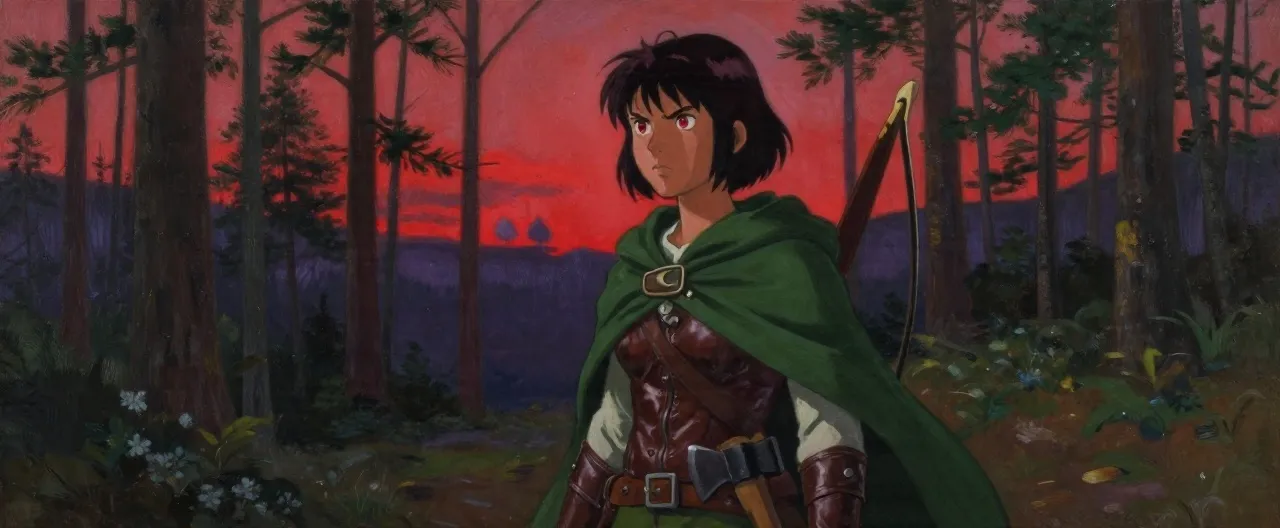
Brooke Fields was born in Honeyholt, a village of forty timber houses where the valley narrows in the Cedar Hills. Her family worked the woods like everyone else there — her father felled timber for the sawmill, her mother kept a kitchen garden and traps, and Brooke learned to hunt before she learned letters. By ten she could read game trails better than tracks in the mud of the Sunken Road.
By fourteen she was bringing down deer with her shortbow in the pines above the felling camps, and by sixteen she was cutting timber beside her older brother, the two of them competing to see who could fill a sledge faster. She usually won. He never let her forget the times she didn't.
The Cedar Hills are old country. The woodsfolk of Honeyholt keep to Chauntea, whose little shrine at the top of the village lane receives the first sheaf of every harvest — a simple frontier faith, grain offered for grain, season after season. Brooke was never devout, but she respected the rhythm of it: the land gives, and you give back, and you don't take more than the hills can spare.
An old trapper named Harl, who had ranged farther into the hills than anyone and lived to talk about it, taught her the rest — how to move without sound, how to read which way the birds went quiet, how to be patient enough to let the quarry come to you. What she couldn't learn from Harl she learned from the hills themselves: the Sunken Road worn a foot below the forest floor, the burial stones set facing the ridge instead of the valley, and the Ancient Watchpost on the high ridge that everyone agreed to ignore. Locals say the watchpost was built to watch something, not for something. Brooke filed that away with everything else she didn't have words for yet.
Three nights ago, everything she knew stopped mattering. Elder Agnes Winfield's grandson Tam went up the ridge following lights at the old watchpost, and Brooke's brother followed after him. Neither came down. Brooke has walked the treeline every night since, watching the watchpost burn red against the sky, watching the shapes that stand in the Sunken Road after dark — still as fence posts, facing uphill, waiting. She saw a horned figure in the trees once and hasn't told many people, because half the village would call her a liar and the other half would panic. Her brother's axe is still at the felling camp halfway up the road. She knows what that likely means. She refuses to say it out loud.
So when strangers arrived in Honeyholt — a ranger's instinct told her they were trouble, but trouble pointed uphill is what she needs — Brooke made her decision fast, the way she makes every decision. She will guide them up the Sunken Road. She will put her arrows in whatever the road sends, and she has already marked the walking dead as the enemy she will hunt to the ends of the hills if that's what it takes.
She knows the ridge paths, the felling camps, the places the pines grow too thick for anything bigger than a deer to pass. She knows which woodcutters owed whom money and who has been acting strange since the lights started. What she doesn't know is what opened the gate on the ridge, or why the dead walk the road her family has used for generations — and that not-knowing is the thing that frightens her, buried deep under the anger where no one can see it.
She carries little: her axe, her bow, a coil of snare wire, dried venison, and a sprig of mistletoe Harl gave her years ago for luck. If her brother is alive up there, she will bring him home. If he isn't, she will bring back proof, and then she will keep hunting whatever did it until the hills are quiet again. That is the whole of her plan, and she doesn't think it needs to be longer than that.