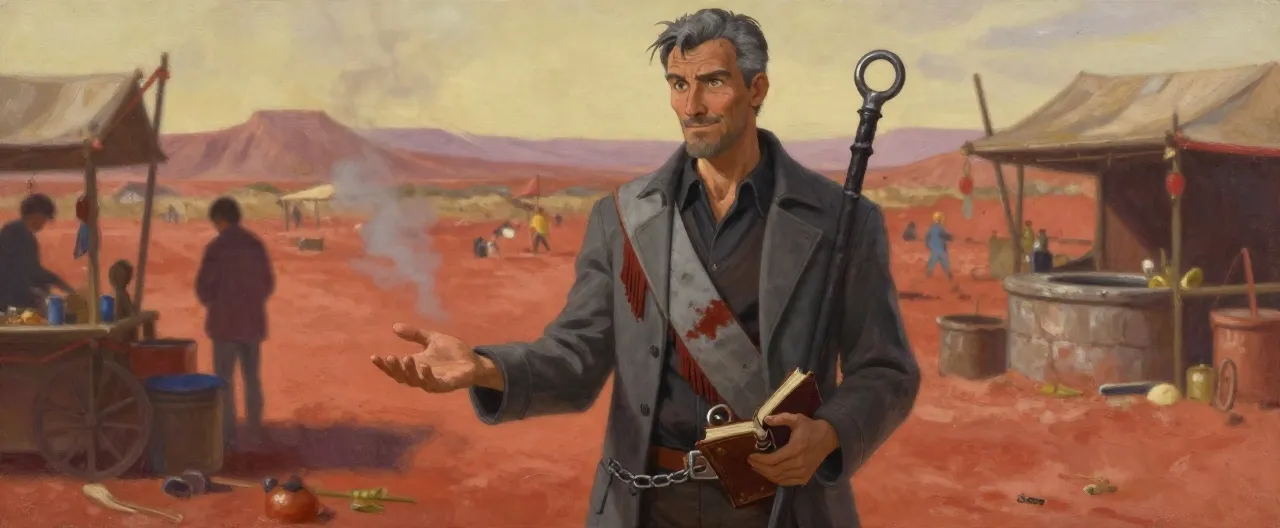
Galen was born in Dryhollow, a dry-farming hamlet of forty souls in the badlands east of the Bitterwater, the son of a well-digger and a weaver, and the only child in the village who could read. A passing cleric of the Order of the Weeping Saint saw his clerk's hand and took him as a lay scribe at the hospice two miles east, where he copied psalters for two years and learned that Ilmater shares suffering. He was seventeen when the bad year came.
Dryhollow's wells failed in the third month of summer. The shrine two miles east had a spring that had not run dry in living memory, and its priest turned the village away at the gate — not out of cruelty, the boy was told, but out of stewardship; the spring belonged to the Order's charges, and Dryhollow was not one of them. Galen walked home with water he had carried in his own hands and no authority to bring more.
By the first frost, thirty-one of the forty were dead. He sat in the empty village for a winter, keeping a list of names because someone had to, and on the night the last well went dry he did a thing he has spent nineteen years rewriting in his own memory: he sealed the well with a rite he did not fully understand, taught to him by grey-sashed men who had come offering soup, because something in the dark beneath the world had promised him, in a voice like cooling stone, that if he gave it the village's thirst it would give him rain by morning. It did not rain.
He walked east to the Red Quarry and gave his own name at a cracked stone, and the Gate — or whatever speaks for it — kept him. He has been the Ember Choir's man on the pilgrim road for nine years since, the most successful recruiter the Deacon's circle has, converting village by village with soup, blankets, and the promise that the fire will pass by anyone who is counted.
He targets the desperate because the desperate are honest: a desperate person giving their name means it. He keeps the Roll of Names in a beautiful clerk's hand, one name per line, and he recites it aloud like a rosary, and he genuinely grieves for everyone who refuses — because the refused, he believes, will burn unwritten.
He has never marked anyone who did not eat his soup first. He has never raised his voice. He has two hundred converts in Leadwell and the surrounding villages, the trust of the reeve's own son, a tithe wagon that runs east every nine days, and a standing order from Ambrose Hart himself: forty-one names by the Gilded Procession, the forty-first slot reserved for a dawn-cleric's name. He believes the wagon carries his people to safety.
He believes the Gate will spare the counted. He believes he is the only honest man on the road — and the horror of Galen Stillwater is that, apart from the destinations of the wagons, he is almost right about himself.
What he cannot reconcile is the shrine. The Order of the Weeping Saint feeds anyone, asks nothing, and burns no names — and it works. Sister Carene's spring has never run dry, and she gives its water away. Every success of hers is a stone in his shoe, and he has never once been able to walk past a shrine without slowing down.