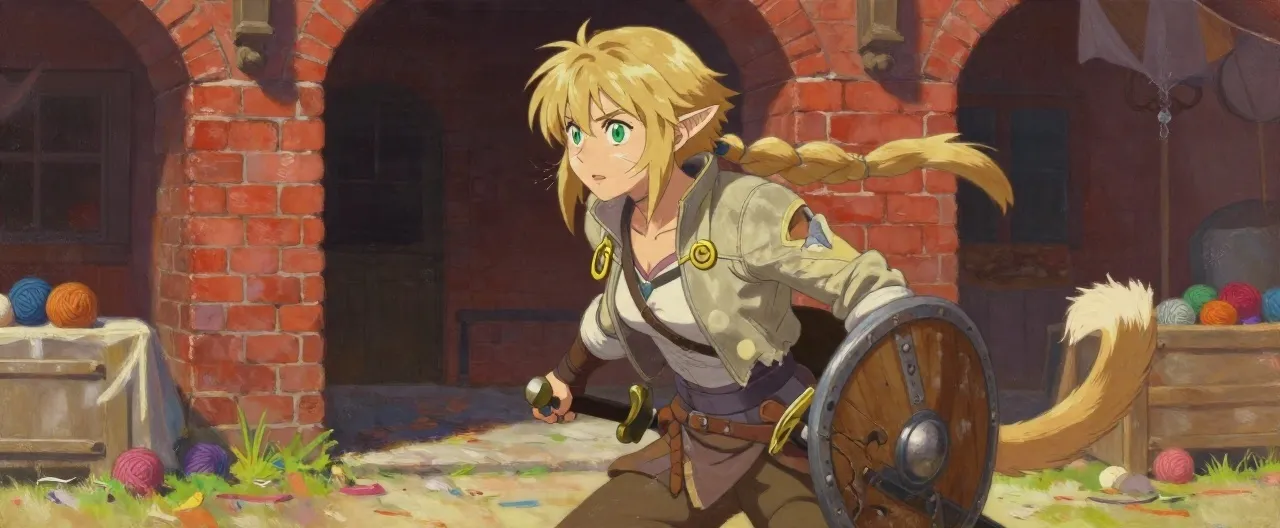
Molly Redman was born under the arcades of Hadley Market, in the storeroom above her father's porter cart, and she has never really left. Her father, Tam Redman, is a market porter of thirty years' standing — a broad, quiet tabaxi who can load a cart so the axles don't complain and route six stalls' worth of goods through a crowded square without a single dropped crate. Her mother, Marla, mended sails on the Silver River barges before Molly was born and left her the brass fish-hook pin when she went upriver with a wool convoy two winters back. The letters stopped coming in spring. Molly doesn't talk about that. She touches the pin before every fight instead, the way other folk say a prayer.
Molly grew up hauling. By ten she could balance a crate on her back and climb the arcade stairs with it; by twelve she knew every stallholder's name, every cart route, and every shortcut across the roof-runs that the porters pretended didn't exist. She learned to fight the way porters learn everything — practically, and the hard way. When a drunk drover took a swing at old Olive Bates over a wheel of cheese, thirteen-year-old Molly put him on the cobbles with a fish-gutting knife she'd never actually intended to use. Meredyth Lamb watched the whole thing from the fair office window, and never forgot it.
So when the fair watch put out the call for seasonal hands this year, Meredyth signed Molly on directly — and then started using her as a runner, because a fair watch guard who can cross the entire market in the time it takes a clerk to find a ledger is too useful to waste on standing still. Molly has been up since before dawn carrying notes between Meredyth and the merchants, and she was at the north arcade when the cheese went.
She saw the drain cover lift from below. She saw the rats come up with their little wire crowns, dragging Olive's moon-milk wheel like a barrel of ale. She screamed. Then she drew her sword, and she's been furious ever since.
She trained her swordwork the honest way: her father's old drill partner, a retired caravan guard named Sella who drinks at the Fish & Fiddle and charges two coppers a lesson. Sella taught her a defensive style — shield up, short sword quick, footwork first, let the other cat get tired and stupid. It suits her. Molly isn't strong for her age, but she is fast, patient, and impossible to knock off balance on a wet roof tile. Her Champion's instincts — that sudden 19-or-20 precision, the athlete's knack for going first when it matters — come from a hundred practice bouts in the arcade shadow after closing time.
In faith, Molly keeps to Tymora, the Lady Luck, the way market folk do — a copper tossed in the fountain, a knock on wood, and a firm belief that fortune favors the cat who keeps moving. She says grace to Chauntea at the fair's opening, because her father does, and because the fair is harvest-adjacent and that's just proper. She has no patience for Shar or anyone who thinks the dark under Hadley belongs to the things down there.
Now the fair she has defended her whole life is under threat from below, and Molly has found her calling: the clowder of adventurers who came for the yarn and stayed for the rat. She'll guide them through the arcades, run their messages, hold a doorway with her shield, and check the shadows over her shoulder the whole time — scared, then stubborn, every time, on purpose. The fair will not fall while she's standing. That's a promise she made to a drain cover, and she intends to keep it.