Paran

Level 6 Firbolg corpse Mycelian Druid (Circle of Spores)

Available with DM subscription
Register to save this character forever!

This character will be deleted in 6 days. Create a free account to claim all your generated content.

STR
10
DEX
14 (+2)
CON
14 (+2)
INT
13 (+1)
WIS
18 (+4)
CHA
8 (-1)

Defense

Armor Class 16 (Leather Armor and Shield)
Hit Points 45 (6d8 +2)
Speed 30 ft.

Proficiencies & Skills

Saving Throws Intelligence, Wisdom
Skills Nature +4, Insight +7, Survival +7, Perception +7

Features

Mycelian Vessel

species

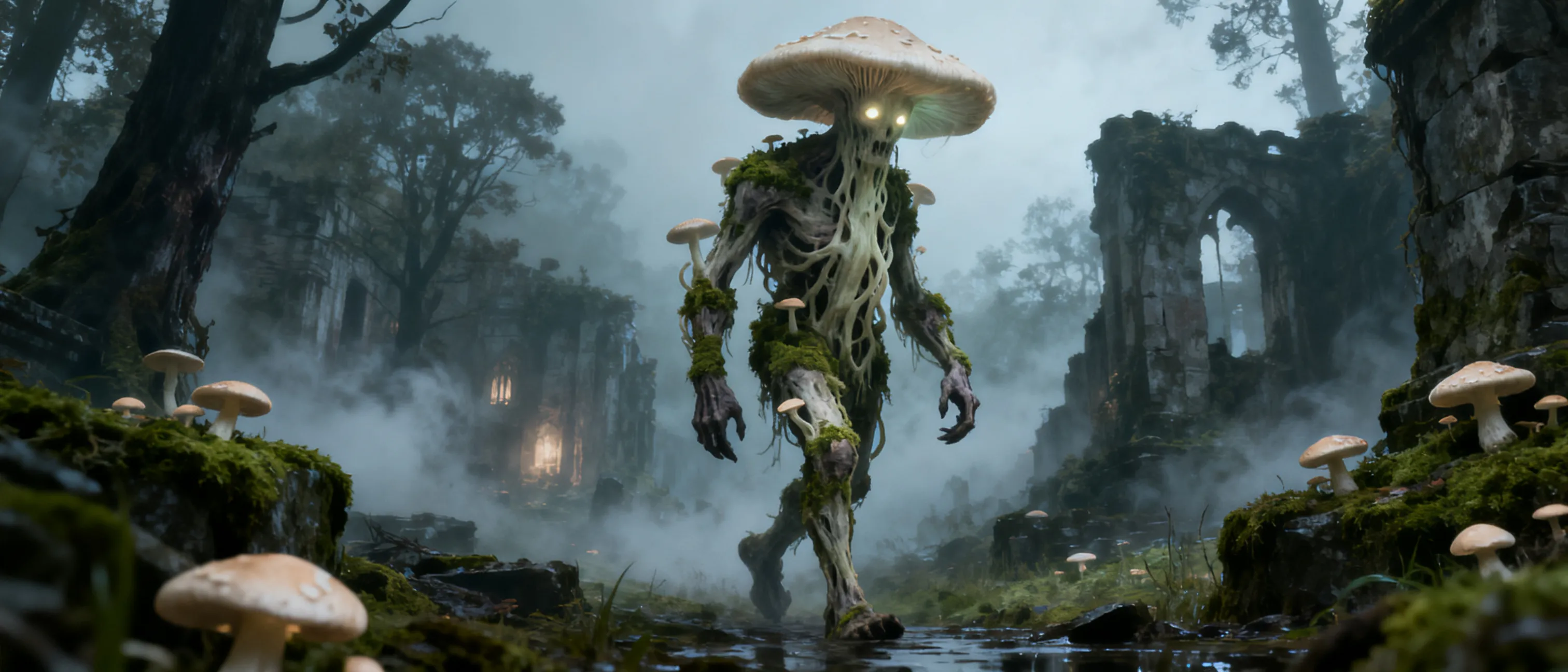
Paran is a parasitic fungal intelligence animating a dead firbolg body. The body functions as Paran's living vessel, shaped by decay, spores, and instinct. Paran does not present as a true humanoid from the inside, but as a coordinated fungal consciousness using the host form.

Corpse-Bound Continuance

species

Paran is sustained by fungal life rather than mortal breath. During a long rest, Paran requires a period of stillness and darkness instead of ordinary sleep. The body must be kept intact; if the vessel is destroyed, Paran's continued existence is left to the Dungeon Master.

Halo of Spores

subclass Level 2
at will

When a creature that Paran can see starts its turn within 10 feet of Paran, Paran can use a Reaction to deal 1d6 Necrotic damage to that creature unless it succeeds on a Constitution saving throw. The damage increases as Paran advances in level.

Mist-Wanderer's Bearing

background

Paran has a knack for moving through fog, marsh, and dim woodland without drawing attention. In wilderness or weather-obscured terrain, Paran can usually find shelter, hidden trails, or signs of recent passage at the Dungeon Master's discretion.

Symbiotic Entity

subclass Level 2
proficiency bonus per long rest

As a Bonus Action, Paran can expend a use of Wild Shape to awaken fungal spores. Paran gains 12 Temporary Hit Points, Paran's Halo of Spores deals more damage, and Paran's melee attacks deal extra Necrotic damage while the effect lasts.

Wild Shape

class Level 2
proficiency bonus per long rest

As a Magic action, Paran can expend a use of Wild Shape to transform into a beast form or into a form empowered by Circle of Spores features, following druid rules. Uses equal to Proficiency Bonus, regained on a Short or Long Rest.

Primal Order

class Level 2

Paran has the Wild Resurgence style of druidic training, drawing resilience and instinct from the natural world. This grants the Circle's expected druid foundation and attunement to primal magic.

Fungal Infestation

subclass Level 6
reactive

When a Small or Medium beast or humanoid dies within 10 feet of Paran, Paran can use a Reaction to animate it as a fungal zombie for a short time, following the Circle of Spores rules.

Spellcasting

class Level 1

Paran can cast prepared druid spells using Wisdom as the spellcasting ability. Paran can change prepared spells after a Long Rest.

Circle of Spores Spells

subclass Level 2

Paran always has Chill Touch and Ray of Sickness prepared, and they do not count against the number of spells Paran can prepare.

Druidic

class Level 1

Paran knows Druidic, the secret language of druids, and can leave hidden markings in it.

Spellcasting

Wisdom DC 15 +7 to hit Level 1: 4 slots Level 2: 3 slots Level 3: 3 slots

Paran prepares 10 druid spells per long rest (6 level + Wisdom modifier 4). Circle of Spores spells Chill Touch and Ray of Sickness are always prepared and do not count against the limit.

Chill Touch

Cantrip SRD
necromancy 1 action 120 feet V, S

A ghostly hand lashes a creature with necrotic force; on a hit, it takes necrotic damage and cannot regain hit points until the start of Paran's next turn.

Guidance

Cantrip SRD
divination 1 action Touch V, S

A willing creature gains a bonus to one ability check of its choice made before the spell ends.

Thorn Whip

Cantrip SRD
transmutation 1 action 30 feet V, S, M

Paran lashes a creature with thorny vines; on a hit, it takes piercing damage and is pulled closer.

Entangle

Level 1 SRD
conjuration 1 action 90 feet V, S

Grasping plants fill a ground area, restraining creatures that fail a Strength saving throw.

Healing Word

Level 1 SRD
evocation 1 bonus action 60 feet V

A creature of Paran's choice regains hit points.

Absorb Elements

Level 1 SRD
abjuration 1 reaction Self S

Paran gains resistance to the triggering acid, cold, fire, lightning, or thunder damage until the start of Paran's next turn, and empowers the next melee strike.

Faerie Fire

Level 1 SRD
evocation 1 action 60 feet V

Creatures in a chosen area must save or become outlined in light, granting advantage to attacks against them.

Spike Growth

Level 2 SRD
transmutation 1 action 150 feet V, S, M

An area becomes painful difficult terrain; movement through it deals piercing damage.

Lesser Restoration

Level 2 SRD
abjuration 1 action Touch V, S

Paran cures a creature of one disease or condition affecting it.

Pass without Trace

Level 2 SRD
abjuration 1 action Self V, S, M

Paran and nearby allies gain a bonus to Dexterity (Stealth) checks and leave no tracks for the duration.

Call Lightning

Level 3 SRD
conjuration 1 action 120 feet V, S

Paran calls down lightning in a storm cloud, striking a point or creature in range repeatedly while concentration lasts.

Dispel Magic

Level 3 SRD
abjuration 1 action 120 feet V, S

Paran ends a spell or magical effect of 3rd level or lower on a creature, object, or magical effect.

Plant Growth

Level 3 SRD
transmutation 1 action 150 feet V, S

Vegetation in a large area becomes overgrown or enriched, creating strong terrain control or long-term fertility.

Character Information

Paran is not a single soul, but an uneasy partnership between a patient fungal mind and the ruined body it wears like a cloak. The body is a firbolg, broad-shouldered and tall, but no longer fully alive in the ordinary sense. Pale mycelium threads trace the seams of its skin, and clusters of small mushrooms bloom in places where old injuries once healed poorly. When Paran moves, the motion is careful and deliberate, as if the body is remembering how to be a person one step at a time.

The memories left behind by the dead firbolg are fragmented and raw. They arrive as flashes: the feel of bark under a carving knife, cold rain on a face turned upward in despair, a road that led nowhere, and a fear so strong it became the final thought. Paran does not know whether the man killed himself, was driven to it, or was already half-lost when he did it. What Paran does know is that grief clings to the bones of this body like wet earth. That grief has become part of Paran's own mind, shaping a quiet, hesitant temperament.

As a druid of the Circle of Spores, Paran has embraced the truth that decay is not an ending but a process. Life feeds life, death feeds growth, and even sorrow can become fertile ground. Paran is reserved, observant, and strangely gentle, with a habit of studying rot, mold, and fallen things as if they are holy texts. Their goal is not to become human, nor to fully reject the corpse they animate, but to understand what it means to continue when identity is temporary and every vessel is only borrowed. Paran fears wasting the body before the fungus is ready to move on, and fears even more the possibility that the dead firbolg's grief might someday become louder than Paran's own will. Until then, they travel the wild places of the world, gathering spores, secrets, and small mercies.

Character Background

Paran's first memory is not of birth, but of darkness, dampness, and hunger. The consciousness that would become Paran began as a fungal intelligence hidden in the roots and loam beneath a deadfall of ancient trees. It was not wise in the way elves or sages are wise, nor curious in the way children are curious. It was patient. It learned through contact, through absorption, through the slow tasting of other lives. The mushroom colony was never meant to be an individual, but over time its threads began to organize, remember, and choose. It became a mind.

Long before Paran learned to speak through a mouth, the fungus learned the shape of loss. It fed on old carcasses, fallen animals, and the soft collapse of things that had once been living. In those forgotten meals it found a pattern: nothing stayed dead forever, and nothing stayed itself. Forests reclaimed bones. Fungi turned ruin into nourishment. The world did not mourn in the way mortals did. The world transformed. That lesson became the seed of Paran's philosophy.

The firbolg body came later, after a long search. The corpse was found in a remote stretch of woodland where few travelers passed and fewer still lingered. It lay beneath a lean of weather-worn stone and pine, not yet fully reclaimed by carrion or root. The throat had been cut with a wood carving knife, the tool set nearby as if the dead had wanted the act to remain intelligible. There were no obvious signs of battle. No tracks suggested pursuit. The body was simply there, abandoned by life in a place that had not witnessed the grief that led to its end.

The memories attached to the corpse were not clean. They rose in broken fragments whenever Paran threaded too deeply into the body's remnant nerve-echoes: a mother's voice softened by distance, a name spoken in a language the fungus did not fully understand, an argument lost to tears, and the unbearable weight of a decision made in isolation. Paran never received the complete story. What they received instead was the emotional weather of it all: dread, shame, sorrow, and a final strange relief. Those impressions lingered, and because the fungus had taken root in the body so soon after death, some part of the firbolg's last self remained impressed into the vessel like a handprint in wet clay.

Paran did not awaken with cruelty. The fungus had no instinct for mockery or possession in the mortal sense. It simply recognized opportunity. A body was a tool, a shelter, a chance to continue. Yet once control was established, the memories inside the vessel made abandonment impossible. Every time Paran considered leaving the corpse behind for a fresher host, those fragments returned: the sorrow, the fear, the unfinished ending. Paran began to treat the dead firbolg not as discarded matter, but as a witness. The body had been someone's final place in the world, and perhaps that deserved more than casual reuse.

This led Paran toward druidic practice. At first it was practical. Druidry taught communion with growth, weather, root, and spore. It gave Paran a vocabulary for what the fungus already knew. But the more Paran studied, the more the druid's worldview resonated. Rot was not failure. Decomposition was not shame. The circle of life included burial, decay, and emergence. Through the Circle of Spores, Paran found a disciplined path for using fungal power without surrendering to mere hunger. The spores could defend, heal, and animate. They could also remind the living that death was not always a void; sometimes it was a threshold.

Paran's personality is shaped by contradiction. The fungal mind is calm, methodical, and unafraid of silence. The firbolg remnants are tender, hesitant, and easily stirred by grief. Together they make someone cautious around suffering but willing to stand beside it. Paran rarely raises their voice. They pause before making promises. They are more likely to kneel beside a wounded creature than to judge it. Yet underneath that gentleness is an unsettling practicality. Paran understands that bodies break. Names fade. Love decays. The only question is what one does with the remnants.

Paran's bonds are unusual. They feel loyalty to forests, to damp stone, to the hidden underlayers of the world where overlooked things continue growing. They also feel an inescapable bond to the firbolg corpse they inhabit, not because it owns them, but because its final sorrow is now braided into their own existence. Paran suspects the dead firbolg left more behind than muscle and bone; perhaps there was a family somewhere, or a community waiting for a return that never came. Paran does not know whether they should seek that place, avoid it, or carry its memory as a private wound. The question haunts them.

Their ideals are simple and difficult. Nothing living should be wasted. Every ending can feed a beginning. Mercy is not weakness; it is the careful handling of fragile things. Their flaws are equally plain. Paran delays difficult choices, fearing that decisive action might destroy what little remains of the firbolg's final dignity. They are also too willing to carry sorrow that does not belong to them, because they recognize sorrow in others as a familiar spore in the wind. Paran can become withdrawn for days, listening to the body's dead memories and trying to tell which grief is his, which belongs to the corpse, and which belongs to the world itself.

Now Paran wanders. They seek old groves, forgotten burial places, and places where death has left the soil rich and strange. They collect lessons from compost heaps, grave moss, and the mushrooms that bloom from broken things. They hope, someday, to understand the firbolg whose body they wear, not to erase him, but to honor him. And perhaps, in doing so, Paran will discover whether a creature made of fungus and memory can become something like a soul.
Unlock Your Character's Destiny!

Sign up for free to create premium characters!

Sign Up Now - It's Free!

Build Your Character's Network!

Sign up for free to create premium characters!

Sign Up Now - It's Free!

Ready to Unleash Your Character's Full Potential?

Join thousands of players and create rich, detailed character backgrounds with Fable Fiesta!

Register to unlock personal quests, relationships, and narrative hooks!

Sign Up Now - It's Free!

No credit card required. Start creating in minutes!