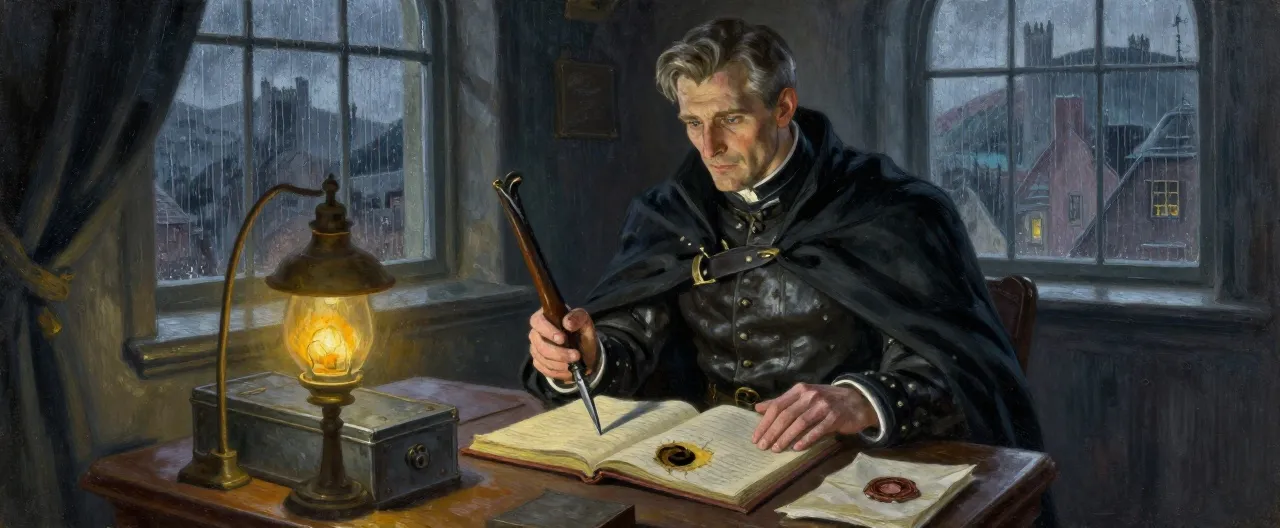
Halvard Bren came to Stonebarrow eleven years ago as a minor treasury clerk assigned to audit the vale's toll collections — a posting that was, he believed at the time, a dead end for a man with debts in the capital and no family name to trade on. He was diligent, quiet, and good with figures, and within two years he had found what every honest auditor finds in the Marrow Vale: that the books balanced only because everyone agreed not to look too closely at the columns.
He reported it once, in writing, to his superiors. The reply he received was not an investigation but an offer, sealed in wax with a copper coin burned through its center.
The first thing the burned coin asked of him was not the tithe. It was a name: Maren Ost, a toll-clerk who had been keeping her own honest columns and asking her own inconvenient questions. Halvard wrote her into the gaol's death register before she ever arrived in Stonebarrow, and she was never seen again — or so his ledgers say. That signature was the true founding transaction of Warden Halvard Bren, and everything since has been compound interest on it.
Within a year he held the Warden's chair. Within three, the vale's tithe was running six times short of assessment, the difference flowing monthly through the Old Toll House strongroom up a chain of hands he has never been permitted to see.
He tells himself he is a partner in something larger. The evidence, which he avoids reading closely, says otherwise: the letters signed 'A.' grow shorter and colder each year, the discretionary-collection writ he operates under is laundered through a mining-guild office rather than the Crown, and the animated armor guarding his vault was made in the capital by the same hands that made the flying swords — ceremonial pieces, sent to watch him as much as the gold. He is an asset with a disposition date, and some part of him has always known it.
His method is patience. Halvard has never drawn a weapon first in his life; he has, however, ended more lives than any swordsman in the vale, using registers, writs, pardons withheld, and men like Rusk Halloran paid from money that was supposed to be tax. He keeps the town's tired guards loyal with small mercies and quiet warnings, keeps two spies dressed as clerks, and keeps one honest guard — Coll Ferren — precisely because an honest man's testimony is cheap currency. He pre-plans every room he works in: cut floorboards, rigged trip-ropes, rooftop ladders, horses stabled two streets from anywhere he expects to be.
What he cannot plan for is arithmetic turning against him. The party's escape from his overflow cells is the first account in six years that refused to close on schedule, and it has unsettled him in ways he refuses to name. He wants three things now: the iron coffer's seal forwarded to the capital before the next quarter, the two witnesses written off as accounts, and a clean road south with one trunk of clean papers and one trunk of ash.
He has already begun keeping insurance against his own employers — a single page of the tithe ledgers hidden in his letter-case lining, proving the Ledger's forgery — though he has never had the courage to spend it. He does not know what the coffer carried. That is the fear beneath all his others: that after six years of faithful service, he was never trusted with anything at all, only used, and that the ledger he has spent his life balancing was always someone else's book, with his name pencilled lightly on a page someone above him can erase.