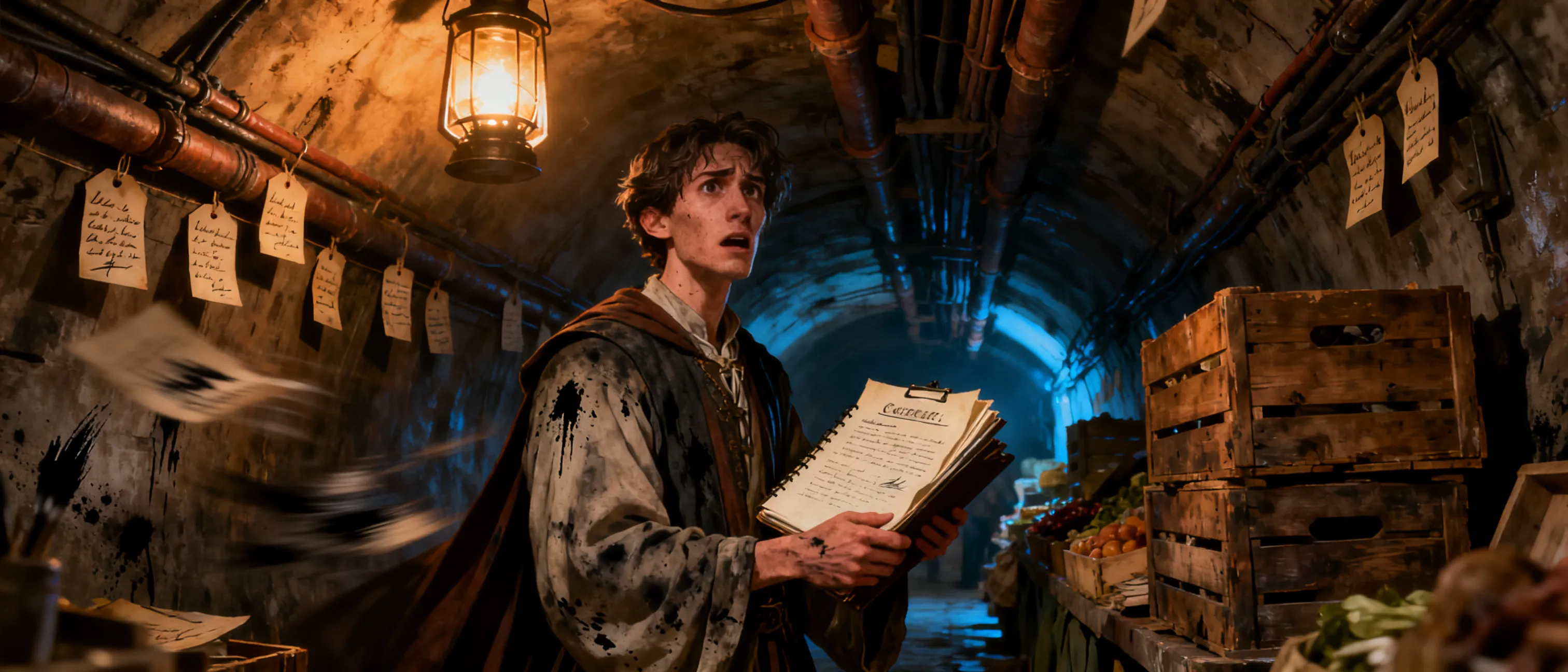
Character Background
Brother Niv was born in an ordinary human settlement where paper meant messages, taxes, and the occasional bill of sale. He was never a grand child. He was the sort who stayed close to the adults, watched before speaking, and remembered the exact shape of a signature if asked to fetch a document twice. That talent did not make him popular, but it did make him useful. He found comfort in order, repetition, and clean ink. A page could be checked. A copy could be compared. A lie, if written badly, could be caught.
When he was old enough, Niv took work wherever records were needed. He copied manifests, inventories, rental agreements, and debt notices. He was good at it because he was careful and because he did not trust himself to improvise. His employers liked him because he was quiet. His coworkers liked him because he was easy to overlook, which meant he could be trusted with keys, boxes, and drafts left on desks. He learned early that being overlooked could be a kind of protection. It was also a kind of loneliness.
Eventually, work brought him to the market known as the Gnome Depot and the Kobold Swap Meet. He expected a bustling but manageable trade hall: odd tools, strange customers, perhaps a few sharp-tongued merchants. Instead, he stepped into a pocket-dimension bazaar where aisles shifted, tags moved by themselves, and every bargain seemed to carry a hidden second meaning. Gnomes argued over route maps while kobolds counted crates with military precision. The market was half comedy, half civic machine, and all of it was more dangerous than anyone had warned him.
Niv was hired for copywork and inventory tracking because the market needed someone who could preserve records without asking too many questions. At first, he thought that suited him perfectly. He could hide in the paper trail. He could copy labels, keep ledgers, and never become part of the story. But the market had a habit of turning clerks into witnesses. One night, while duplicating a contract bundle for the underworks, Niv noticed a page whose seal did not match the rest. The altered line named Marrow Quill, and there were references to black iron tags, routed goods, and a payment structure that made no sense for normal trade. His instincts told him to stop, but curiosity and duty won out. He copied the page exactly, then hid the original note and made a second copy for himself before fear caught up with him.
That single act changed everything. From that point forward, Niv became aware that someone was watching ledgers, not aisles. Goods began to vanish along hidden routes. Workers whispered about black tags and mislabeled stock. He heard arguments in the Auction Underworks that sounded too professional to be ordinary theft. The more he noticed, the more dangerous he became. He is now in too deep to leave safely, because leaving would mean taking the one piece of paper he knows can expose the wrong people, and staying means continuing to breathe beside people who might prefer him silent.
Despite his fear, Brother Niv is not cowardly. He is cautious, and there is a difference. He fears public exposure, retaliation, and the possibility that his copying work has already implicated someone innocent. He also fears that he will freeze when the moment comes to speak. His greatest flaw is that he believes silence can keep everyone safe. His greatest strength is that he can still be persuaded to do the right thing if someone shows him the cost of not acting.
He tends to stand slightly behind larger personalities, pretending to take notes while listening to every word. He trusts procedures more than charm, but he can be moved by kindness when it is practical and specific. He is the sort of ally who can identify a forged route, recall the exact wording of a disputed clause, and remember what someone was carrying three hours before a fight. In the right hands, that makes him invaluable. In the wrong hands, it makes him a target.
His bond is to the market itself, even if he would never say so aloud. He wants the Gnome Depot and the Kobold Swap Meet to survive, not because they are simple or fair, but because he has seen what happens when the records fail and the wrong people control the shelves. He dislikes pretending to be heroic. He would rather be accurate. But that accuracy, in this campaign, is heroism enough.