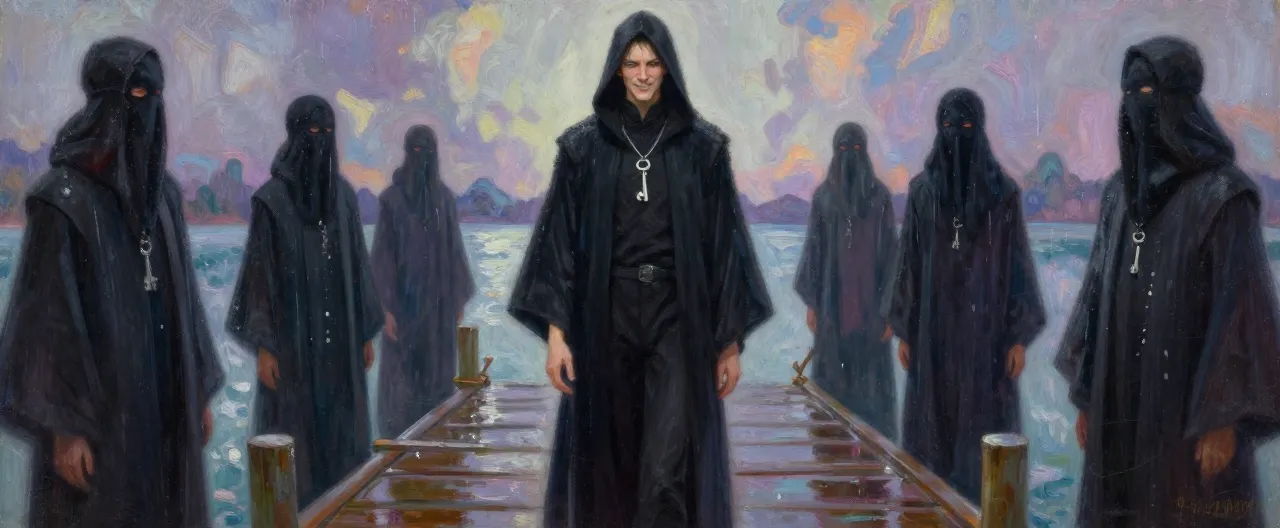
Character Background
Kaelen was not born into privilege, though he learned early how to imitate it. He grew up in a wet, crowded port where every night brought either a storm, a smuggling deal, or a funeral. His father worked the docks until his back failed; his mother sold prayers, charms, and practical lies to sailors who wanted safe passage and needed someone to tell them the sea was listening. Kaelen watched grown people barter over fear before he had the words to describe what he was seeing. He noticed that a calm voice could quiet a mob more effectively than a threat, that a well-placed rumor could empty a tavern, and that people were most easily steered when they thought they were choosing freely.
As a child, he was clever, observant, and deeply resentful of how often the world rewarded the loud and violent over the careful and useful. He learned his letters from a disgraced clerk, his songs from a broken-voiced sailor, and his early rituals from a chapel keeper who believed the boy's questions came from devotion rather than ambition. Kaelen never believed in simple virtue, but he did believe in pattern. He believed that every empire, every temple, and every family fell apart for the same reason: someone wanted too much, trusted too little, and arrived at the truth too late.
That philosophy made him invaluable to others and intolerable to anyone who saw through him. He spent years moving between patrons, dock gangs, private cults, and little courts of desperate believers, always one step ahead of the debts he left behind. He learned how to disguise himself, how to talk his way past guards, and how to say exactly the right thing to make a frightened person feel chosen. Eventually he found the Ebon Tide, or perhaps they found him. The cult gave him structure, a doctrine large enough to hold his appetite, and a promise that the world could be made obedient if only enough people were willing to pay the price.
Kaelen rose quickly because he understood the one thing most zealots do not: faith alone does not move ships, buy blades, or erase witnesses. Logistics do. Fear does. Information does. He became the cult's voice, then its planner, then its leader in all but name. He cultivated spies in ports, hired desperate sailors, and turned old tide shrines into listening posts. He collected fragments of prophecy and interpreted them in the most useful possible way: as permission. The Shattered Key became his holy obsession because it offered both a literal prize and a symbolic one. If the gods had sealed away a world-shaping power, then whoever mastered the key could claim authority over the rules that everyone else lived by.
His personality is patient, polished, and corrosive. Kaelen compliments before he threatens, bargains before he betrays, and rarely kills when he can instead make someone useful and frightened. He is charismatic enough to inspire loyalty and cold enough to never mistake that loyalty for affection. His ideals are simple to state and monstrous in practice: the strong should command, the weak should serve, and history should belong to the people willing to write it in blood. His bond is not to any single follower, but to the vision of a reordered world in which his judgment cannot be denied. His flaw is that he cannot imagine any power greater than his own design. If that flaw is ever challenged honestly, he may hesitate. If it is proven in front of him, he may break—or become even more dangerous as he tries to outrun the fear of being wrong.
That is why Kaelen avoids direct confrontation. Combat is chaotic, and chaos reveals uncertainty. He would rather send cultists into the mud, let traps do the killing, and let rumors do the rest. If cornered, he uses control magic and escape routes like a professional gambler with a loaded deck. He does not need to win every fight. He only needs to survive long enough for the next lie to become true.
Now, with the first clues to the Shattered Key surfacing in the Sunken Fen, Kaelen sees the campaign as a race between inevitability and interference. To the heroes he is a villain in black robes. To himself, he is the only one willing to make the necessary choices. Whether he ends as a defeated tyrant, a recurring shadow on the sea, or a broken man who finally sees the cost of his own convictions depends on who reaches him first: the truth, the vault, or the blade.