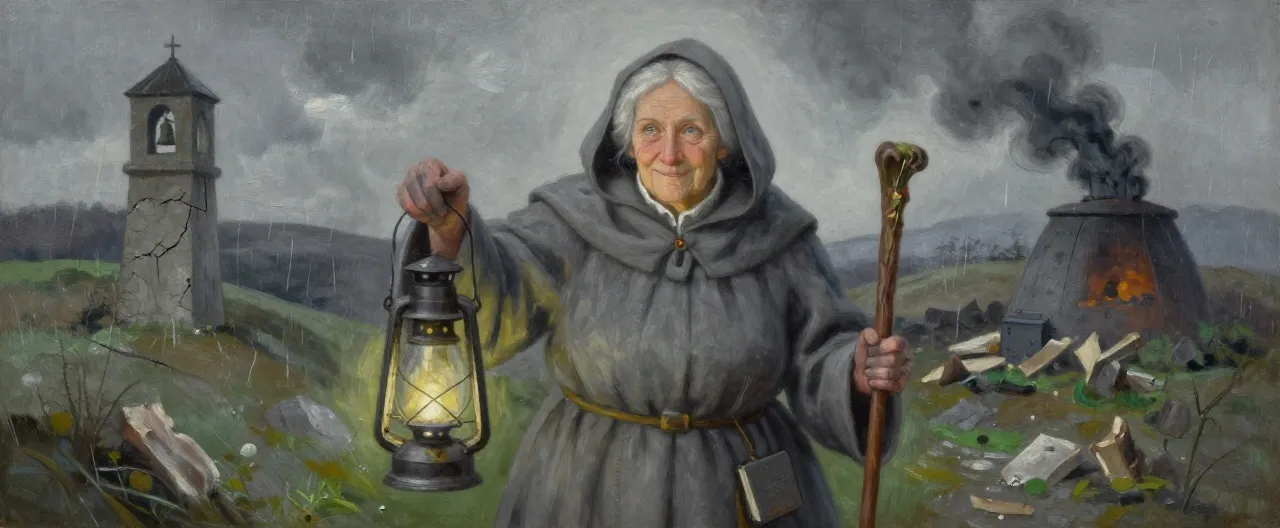
Agnes Wakefield was born sixty-odd years ago on a chalk farmstead south of Ripon, the middle of five children of a shepherd and a wool-sorter, and she buried three of her siblings before she was thirty — fever, then the winter, then the well. She kept the burial society's book for her village, a circle of chalk-country women who passed a hat for funerals, and she was good at it: careful, unsentimental, and kind in the specific way of someone who has dug the graves herself. When her husband died and her children left for the cities, the society was what remained, and she poured her whole remaining life into it.
Eleven years ago the burial society became the Ashen Tithe, though Agnes did not plan it that way. A hard year brought more deaths than the hat could cover, and a stranger's iron courier's box appeared at the society's meeting post, locked, with no name but a ledger-and-quill stamp, full of ash-marked platinum and a single courteous note: *For the burdens of the chalk country. The count will be kept.* The coin never stopped coming, and the instructions that came with it were always gentle, always reasonable, and always, somehow, already what Agnes had been thinking.
Feed the ground. Comfort the frightened. Carry the burden. She woke one morning that same season with ash-grey palms and the ability to see through smoke, and she chose — sincerely, and with enormous relief — to understand it as a calling.
She built the Tithe the way she had built the burial society: from grief. She recruited the widowed, the bereaved, the frightened — Stella Bridgeford first, a carter's widow carrying her husband's ashes in a flour sack — and gave them a shape for their sorrow: grey robes, ash-marked palms, the language of release and keeping safe. The camp at Charcoal Woods, the bone-ash kiln, the tithe wagon, the network of paid and frightened locals reaching into Ripon's own council — all of it grew from her design, funded by the Quiet Ledger's never-failing platinum.
She believes, with her whole heart, that she is the only thing standing between the Chalk Country and the thing beneath the chalk, and that the count she keeps is a count of lives saved.
What she has stopped examining is the arithmetic. The Ledger's payments began before she ever saw the sleeping thing. The faceless collector who takes the autumn tithe wears her own voice. The spiral in the crypt is turning, not settling. And in a letter she has never sent, hidden beneath a bundle of keepsakes she tells herself are burdens, she has begun to ask whether she has been the shepherd or simply the flock's best-trained dog.
She is a lieutenant, not the master — the Quiet Ledger remains, and it now knows the party's names — but she is the hand that has fed the dark below the chalk for eleven years, and her ledger, her letters, and her conscience are the first true thread of a much longer road.