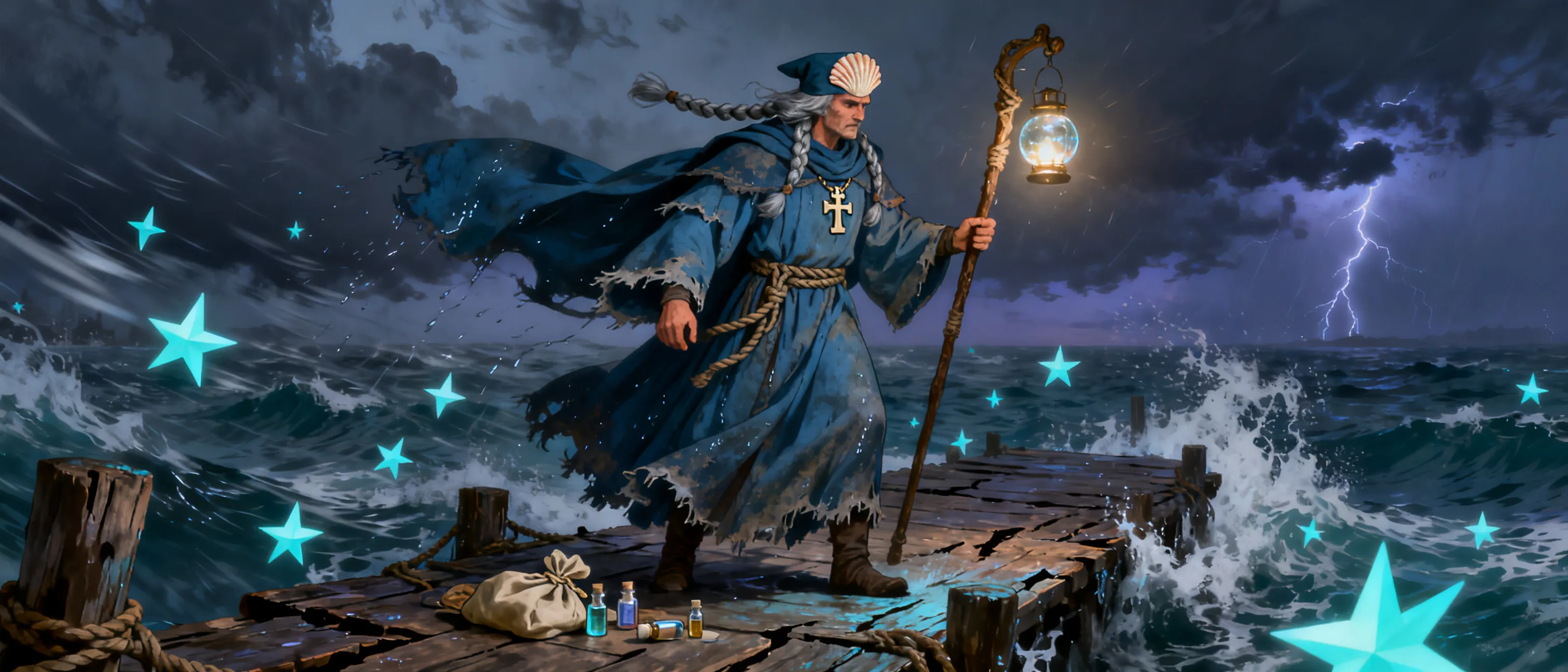
Character Background
Sister Maelin Tidebound was born in a tide village east of Port Haven, where the sea was both pantry and graveyard and everyone learned to respect what floated in after a storm. Her family were net-menders, eel smokers, and practical believers rather than grand theologians. They prayed before launches, thanked the dead for leaving their tools behind, and treated luck like a debt that had to be repaid in work. Maelin grew up among all three habits: labor, grief, and ritual. As a child she was quiet, observant, and too curious to stay away from the shoreline when the waves carried strange debris ashore. She learned early that the sea could deliver useful things, beautiful things, and terrible things without explanation.
Her first real lesson in faith came after a fishing skiff returned with one fewer crewman than it had left with. The lost sailor’s family asked the local shrine for help, but the priest at the time only offered words and none of the practical care the village needed. Maelin remembered that. When a later storm struck the village hard enough to collapse a storehouse and break three ribs in a dockhand, she was the one who held the splint steady, boiled water, and asked for cloth. That experience shaped her idea of devotion: sacred work should leave people less broken, not merely more resigned.
She entered temple service in Port Haven young, first as a scribe and attendant, then as a healer assigned to sailors, caravan guards, and dock laborers who could not afford a full physician. Her superiors quickly realized she had a gift for patient observation. She noticed patterns in fevers, salt burns, and hallucinations that others dismissed as exhaustion. When rumors of star shards began to spread, Maelin was one of the first in the harbor to insist they were not just curiosities. She studied their effects on water, metal, fish, and living flesh. She kept careful notes, drew diagrams, and compared testimony from sailors who swore they had seen the same glow from different islands. What some called obsession she called prudence.
The first time she witnessed shard corruption, it was on a survivor pulled from a wrecked cutter near the Near Shoals. The crew had found a fragment and stored it below deck. By the time the ship broke apart in a squall, several sailors were sick, one was raving, and one was still smiling too steadily while insisting everything was fine. Maelin treated the living, comforted the dying, and later performed rites over the warped remains of the shard. She learned then that corruption was not always loud. Sometimes it looked like calm obedience, the sort of thing ambitious people might mistake for wisdom. That realization made her wary of leaders who prized certainty more than truth.
Her reputation grew when she began helping not only the injured, but the curious. Dockmasters called her when strange residue appeared on nets. Observatory staff invited her to compare notes on flickering star readings. Fisherfolk came to her with tales of glowing shoals and singing currents. Maelin became a bridge between temple, harbor, and scholarship because she did not treat ordinary people like fools. She listened to stories others would have dismissed, and those stories often led her to the right place. She also earned a reputation for refusing to let powerful people buy her silence. Captains who tried to turn shard lore into leverage found her polite, immovable, and remarkably difficult to threaten.
When the faction race over the shards intensified, Maelin’s path became more dangerous and more important. She saw too many factions speaking of the wish as if it were a tool that could fix the world without changing the people holding it. To her, that sounded like the oldest lie in history. She does not deny that a wish might heal drought, end a war, or restore a lost port. But she also knows that every wish has a holder, and every holder has motives. Her fear is not the wish itself; it is the casual belief that anyone who wants it badly enough deserves to wield it.
Maelin’s personality combines quiet compassion with a strict moral spine. She is patient with the injured, direct with liars, and hard to impress. She has a sailor’s respect for competence and a priest’s intolerance for vanity disguised as purpose. She can be warm in private, especially when tending the wounded or comparing notes over tea, but in council she becomes exacting. She will not shout to win an argument. She will simply keep asking what happens next, and then after that, until the falsehood in the room runs out of places to hide.
Her bonds are simple and strong: the harbor that raised her, the people who cannot afford to be discarded, and the old texts that warn of how power warps those who claim to manage it. Her ideals are stewardship, honesty, and mercy with boundaries. Her flaws are equally clear. She can be too cautious, too willing to carry burdens alone, and too inclined to assume that if she understands a danger well enough, she can keep it from hurting anyone. That last belief has already been tested by the shards. It will be tested again by the wish.
If the campaign’s heroes earn her trust, Sister Maelin Tidebound becomes much more than a healer in a temple robe. She becomes a keeper of routes, a witness to corruption, a moral compass with no patience for easy answers, and one of the few people in the Hundred Isles who truly believes that surviving the starfall is not enough. The archipelago must be preserved without being owned. That is the vow she carries into every storm.