Caldris Vale

Level 2 Lightfoot Halfling Halfling Rogue (None)

Available with DM subscription
Register to save this character forever!

This character will be deleted in 0 days. Create a free account to claim all your generated content.

STR
8 (-1)
DEX
16 (+3)
CON
14 (+2)
INT
15 (+2)
WIS
12 (+1)
CHA
13 (+1)

Defense

Armor Class 15 (studded leather and Dexterity)
Hit Points 17 (2d8 +2)
Speed 25 ft.

Proficiencies & Skills

Saving Throws Dexterity, Intelligence
Skills Insight +3, Stealth +5, Deception +3, Perception +3, Investigation +4, Sleight of hand +5

Features

Lightfoot Halfling

Species Level 1

Caldris is Small, his walking speed is 25 feet, and he can move through the space of any creature that is of a size larger than his. He can attempt to hide even when only obscured by a creature that is at least one size larger than him.

Sneak Attack

Class Level 1
once per turn

Once per turn, Caldris deals an extra 1d6 damage to one creature he hits with an attack roll if he has advantage on the roll, or if another enemy of the target is within 5 feet of it and Caldris does not have disadvantage on the roll.

Alert

Background Feat Level 1

Caldris adds his Proficiency Bonus to Initiative rolls. He also cannot be Surprised while conscious, and after rolling Initiative he may swap his Initiative with a willing ally who is also conscious and not Incapacitated.

Rogue Training

Class Level 1

Caldris is trained to exploit openings, move quietly, and act decisively when the moment is right. He has proficiency with light armor, simple weapons, hand crossbows, longswords, rapiers, and shortswords.

Criminal

Background Level 1

Caldris has proficiency with the Stealth and Sleight of Hand skills, and he is adept at obtaining illicit access, arranging quiet contacts, and moving through criminal circles without drawing attention.

Expertise

Class Level 1

Choose two of Caldris's skill proficiencies. His proficiency bonus is doubled for any ability check he makes that uses those skills. Caldris has Expertise in Investigation and Sleight of Hand.

Thieves' Cant

Class Level 1

Caldris knows the secret mix of signs, phrases, and coded meanings used by criminals and covert operators to conceal messages in ordinary speech and markings.

Cunning Action

Class Level 2
bonus action

On each of his turns, Caldris can take the Dash, Disengage, or Hide action as a Bonus Action.

Brave

Species Level 1

Caldris has advantage on saving throws he makes to avoid or end the Frightened condition.

Character Information

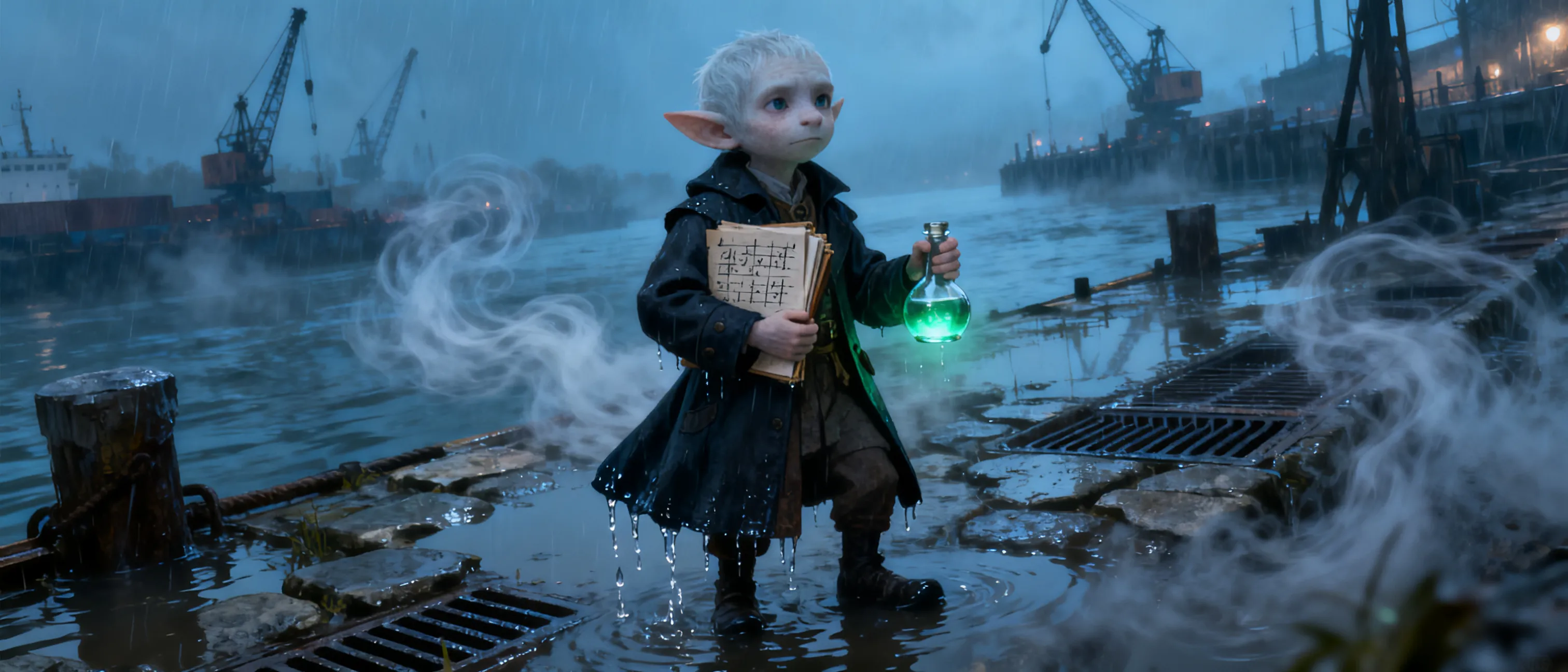
Caldris Vale is the sort of man people forget while he is standing in the room, and remember only after the damage is done. He speaks softly, dresses neatly, and keeps his hands clean unless he has a reason not to. In public, he appears like a ledger clerk or a minor factor of trade, someone too precise to be dangerous. In truth, he is the hidden architect of the river sabotage, a patient manipulator who sees the town not as a place to protect, but as an instrument to be tuned.

He believes the drowned ruin beneath the marsh contains a power source that could make river trade stable, profitable, and obedient to his will. To reach it, he has poisoned water, bribed dockworkers, used coded ledgers to map supply lines, and turned the old drainworks into a private corridor of influence. He does not rage; he calculates. He does not threaten loudly; he explains, in a tone almost kind, why suffering is inevitable and why the people who complain are simply too short-sighted to understand the greater design.

What makes him dangerous is not cruelty alone, but discipline. Caldris plans for failure, leaves traps for pursuit, and prefers hired muscle or undead sentries to any direct duel. When cornered, he withdraws behind hazards and destroys evidence rather than gamble on pride. He is not a battlefield tyrant. He is a systems predator, a man who wins by making every bridge, gate, and rumor work for him before anyone realizes the river itself has become hostile.

Character Background

Caldris Vale was born into the damp margins of a river settlement where storage sheds leaned under the weight of rain and commerce always smelled faintly of tar, fish, and rot. As a child, he was the kind of halfling adults spoke over rather than to: small, quiet, observant, and easy to underestimate. He learned early that people revealed more when they thought he was harmless. Dockworkers complained about wages in front of him, traders boasted in front of him, and constables ignored him while searching larger, louder suspects. By the time he was old enough to carry a satchel of accounts, he already understood the real architecture of the town was not brick or timber, but obligation. The town ran on favors, fear, and the steady movement of goods.

He began in clerical work, copying manifests and comparing cargo weights for merchants who valued accuracy more than honesty. That trade taught him the shape of fraud: where numbers were shaved, where crates were replaced, where delays could be hidden behind weather or bad bookkeeping. He discovered that almost every problem in the river district had a price tag attached somewhere, and that people were willing to pay dearly to avoid embarrassment. This made him valuable. It also made him dangerous. He learned to see leverage everywhere, to think in terms of access routes, weak points, and the long delay between cause and consequence.

At some point, Caldris found fragments of a map tied to the old marsh drainworks and the drowned ruin below it. Whether he inherited the clues from a dead relative, bought them from a desperate archivist, or stole them from a forgotten lockbox no longer matters; what matters is the effect they had on him. The ruin became an answer to all his complaints about scarcity. If there was a hidden source of power under the marsh, then the town’s suffering could be converted into control. He did not need to be rich by ordinary means. He needed the river itself to bend.

His method was never dramatic. He paid dockside muscle to move suspicious cargo. He cultivated one frightened informant in town and made that fear useful. He used the old drainworks, a forgotten part of the town’s bones, to hide contamination and reroute traffic. He kept coded ledgers not just to conceal guilt, but to make guilt sortable. In his mind, the poor district was a variable, a region of losses that could be tolerated if the larger machine of trade was brought under control. This is the center of his flaw: he is not a cackling destroyer. He is a man who can explain every wound he causes as if explanation were the same as justification.

His bonds are narrow and transactional, but not empty. He trusts a few people because he has to, and because he understands that even a patient plan requires hands to carry it out. Yet every ally is a future liability, every witness a future risk. He respects competence, hates unpredictability, and quietly despises those who can afford moral certainty. He wants the river to answer to him because, deep down, he fears a world that cannot be measured, coded, and managed. His flaw is not merely greed. It is the belief that the right person can make suffering orderly enough to become acceptable.

If Caldris is threatened early, he can be driven out, but not undone. He will bargain if he must, especially if safe passage preserves his notes and his name. He is difficult to redeem because he has already built a philosophy around necessity. He may, however, fracture if confronted with proof that his patronage network will collapse and that the ruin beneath the marsh is still functioning without his control. In that moment, the soft-spoken man may finally reveal the panic beneath his patience: not fear of death, but fear of being irrelevant to the great mechanism he tried so hard to own.
Unresolved Plots

  • A coded ledger page references a second, deeper chamber beneath the ruin, suggesting Caldris only found the first layer of a much older engine.
  • One of his hired dockside muscle disappears after seeing something under the floodgates that was not supposed to be alive.
  • A frightened informant may still be in town, and their testimony could expose both Caldris and the people who funded him.
  • The alchemical contamination in the river is changing in stages, implying someone is timing the sabotage to an outside ritual or opening.
  • The hidden access to the old drainworks appears to have been repaired by hands that predate Caldris's current operation.

Secrets

  • Caldris did not discover the drowned ruin by accident; he inherited a partial map and has been reconstructing the route for years.
  • He believes the town's poor district is strategically expendable, not because he hates them, but because he has convinced himself that history always sacrifices the weak first.
  • The notes he keeps in coded form include a second patron or benefactor whose identity he has not yet fully verified.

Fears

  • Being exposed as a man who misread the ruin and caused suffering for nothing.
  • Losing control of the dockside network and becoming irrelevant.
  • Facing the water source itself and discovering it cannot be controlled, only awakened.

Aspirations

  • Secure permanent control over river trade through hidden leverage.
  • Turn the drowned ruin into a dependable source of power or influence.
  • Prove, to himself as much as anyone else, that necessity excuses what morality will not.

QUEST -- The Hidden Flow Below

Caldris is convinced the drowned ruin beneath the marsh contains a mechanism or reservoir that can be turned into leverage over the town's river trade. This quest follows his obsession with infrastructure, hidden passages, and control through necessity. To complete it, he must map the drainworks, recover the submerged access route, and identify which old channels still respond to the ruin's dormant power. Along the way, he must decide whether the ruin is merely a resource or a living wound that will keep demanding more poison, more bodies, and more secrecy. This quest matters because it turns his practical ambition into a moral rupture: each successful step makes him stronger politically, but also more dependent on the corruption he claims is temporary.

Current Stage

Recover the old maintenance route and prove the drainworks still connect to the ruin.

Choice

Preserve the route in secret and keep using hired workers to mask the access point.

Caldris gains a concealed line into the marsh ruin and keeps his network intact, but he also becomes dependent on unreliable hired muscle. Every additional witness becomes a liability, and the risk of exposure grows with each shipment. His patience holds, yet the town slowly learns to fear the same places he needs most.
Alternative

Destroy the route after using it once, forcing a slower but cleaner campaign of bribery and proxy agents.

Caldris sacrifices convenience for deniability, cutting off the most obvious proof of his involvement. The choice makes him harder to trace, but it also limits his access to the ruin and increases pressure on his informants. He becomes more isolated, more dependent on documents and more willing to burn anyone who knows too much.
Mechanical Rewards
  • Gain a permanent bonus to Investigation checks made around infrastructure, ledgers, hidden routes, and sabotage
  • Unlock a custom alchemical contact or supply line if he keeps the network intact
  • If the ruin is mastered, Caldris may gain one custom once-per-long-rest sabotage effect at DM discretion
Narrative Rewards
  • Control over a hidden route into the drowned ruin
  • A stronger hold on the dockside underworld
  • A clearer understanding of what truly powers the marsh below

QUEST -- The Ledger of Necessary Losses

Caldris keeps records not merely of money, but of cost: who can be bought, who can be sacrificed, and what the town will tolerate before it breaks. This quest forces him to recover, conceal, or destroy the ledgers that bind his patronage network together. Each ledger page is both evidence and confession, and the wrong page in the wrong hands can unravel his operation. The emotional core of the quest is Caldris's conviction that suffering can be quantified and managed. He must decide whether to preserve the paper trail that makes him powerful or erase it and accept the loss of the people and promises he has used to climb.

Current Stage

Identify all copies of the coded ledgers and who has seen them.

Choice

Track down every witness and silence them before they talk.

Caldris tightens his grip by removing human uncertainty, but the town begins to notice the pattern. Fear spreads faster than rumor, and his enemies gain a simpler story: the quiet man with the papers is the one making disappearances happen.
Alternative

Plant false pages that implicate a rival and preserve the original ledger in secret.

Caldris keeps the true account while redirecting blame toward someone else. He becomes more dangerous because he can weaponize the town's desire for easy answers. The rival may become a long-term enemy, but Caldris's own network survives intact for now.
Mechanical Rewards
  • Gain a permanent bonus to Deception checks involving records, schedules, and false accounts
  • Unlock a custom coded-ledger contact network that can deliver messages or bribes
  • If protected, the ledgers can serve as leverage granting advantage on one negotiation per session
Narrative Rewards
  • Control over the conspiracy's paper trail
  • New leverage against rivals in town
  • A clearer picture of who funded the initial sabotage

QUEST -- The Informant Who Still Flinches

Somewhere in town, at least one frightened informant knows enough to expose Caldris but not enough to survive retaliation alone. This quest follows the fragile human cost of his operation. He must decide whether to retrieve, convert, or erase this witness. The informant is not just a loose end; they are a mirror of the fear Caldris has cultivated. If he saves them, he admits that people are more than tools. If he silences them, he reinforces the world he built: one in which even the smallest act of conscience is punished. This quest is important because it can turn Caldris from merely secretive into truly tragic, or confirm him as utterly committed to his own rational cruelty.

Current Stage

Locate the informant and learn what they told others.

Choice

Protect the informant and hide them until the crisis passes.

Caldris chooses containment over cruelty, preserving a piece of his network's humanity. The informant may later become a problem or a witness, but they also represent the possibility that he can still make choices that do not end in blood.
Alternative

Threaten the informant into becoming a more useful liar.

Caldris deepens the cycle of fear that already holds the town in place. The informant becomes a mouthpiece, but also a volatile liability. This keeps him safe in the short term and more hated in the long term.
Mechanical Rewards
  • Gain a custom one-use contact reveal: once per adventure, the DM may provide a hidden fact from an informant
  • If the informant is spared, Caldris gains a social asset with advantage on one persuasion attempt to bargain for passage
  • If the informant is silenced, gain advantage on the next escape or concealment attempt
Narrative Rewards
  • A living witness who can become ally, liability, or tragic proof
  • A clearer understanding of how fear sustains the conspiracy
  • A chance to decide whether Caldris is still capable of mercy

Major Decision

Context

The first time Caldris realizes the drowned ruin answers to contamination, not prayer.

Choice Made

Push forward with poison and sabotage, or slow down and preserve the town's water while gathering stronger leverage.

Impact

If he pushes forward, he becomes more effective but more hated, and his methods grow harder to hide. If he slows down, he gains time and legitimacy but risks losing the momentum that keeps his network obedient.

Major Decision

Context

The party exposes the local conspiracy, and Caldris must decide whether to stand by his dockside agents or abandon them.

Choice Made

Protect his hired network or burn it to save himself.

Impact

Protecting them strengthens loyalty but leaves witnesses alive. Burning them preserves his escape and keeps his role hidden, but it creates a deeper pattern of betrayal that can haunt him in later acts.

Major Decision

Context

He finally understands that the ruin beneath the marsh may be dangerous even to the people he wants to control.

Choice Made

Treat the ruin as a tool, or back away and seek a different source of power.

Impact

Using the ruin risks catastrophe and binds him to a deteriorating power source. Backing away preserves his life and reputation but makes him look less absolute, which is something he privately despises.

Transformative Moment

Trigger

He survives an early confrontation and sees how quickly the town can turn on him.

Transformation

Caldris learns that fear is more reliable than respect, and he begins shaping his plans around making people choose the lesser evil he offers.

Mechanical Changes

Social tactics

Gain a stronger preference for concealment, leverage, and indirect conflict.

The early exposure teaches him that open control is fragile.
Escape planning

Caldris gains a lasting bonus to escape-oriented preparations at the DM's discretion.

He adapts by planning for retreat as carefully as for victory.

Transformative Moment

Trigger

He discovers the ruin is older and less controllable than his ledgers imply.

Transformation

His certainty cracks. He becomes less a confident planner and more a man trying to keep a failing theory from collapsing in public.

Mechanical Changes

Investigation

Gain a permanent bonus to checks involving ancient infrastructure and hidden mechanisms.

He studies the ruin obsessively to compensate for uncertainty.
Risk tolerance

He becomes more likely to bargain or withdraw rather than fight to the death.

He values information and survivability over pride.

Transformative Moment

Trigger

Someone he thought could be bought refuses him and still survives.

Transformation

For the first time, Caldris must accept that control is not the same thing as inevitability. He either hardens into cruelty or begins to understand the limits of his own methods.

Mechanical Changes

Deception

Gain a situational bonus when using false surrender, false agreement, or staged retreat.

He learns to weaponize expectation rather than force.
Emotional state

He becomes vulnerable to frustration when his plans are disrupted by mercy or loyalty.

This weakness can be exploited by persistent opponents.

Ally: Nera Tallow

Relationship Fractured ally and dockside fixer
Influence 4/10
Loyalty 6/10

Shared History

Nera was the first person Caldris paid to move goods through the river district without questions. She learned quickly that he never asked for violence unless he had already decided the violence would be blamed on someone else. In return, he learned that she was practical, frightened, and smarter than the men who thought they owned the docks. Their partnership began with ledgers, favors, and quiet meetings in storage sheds during rainstorms. Over time, Nera saw enough to understand that Caldris was not merely corrupt; he was disciplined, patient, and willing to let poorer neighborhoods absorb the cost of his ambitions. She still works for him because he is careful with money, careful with secrets, and careful with the people he hurts. The relationship is not affection. It is mutual dependency, built on the knowledge that each of them knows where the bodies are buried, and that either could ruin the other if they chose the wrong side.

Potential Breaking Points

  • If Caldris withholds money or protection from her crew
  • If the party offers Nera a safer exit
  • If she learns he plans to sacrifice the dock ward

Enemy: Maris Vell

Threat Level 5/10
Conflict Type Investigative rival and civic obstruction

Personal Stakes

Maris has seen enough spoiled cargo, false manifests, and frightened dockworkers to know there is a human hand behind the town's collapse. She suspects Caldris even before she has proof, and if she can connect him to the sabotage, she will expose not just his operation but the entire chain of people who made it possible.

Possible Resolutions

  • Expose Caldris publicly through evidence and witness testimony
  • Break his network by turning dockworkers against him
  • Force a negotiated retreat by threatening the ledgers

Enemy: Brother Harl

Threat Level 4/10
Conflict Type Moral and theological opposition

Personal Stakes

Brother Harl believes the river is not a resource to be mastered, but a covenant to be honored. He sees Caldris as someone who has turned scarcity into an excuse for cruelty. Their conflict is ideological, but it becomes personal when Harl begins sheltering the families most affected by the poisoning.

Possible Resolutions

  • Harl can rally the town against Caldris
  • Harl may be framed using false pages from the ledger
  • Harl could become a bargaining chip if Caldris needs public forgiveness

Faction: Dockworkers' Guild

Standing -3/10
Influence Controls labor, loading schedules, storage access, and rumor flow along the riverfront.

Obligations

  • Pay hush money to selected foremen
  • Avoid sabotage that visibly harms guild families
  • Supply work to anyone who can be turned into a dependency

Benefits

  • Access to docks after hours
  • Information about shipments and arrivals
  • A network of laborers who can be bought, scared, or redirected

Ready to Unleash Your Character's Full Potential?

Join thousands of players and create rich, detailed character backgrounds with Fable Fiesta!

Register to unlock personal quests, relationships, and narrative hooks!

Sign Up Now - It's Free!

No credit card required. Start creating in minutes!