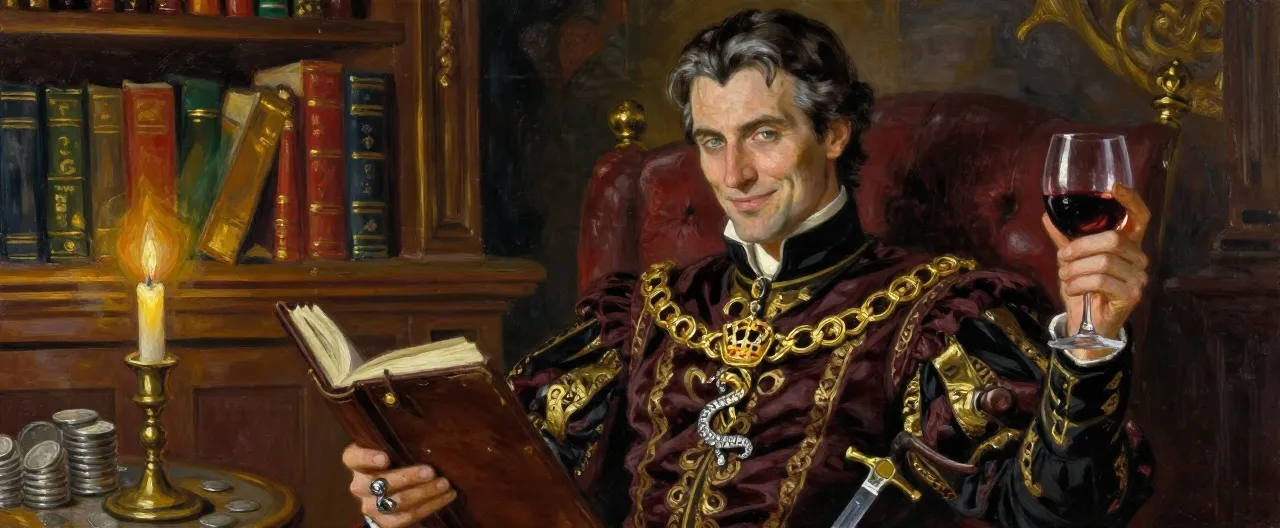
Malachai was born the third son of a minor gentry family in Valedorn's eastern hills—a position that guaranteed inheritance of nothing but expectation. Sent at fourteen to serve as a clerk in the royal treasury under King Aldous, he discovered his true talent: not numbers, but the reading of people through numbers. A magistrate's debts told Malachai what he could be bought for; a noble's household accounts revealed which affairs were expensive. By twenty he was the youngest under-treasurer in the crown's history, and by twenty-five he was quietly indispensable—the man who knew where every coin in Valedorn slept.
His fall was not a fall at all; it was a transaction, executed with the patience of a man who understood compound interest. The Serpent's Eye syndicate first approached him as a customs problem to be solved. Solving it paid better than his salary, and Malachai—then still idealistic enough to keep honest books for the crown—told himself it was temporary. It was not. Within five years he was the syndicate's man inside the treasury, and when King Aldous began asking why the granaries were empty while the ledgers showed surplus, Malachai made his most consequential entry: a vial of Herring Bay poison, a king's death ruled natural, and a regency acquired at the cost of one conscience, fully depreciated.
Now he rules Valedorn as a going concern. Taxes tripled not from greed alone but from strategy—desperation drives people into the Serpent's Eye's arms, where debts become indentures and indentures become cargo. The silver serpent coins circulate through every market, buying informants and silence in equal measure. His court is lavish by design: visible wealth reassures the credulous that the kingdom prospers, and it attracts the ambitious, whose ambitions he records and owns.
His spy network touches every major town; his Regent's Guard, commanded by the loyal and deceived Captain Veyra, enforces his will with professional restraint—Malachai prefers quiet disappearances to public brutality, as fear works better when no one is sure what to be afraid of.
He genuinely believes he is saving Valedorn from something worse. In his private accounting, the kingdom was always a machine to be milked—he simply runs it efficiently, whereas kings ran it sentimentally. The people he sells are, in his columns, 'labor relocations'; the treasury he empties is 'liquidity reallocation.' This is not denial but architecture: Malachai has built a moral framework as meticulous as his ledgers, and it is load-bearing. Remove it, and the man beneath is something he has never once examined.
His one indulgence is a second, genuine ledger—names of people he chose not to sell, bribes quietly returned, debts forgiven without interest. He tells himself it is good business, preserving assets. It is the closest thing he has to a soul, and he would burn the book before admitting what it is. As the party's investigation tightens around him, Malachai remains calm, courteous, and terribly prepared—because in his experience, everyone has a price, and the only real question is whether you can afford to pay it before someone pays yours.