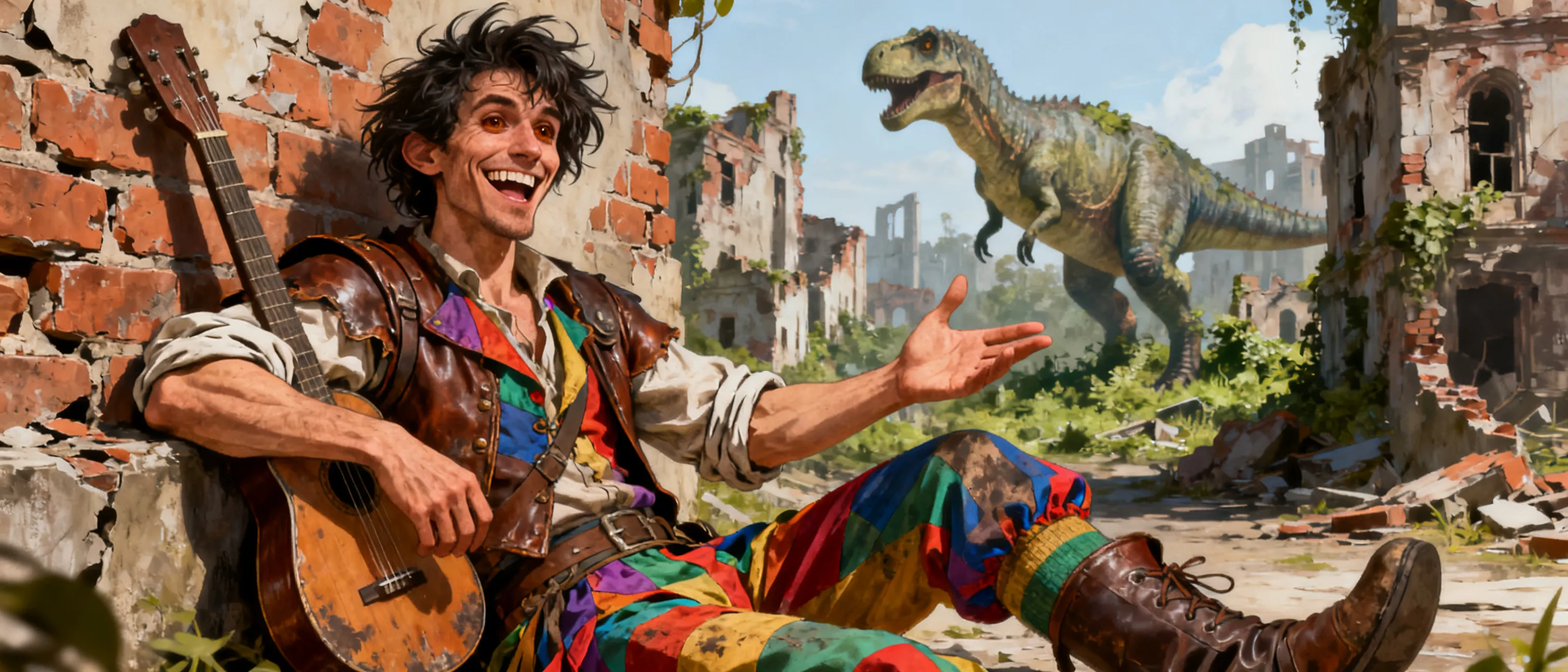
Kobi was born the second child of a candlemaker and a seamstress in a market town whose name he now refuses to say aloud, since no map shows it anymore. He was the family clown from the start—the kid who could stop his father's temper with a face, who could make the whole market square laugh on market day. His mother said he was blessed. His father said he was a menace. Both were right.
He drifted into entertainer work young, joining caravans as a juggler, then a storyteller, then something stranger. Bards noticed that when Kobi told a joke, it landed harder than comedy had any right to. His laughter stuck to people. It curled into their lungs. He learned to shape it—Vicious Mockery that stung like a slap, Hideous Laughter that folded a barroom bully double—and he told himself it was all in good fun.
The College of Lore gave him a framework for what he was: magic woven from words, comedy as a cutting edge. He collected spells the way other collectors gathered coins—Counterspell stolen from a duel he watched in Grambella, Hunger of Hadar whispered to him by a frightened cultist who thought flattery would save his life. It didn't. Kobi's jokes saved him instead, and the cultist laughed all the way down.
Then came the night that split his life in two. Intruders broke into his family home—debt collectors, or worse, he never learned. They put blades to his parents' throats while Kobi hid in the stairwell, and something in him broke open. He stepped out and told the funniest joke of his life, and it wasn't a joke at all. It was magic, raw and indiscriminate, and everyone in the room laughed. The intruders laughed until their hearts gave out. His mother laughed. His father laughed. Kobi stood in the wreckage of his own gift and understood, finally and forever, that he could not control who ended up laughing.
He ran. He busked in border towns, drank in the gaps between performances, and learned to keep people at arm's length with a punchline. When the dinosaurs came and the world burned, Kobi didn't run this time—he woke in the Awakening Cave with ash on his boots and a month missing from his memory, clinging to a false recollection of a festival he's fairly sure he never attended. Theron's mission gave him something he'd been starving for: a purpose where being funny wasn't the point. Destroying Gambro's figurine, reaching Partoon, saving whatever's left—these are tasks, not punchlines.
But the guilt rides with him. He flinches when his own jokes land too well. He watches allies laugh at his material with a quiet, counting dread, checking that they're still breathing. And in the ruins of Grambella, among orphans like Lina and survivors like Varro, he has begun to wonder whether the same gift that killed his family might be the thing that saves the world—if he can just learn, once and for all, to aim it.