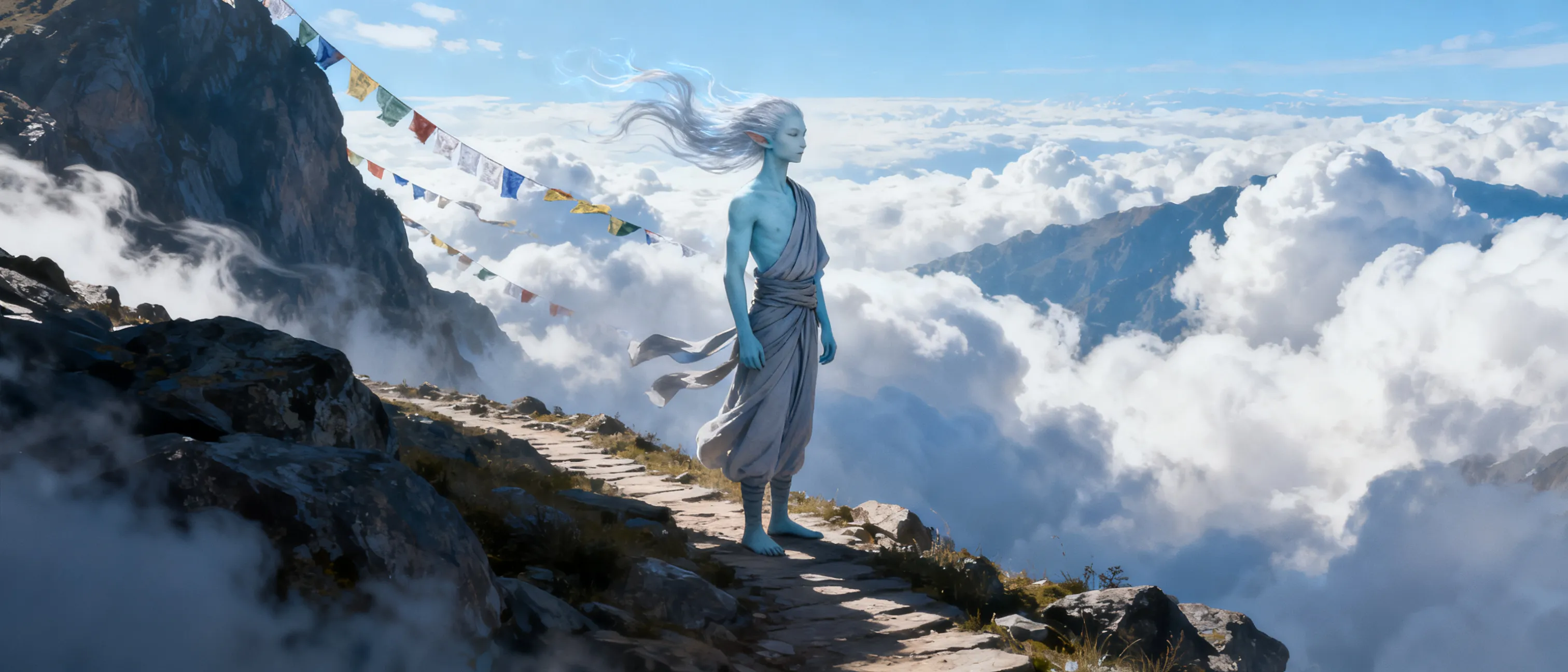
Character Background
Kael was born during an unusually strong storm season on a narrow ridge of stone high above the lowlands. The elders at the mountain sanctuary later said the winds howled around the roof for three nights when he first cried, as though the sky itself had taken an interest in him. His earliest memories are of white clouds drifting beneath the monastery terraces, prayer bells ringing in thin mountain air, and robed caretakers teaching him to breathe slowly whenever the world seemed too large. He was an inquisitive child, quiet for only short stretches at a time, and always moving. While other children were content to play in courtyards or memorize hymns, Kael climbed walls, balanced on railings, and tested the edges of every path.
At first the monks thought he was simply difficult. He asked too many questions about storms, about why candles flickered when doors opened, about whether a person could learn to move like wind over rock. But the sanctuary’s eldest instructor, a patient woman with weathered hands, recognized something different in him. Kael was not unruly so much as sensitive to motion. He noticed things other children missed: the subtle pull of air before rain, the tension in a person’s shoulders before anger, the sound a loose stone makes before it gives way underfoot. He was taught that awareness was the first defense and that a calm mind could become a shield stronger than iron.
His training was demanding, and at times lonely. The monastery prized restraint, and Kael had to learn to discipline an instinct that always wanted to leap ahead. He ran circuits in the cold dawn air, practiced forms until his muscles trembled, and stood motionless for hours while the wind snapped at his robes. In the evenings he was instructed in scripture and service, helping mend the sickroom, copy devotional texts, and carry food to travelers sheltering at the sanctuary gates. These acts mattered to him more than he liked to admit. He discovered that the monastery’s true strength was not in its walls or vows, but in the way its people quietly protected one another.
As he grew older, Kael began assisting the sanctuary’s healer-priest, who noticed his unusual affinity for divine breathwork. Rather than studying as a full cleric, Kael learned a smaller, simpler ritual practice: a blessing spoken at the right moment, a touch meant to steady the wounded, a prayer carried on an exhale. These exercises gave him confidence that discipline and mercy could coexist. He came to believe that healing was not weakness and that aid offered at the right time could avert violence before it began. From this teacher he learned the cantrips and rite that now accompany him on the road, not as a replacement for martial training, but as a companion to it.
The decision to leave the monastery did not come lightly. For years Kael had felt the pull of the wider world through every open gate and every story told by pilgrims. The sanctuary served travelers, but it remained safely apart from the harsher truths of trade roads, border disputes, banditry, and the quiet injustices that never reached mountain air. Kael began to suspect that his training would remain incomplete if he never tested it where the stakes were highest. He asked permission to go, and though the elders worried, they saw that his resolve was genuine. They gave him blessings, a simple set of wraps, and the understanding that discipline must eventually be proven rather than preserved.
Kael left with a calm face and a heart far less certain than he pretended. He carries with him several bonds that shape his every step. He feels loyalty to the sanctuary that raised him, gratitude to the healer who taught him mercy, and a deep need to justify the faith others placed in him. His ideal is straightforward: strength should defend, not dominate. He believes a person can be firm without becoming cruel. His flaw, however, is that he often tries to bear too much alone. He would rather endure pain silently than admit he is overwhelmed, and he can be stubborn about accepting help when he needs it most.
In the world beyond the mountains, Kael hopes to become a living answer to the fears he has seen in others. He wants to be the kind of ally who arrives before despair hardens into violence. He wants to master his body so thoroughly that no environment can unbalance him, no enemy can easily corner him, and no storm—literal or emotional—can force him from the path he believes is right. Yet underneath all that discipline is something more vulnerable: a sincere longing to understand where he belongs. The wind can move anywhere, but Kael still wonders whether he is meant to keep traveling forever or whether one day he will find a place in the world that feels like home. Until then, he walks with quiet purpose, listening to the sky, carrying his prayers in his breath, and meeting each new road with open hands and a guarded, hopeful heart.