Character Background
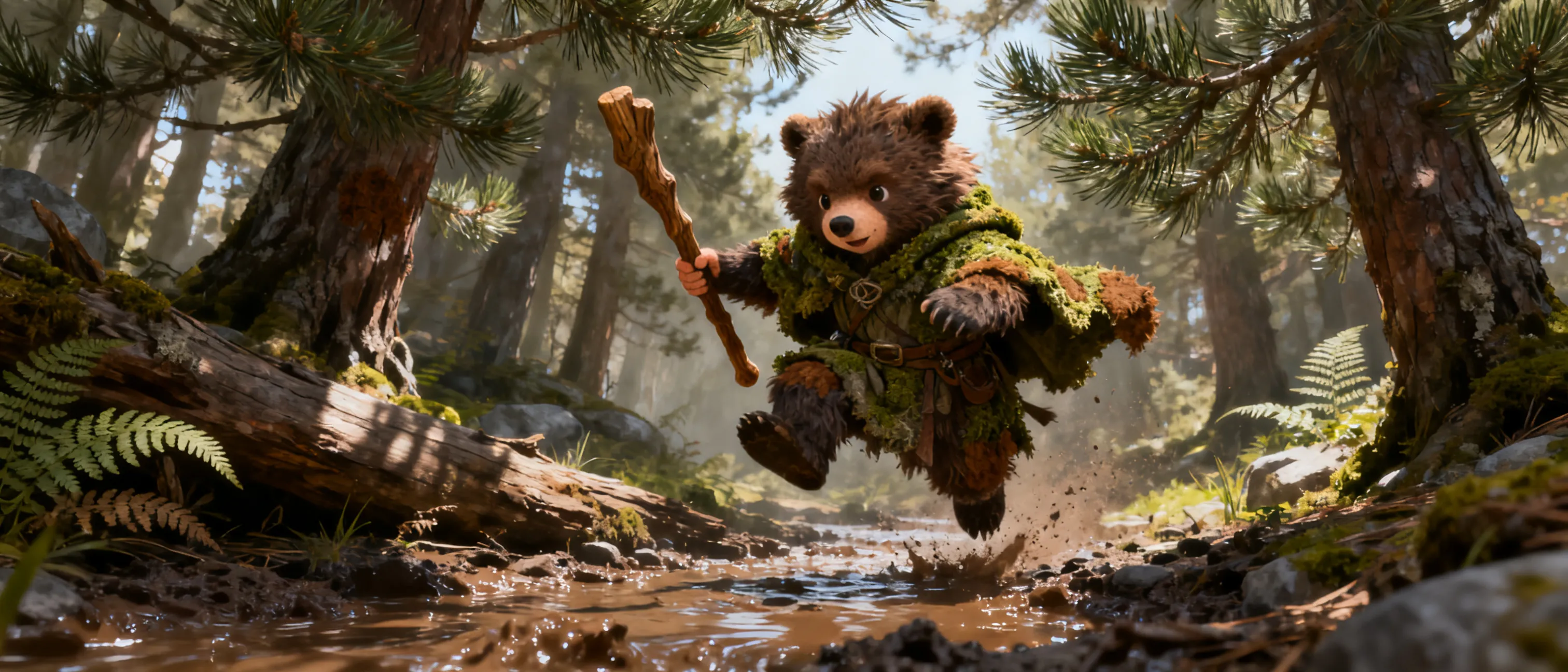
Bran Mosspaw was born on a cold spring morning in a halfling village set against the edge of a vast old forest. The settlement was small enough that everyone knew everyone else’s business, which meant Bran’s unusual appearance became the subject of gossip before he could even walk. He had the compact height of a halfling child, but there was something about him that never quite matched the rest of the village. His shoulders were broad, his hands were strong, and a thick coat of coarse brown fur grew along his arms, back, and the line of his jaw. His ears were rounded and human enough, but his eyes always seemed too deep and dark, like they belonged to something that had spent years watching the forest at dusk.
His mother, a practical and loving herbalist, refused to treat him as a curse or miracle. She taught him to gather roots without uprooting the patch, to tell which mushrooms healed and which poisoned, and to apologize to the land when he took too much. His father was less certain what Bran was meant to be, but he was kind in the quiet way of rural fathers who do not know the right words for wonder. From both of them, Bran learned work, patience, and the habit of observing before acting.
But the village did not make things easy. Children mocked his hair and called him bear-blood. Adults lowered their voices when he passed. When he was frightened, he sometimes lashed out with a force that shocked even him, and once he broke a fence post in half after being cornered by older boys. After that, the whispers became worse. Some said he was touched by a spirit of the wild. Others claimed that, somewhere in his family line, an ancestor had made a bargain with a beast. None of the stories were true in any simple way, but all of them seemed to circle the same truth: Bran was not wholly one thing.
His turning point came during a harsh winter when hungry wolves moved too close to the village. Bran, then barely old enough to understand the danger, followed the tracks into the trees with nothing but a carving knife and a bundle of herbs. Instead of killing the wolves, he found them thin, desperate, and limping from old injuries. When he tried to drive them off, the lead wolf lunged, and panic flooded through him. He remembers the moment poorly afterward—only the sensation of claws that were not quite claws, a roar in his chest, and the wolves backing away from something far larger than a halfling child. By the time the villagers found him, the pack was gone. Bran had not been bitten, but he had also not been entirely himself.
That winter changed everything. The village elder, who had long suspected the old forest held deeper answers than the roadside prayers of the settlement, sent Bran to a nearby circle of druids. There, among the pines and stones, Bran finally met people who did not fear his strangeness. They recognized in him a rare tension between discipline and instinct, between the careful mind of a small folk and the brute strength of the great ursine spirits that haunted the deep woods. They taught him that wildness need not mean cruelty and that restraint need not mean weakness. They taught him the old language, Druidic, and with it the secret habits of the land: how trees warned one another, how birds spotted danger before people did, how storms carried messages no ordinary ear could hear.
Bran proved a willing but difficult student. He excelled in tending wounded animals, reading spoor, and calming frightened beasts with a low voice and steady hands. He struggled more with anger. When he felt cornered, his instincts came alive too quickly, and the druids had to teach him breathing exercises, grounding rituals, and the practice of speaking his fear aloud before it became fury. Over time he learned that the bear within him was strongest when it was hungry, terrified, or protecting something helpless. That knowledge did not make him less dangerous; it made him more responsible.
As an adult, Bran now travels beyond the forest that raised him. He seeks lost groves, ancient rites, and any lore that might explain what he is becoming. He is not ashamed of his nature, but he does not trust it blindly either. In his human form, he can be reasoned with, talked down, and guided by logic. In the shape he someday hopes to master more fully, he is far more dangerous—unpredictable, territorial, and driven by instinct. That contrast has become the central fact of his life.
His bonds are simple but powerful: his mother’s kindness, the druid circle that gave him direction, and the woods themselves, which he sees not as a backdrop but as a living community. His ideal is balance. He believes creatures should live without needless cruelty, that power should guard rather than dominate, and that every beast, including the one inside his own heart, deserves understanding before judgment. His flaw is equally plain: when threatened, he sometimes reacts before thinking, and once his protective fury takes hold, he can become almost impossible to redirect. He knows this, fears this, and still walks forward anyway, because someone has to stand between the civilized road and the hungry dark beyond it.