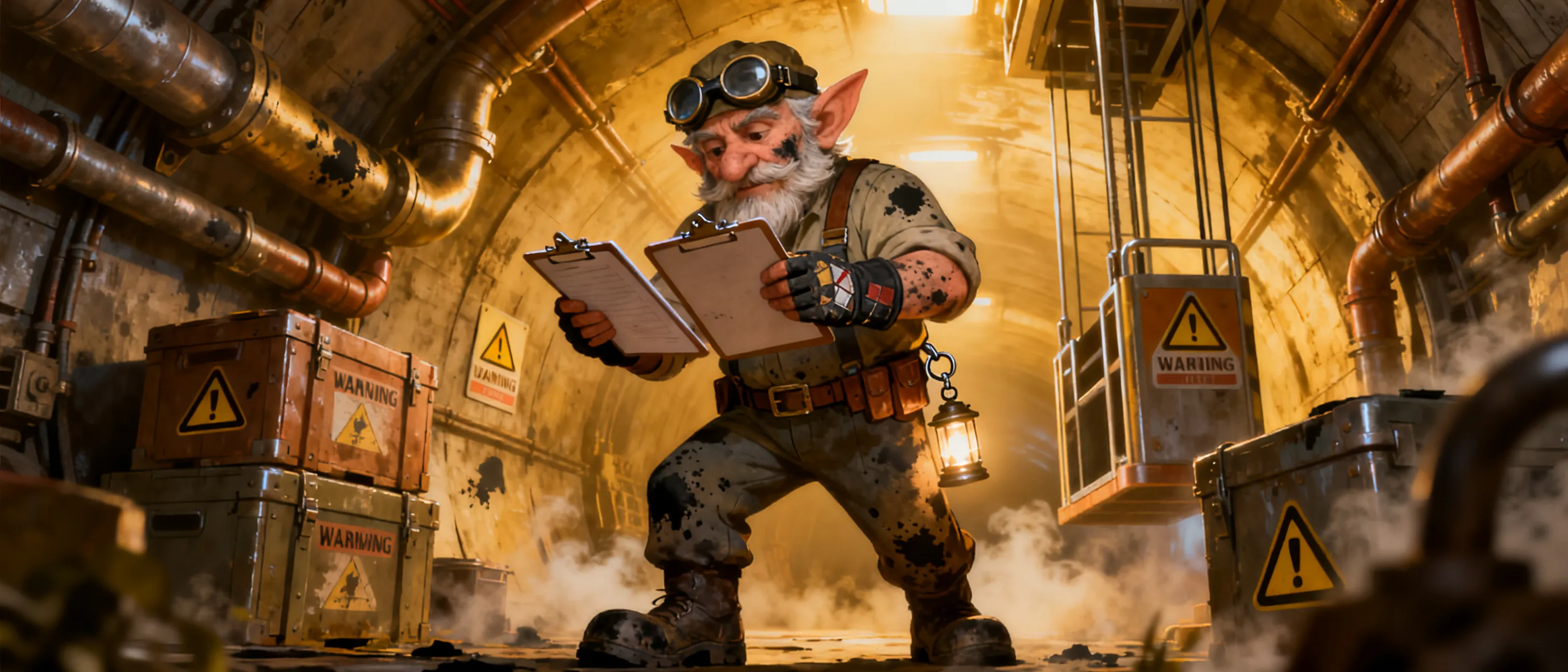
Character Background
Rill Vexbolt was born beneath the market, in a corner of the pocket-dimension where the lamps were always dimmer, the air was always warmer, and everyone smelled faintly of oil, dust, and metal shavings. Her earliest memories are not of toys but of tools laid out in careful rows, of older workers teaching children not to touch red-handled valves, and of her own mother counting inventory tags as if they were holy text. In a place like the Bazaar of Misplaced Things, where value can change hands before a bargain is finished, precision is survival. Rill learned that lesson before she learned to lie properly.
As a child, she was the one who crawled into vent grates to fetch dropped washers, who noticed when a lift cable had been frayed by a hair’s breadth, and who asked too many questions about why the same hallway could be mapped three different ways depending on which clerk drew it. She was clever in the stubborn, practical way that makes adults sigh with relief and annoyance at the same time. When other children played vendor and customer, Rill played foreman and inspector. She made pretend clipboards out of old box lids, wrote impossible notes in charcoal, and scolded imaginary apprentices for leaving screws in the wrong tray.
Her talent became useful young. The underworks are not glamorous, but they are the hidden backbone of the market. Lifts move the goods, pipes move the steam, bells warn of contamination, and locks decide who gets access to the places where bad things are stored before they become worse things. Rill apprenticed with maintenance crews who appreciated her memory and her hands. She learned how to listen to a machine the way some people listen to a room full of gossip. If a hinge was wrong, she heard it. If a seal had been tampered with, she felt it in the tension of the latch. If a route map had been copied by someone who did not understand the layout, she spotted the mistake by instinct and stubborn rage.
By the time she was old enough to be trusted with a master key, she already knew the underworks better than many of the people who signed off on them. That knowledge made her valuable and miserable in equal measure. She was promoted into responsibility faster than she was promoted into rest. Every crisis became her problem. Every delayed shipment became her fault. Every jammed lift, rogue cart, and mislabeled crate seemed to land at her feet with someone else asking why she had not prevented it. Rill answered with repair, not complaint, because repairs are what she does. But over the years, that habit hardened into a private resentment. She began keeping duplicate notes, then triple notes. One clipboard held the official route. One held her corrections. One held the truth as she suspected it, which meant the least and the most reliable things she knew were always in tension with one another.
Then the route changes started.
At first they were small. A maintenance stair moved two turns over. A lift stopped where it should not. A quarantine gate opened on the wrong side. Rill assumed a careless clerk or a bored runner was to blame. But the patterns got worse. Black iron tags appeared on goods that should have been quarantined. The moving routes began to feed into places that did not exist on any approved map. Workers swore they had followed the posted directions and still wound up in the wrong aisle. Rill retraced the paths herself, clipboard in one hand, wrench in the other, and found that someone with access to both gnome and kobold systems was not just tampering with the underworks. They were teaching the market to misplace its own bones.
That was when she started sleeping badly. Not because of fear, exactly, but because of responsibility. Rill is not a romantic person; she does not imagine destiny. She imagines failures. A lift brake snapping. A worker getting trapped in a mislabeled shaft. A quarantine line breaking and releasing cursed returns into the wrong corridor. She imagines all the ways a system can be twisted into a weapon and hates herself for how quickly she can see the mechanism behind it. Her anger is useful because it keeps her moving. Her exhaustion is useful because it reminds her what happens when nobody does the maintenance.
When the party first meets her, she is already carrying too much. She is furious that routes keep changing, furious that the saboteur understands her work, furious that the market’s leaders treat the underworks like the ugly underside of a profitable machine. But she is also exhausted enough to accept help if it is real. The players may become her proof that outsiders can be more than opportunists. If they are respectful, she will open doors, hand over keys, and tell them exactly which pipes will burst if they try to sprint through the wrong corridor. If they are greedy, she will mark them as threats and keep one hand on the alarm bell.
Her ideals are practical. Work should be logged. Danger should be named. People should not be left to die because a system made hiding the problem easier than fixing it. Her flaw is equally practical: she believes too much can be solved by competence alone, and that if she just checks the route one more time, maybe the world will behave. The campaign will challenge that flaw by forcing her to rely on trust, improvisation, and the ugly truth that some failures are not mechanical at all. They are about power, secrecy, and people choosing profit over responsibility.
If the party earns her loyalty, Rill can become one of the campaign’s most grounded allies. She will not sing songs about them. She will not call them chosen heroes. She will hand them a key, show them a bypass, and say something like, 'Don’t make me regret this.' In the underworks, that is practically a love letter.