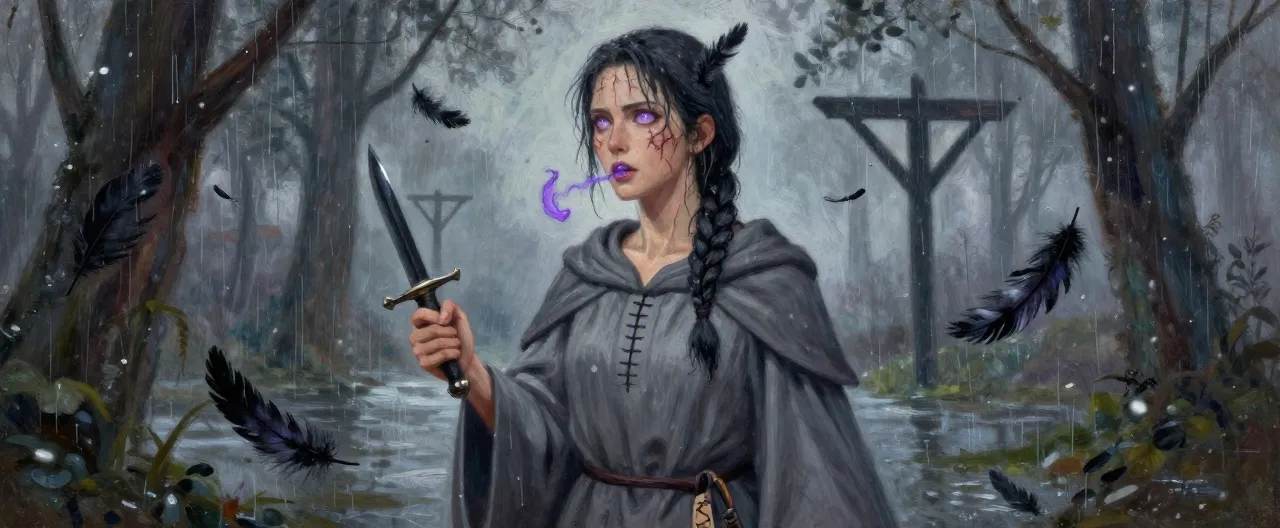
Nira was born Nira Callowen, the daughter of a tanner in a drowned village in the Blackfen lowlands, where the rain fell nine months of the year and the other three the bog breathed. Her childhood was ordinary in the way that only poverty can be ordinary: scraping hides, hauling water, watching the reeds for the shapes that sometimes moved in them. The Choir found her village when she was sixteen.
They came seeking something buried beneath the peat—a fragment of Vaelthar's original notes, written before the Codex was ever bound. They did not find it. Instead they found people, and the Magister's doctrine holds that any flesh which has touched void-leaked ground is either an offering or a vessel, and vessels must be tested by flaying.
Nira was strapped to the trestle. She remembers the sound of the silver knife being honed more clearly than she remembers her mother's face. She remembers reciting her own name over and over so that whatever came after would know who had been erased. And she remembers Magister Vaelen Mor arriving late, unbinding her, and saying in a voice like a closed door: 'This one whispers already.' Whether the Void had actually touched her or whether Mor simply saw a terrified girl who would owe him everything, Nira has never permitted herself to wonder. Gratitude, for Nira, is a load-bearing wall. Question it and the whole structure falls.
She was raised in the Choir's doctrine for six years before her first flaying. She performed it herself, on a deserter named Jorn, and wept the entire time—not from remorse, she insists, but from the overwhelming intimacy of the act. To flay someone properly, you must know their body as a lover does. The Choir teaches that skin is the Codex's true medium: the book was bound in Vaelthar's skin, the Fane's tapestries are tattooed pages, and every flayed apostle becomes a living manuscript.
Nira believes, with a fervor that frightens even other cultists, that she is being written. Her scars are punctuation. Her three facial scars were given to her by Mor himself, one for each of the Choir's tenets: Silence, Surrender, Scripture.
Her rise through the Choir was not meteoric but methodical. She served first as a bog-runner, moving pages through Blackfen in waterproofed cases strapped to her chest like a child. She learned the water, the reeds, the timing of patrols. She learned to ambush from below, rising out of black water with her hands full of whispers. When Matron Vela's asylum began producing stitched patients, it was Nira who transported them.
When the void-touched raven of the Sunken Archive shed its black feathers, it was Nira who gathered them—wading into magical darkness with Devil's Sight, unblinking, while other initiates went mad. The feather braided in her hair is the raven's first gift to her, and Choir cultists recognize its authority instinctively; the bird, whatever it is, has marked her as its own.
Her relationship with the party is defined by Gallows Ford. She hanged three deserters there as a message and waited in the reeds to ambush Elara Voss's escorts. She lost—or at least, she retreated—and the party has been an itch in her mind ever since. She does not hate them the way a person hates. She studies them the way she studies skin: where they will split, where the grain runs, where the knife should enter.
She has memorized their tactics from Choir scouts' reports. She knows the spellcaster's tells. She has rehearsed, alone in the Fane, the exact words she will whisper into their ears when she finally holds them down.
In the Hall of Mirrors she meets her fate: half-transformed into a flayed thing, her body a patchwork of grafted skin, gurgling through a throat that no longer fully belongs to her. She carries the key to the throne room. She has, by then, begun to hear the Codex reading her—her own life, backward, in a voice she almost recognizes. Whether that final Nira feels triumph or terror is a question the module deliberately leaves open, and a good GM will let her last words be ambiguous: 'Read me. Free me.'