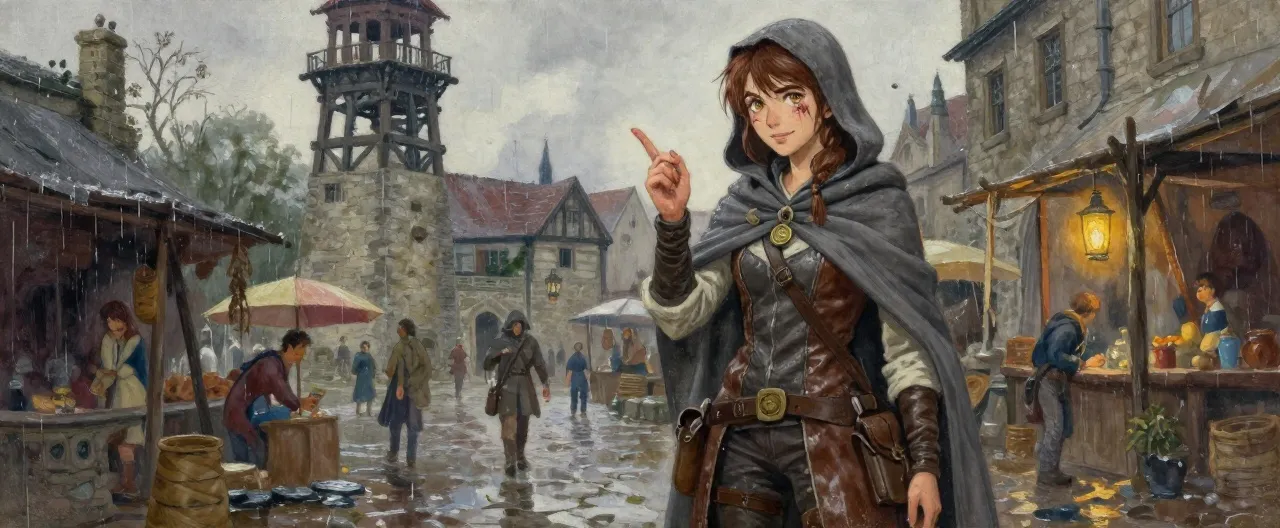
Sophie Redwick was born in Brampton, a market town three days' ride north of Elmwood on the same trade road, the middle child of a wool factor named Edwin Redwick and his wife Ruth, a seamstress. Her father kept meticulous books, and Sophie learned to read figures before she learned to read letters. She also learned, watching him, that the numbers in a ledger and the numbers in reality are two different things, and that the gap between them is where the money lives.
When Sophie was fourteen, Edwin's business partner — a man named Garvin Holt, polished, generous, universally liked — quietly transferred the firm's debts onto Edwin's name and vanished with the capital. The Redwicks lost everything. Her father took work as a clerk for the merchants' guild at half his old wage and never recovered his standing; her mother took in sewing until her eyes failed. Sophie, at fourteen, understood two things with total clarity: first, that the man who stole from her family would never face justice through any legitimate channel, because he had made himself too useful to the people who ran such channels; and second, that ledgers do not lie, but the people who write them do.
She went to work at fifteen as a runner for a Brampton moneylender named Doss, a woman with a ledger of her own and a network of debtors, couriers, and copyists that stretched down the trade road. Doss taught her locks, ledgers, and the difference between stealing and borrowing — a distinction Sophie has always found useful and never entirely convincing. She learned Thieves' Cant from Doss's collectors. She learned forgery from a disgraced guild scribe who was paid in drink and taught Sophie everything he knew before the drink finished him.
By nineteen she was forging bills of sale, altering debt records, and — her specialty — auditing other people's books to find where they were crooked. It turned out she had a gift: she could look at a column of figures and see the lie in it the way a musician hears a wrong note.
At twenty-two, she found Garvin Holt. He was living comfortably in a town two hundred miles south, calling himself a wool merchant, with a wife and a house and a reputation. Sophie did not kill him. She did something she considers far better: she spent three months quietly building a duplicate of his forged books, then delivered the originals to his creditors and his wife on the same day. Holt fled his debts and his marriage in a single night.
Sophie kept a copy of his ledgers as a trophy and has never spent the ten gold pieces she found in his desk drawer — she keeps them wrapped in cloth in her satchel as a reminder that the truth is in the paperwork.
Her faith found her the same way. A priestess of Waukeen in Brampton, a brisk woman named Marla Trench, caught sixteen-year-old Sophie attempting to alter a tithe record in the temple's own counting-house — and instead of calling the watch, sat her down and explained that Waukeen does not care whether you are lawful, only that you understand what coin is: a promise made physical. Every coin is a contract.
Forging a ledger is forging a promise. Sophie has been quietly devout ever since, in the way of someone who finds theology useful rather than comforting. She wears the brass coin at her throat and pays her tithes, and she believes — genuinely — that every coin tells the truth about its owner. Old coins tell the oldest truths.
Her criminal contact is Doss's network, which survives her. Specifically, a copyist named Fenwick who works out of a stationer's shop in Brampton and can pass messages down the trade road. Fenwick expects payment in kind: information, favors, or the occasional document Sophie 'finds.'
Why is she on the Clover Downs road, bound for Elmwood and its Harvest Fair? Business, ostensibly. Doss's old network has heard rumors — nothing solid — that someone has been buying up debts in the small towns of the Downs. Not collecting them; buying them, quietly, at fair prices, and then doing nothing with them. That is not how debt works. Debt is a lever. Someone is accumulating levers and not pulling them, which means they are waiting for something, and Sophie does not trust anyone who waits. She is traveling the road town by town, reading whatever books she can get her hands on, looking for the pattern.
Elmwood is simply her next stop. She has heard the honey is good, the wool is better, and the ale is cheap. She intends to spend a few days at the fair, poke through the town's public records if anyone will let her, maybe lift a look at the tithe ledgers if the alderman's counting-house has a window — and then move on south.
That is the plan. The plan does not survive the morning three strangers in painted masks climb the bell tower and announce that the gods have returned to judge Elmwood's tax collector — and by noon the tax collector is dead in a locked room.
Sophie will be in the square when it happens. She will hear the proclamation, and her professional instincts will fire immediately: rehearsed cadence, glances to a man in a grey coat, a performance with a paying audience. She will think, before anyone else in the crowd does: who paid for this? And when the boy runs in shouting that Alderman Pemberly is dead, she will already be moving toward the counting-house — because a locked room, a dead tax collector, and a town full of forged-looking theater is, to Sophie Redwick, not a tragedy. It is an audit.