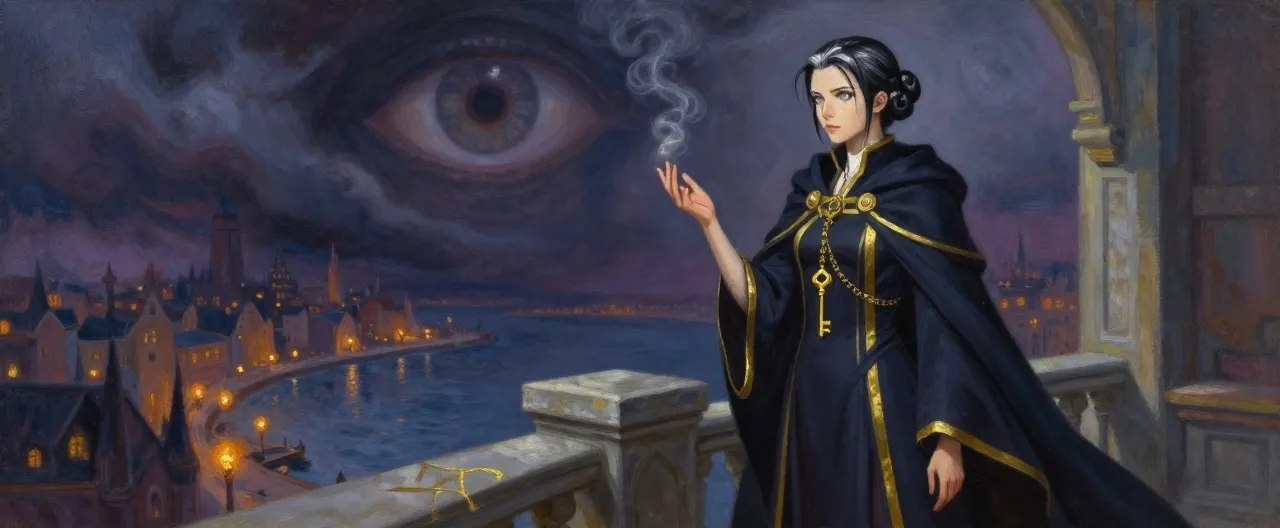
Veyra Sorn was born into a disgraced family. Three generations ago, her grandmother, a minor harbor official, signed a judgment under dubious circumstances that stripped the Sorn name of land, title, and standing in Brinewatch's merchant circles. Veyra grew up watching her father bow to men his grandfather had outranked, and she resolved early that records—ledgers, judgments, registries—were the true thrones of the world. Whoever writes the record rules the reality.
She entered the customs house at sixteen as a copying clerk, meticulous and unreadable, and rose by making herself indispensable to people who then conveniently fell from grace. She learned that mercy is a currency more stable than gold: spare a smuggler once, own him forever. By twenty-five she held a magistracy appointment, and within two years she had converted a bankrupt dockworkers' mutual-aid society into the Gilded Key Network—a web of thugs, cultists, and informants who wear her golden key amulets and believe, most of them, that they belong to a charitable order.
The Hollow Archivist found her, or she found it—the distinction matters to no one but her. It came as whispers in the sealed archive below the magistrate's office, promising knowledge of the Lattice's true nature: that the system granting skills, stats, and levels to all of Aetheria is not a blessing but a binding, a cage of imposed fate. The Archivist offered her the tools to unwrite it, anchor by anchor.
The first anchor lies beneath Brinewatch itself, in the Undercity ritual chamber, where a golden key focus the size of a door drinks the anima of chained demi-humans. The second rests in the Sunken Library; the third in the Ashen Peaks. Veyra's harvest is the key that turns each lock.
She is careful. Her public charity is genuine in its mechanics—orphans are fed, festivals are funded—because a benefactor's reputation is armor no blade pierces. Her journal, kept in cipher and hidden behind a false shelf in her office, records every tithe, every payment, every debt, including two entries she has never spoken aloud: the memory-wraith in the deep archive that guards her family's original judgment, and the null-signed child in her cells whom the Lattice cannot see.
Her operational style reflects her ledger mind. In negotiation she opens with charm—literal and social—turning allies against each other before steel is ever drawn. In combat she uses compulsion first: golden chains of force to restrain the fastest opponent, Charm Person to set prisoner against prisoner, Command to make a body shield of someone the heroes want to protect. She keeps muscle between herself and melee, drains weakened foes with her anima siphon to stretch her endurance, and treats retreat not as failure but as prudent accounting.
If the golden key focus is destroyed or she falls below half her health, she vanishes through hidden passages beneath Brinewatch rather than die for a patron who would simply file her away.
Her weaknesses are the seams in her ledger. Old Marrow, the retired barkeep she once spared as a young clerk, shelters the very demi-humans she hunts and does not yet know her hand in it. Ondrey Vass, the scribe she framed for her own skimming, sells her ritual ledgers to a rival faction in the Ashen Peaks, and his Lattice-anchored memory makes him a threat she cannot simply kill. And the Archivist itself is an unfaithful partner: it takes her tithes, grows stronger, and gives back only enough to keep her writing. Somewhere in its vast attention, Veyra suspects, her own name is already penciled in for erasure. She intends, before that day, to hold the pen herself.