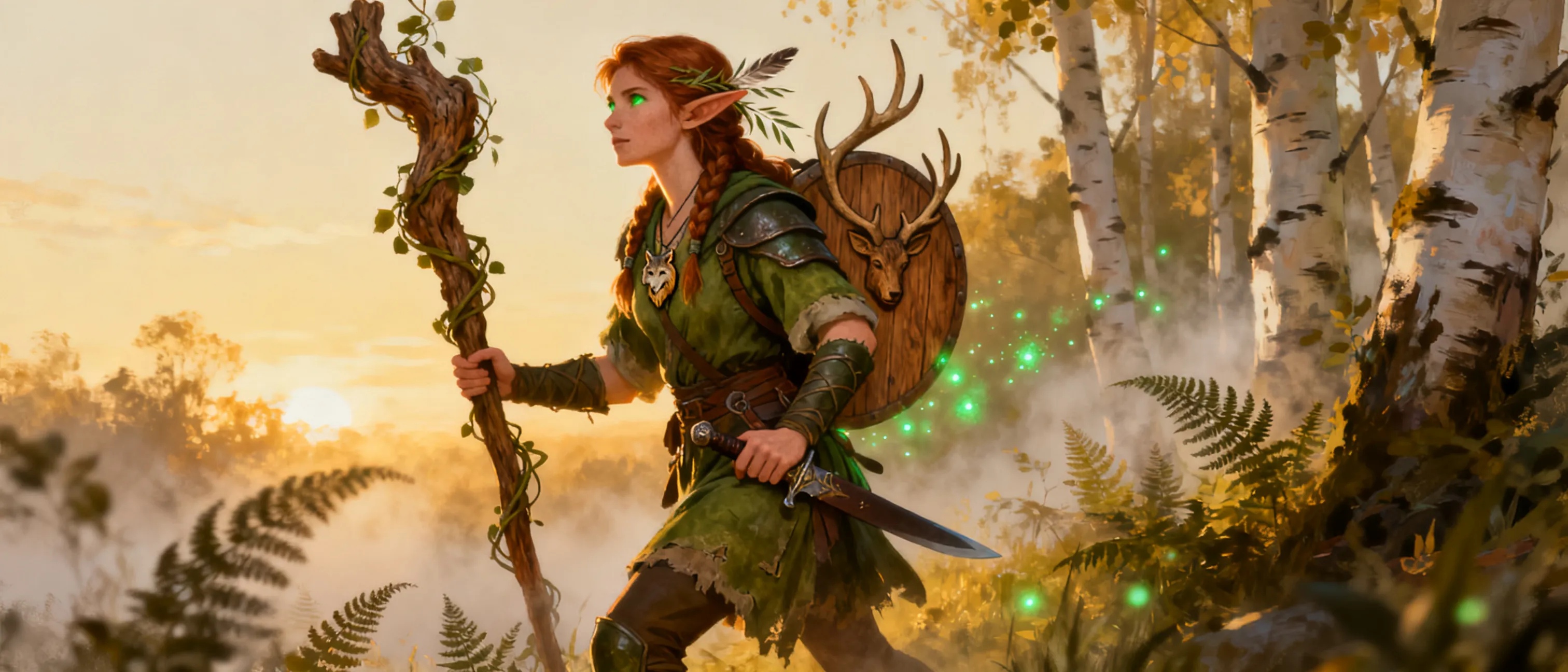
Sylvara never knew her parents. She was found as an infant—alone, half-frozen, and clinging to life at the edge of a burned clearing—by a nomadic band of wood elves who ranged the deep forests in loose, seasonal circuits. The band's elders debated briefly whether an orphaned stranger should be taken in; the answer came when a she-wolf, oddly calm, was discovered watching over the child from a distance. The band's oldest druid declared the child marked by the wild, and Sylvara was named for the whispering thorns of the grove where she was found. The carved wolf token she wears to this day commemorates that rescue, and the story is told at every midwinter fire.
Growing up among the band, Sylvara learned everything a nomad child learns: how to read tracks and weather, how to forage without stripping the land, how to move silently, how to mend and cook and defend a camp. She was never the strongest—her slight frame made her a poor wrestler among the other children—but she was the one who always knew where the water was, which berries were safe, and when a storm would break.
Her talent for the old magic surfaced early: flowers bloomed in her wake, and injured animals sought her out. The band's druids took her as a student, teaching her the primal tongue of the wild and the Warden's discipline of standing between the defenseless and harm.
Her legend among common folk began the winter the band wintered near a struggling logging village. When fever swept through the settlement, the elves' laws of separation might have kept them apart—but Sylvara slipped down alone, carrying goodberries, poultices, and her growing healing gifts. For a month she nursed the sick in secret until she was caught; instead of driving her off, the villagers fed her, hid her from a suspicious sheriff's patrol, and told her, when she finally left, that her cot would always be made.
She was eleven seasons old by elven counting. Since then, wherever she has wandered, common folk seem to know her by reputation: the green-clad elf who came when the fever came.
Now she has struck out on her own circuit for the first time, carrying her band's traditions into the wider world. She seeks to grow into the Warden's mantle—protecting travelers, villages, and the wild places alike—and to learn why the clearing where she was found was burned, a question the elders would never answer fully. Her path is guided by three simple habits: leave every campsite better than found, feed anyone who is hungry, and never let the forest's voice go unheard. The motes of green light that drift around her at dawn suggest the wild itself is watching its wardens' newest daughter with interest.