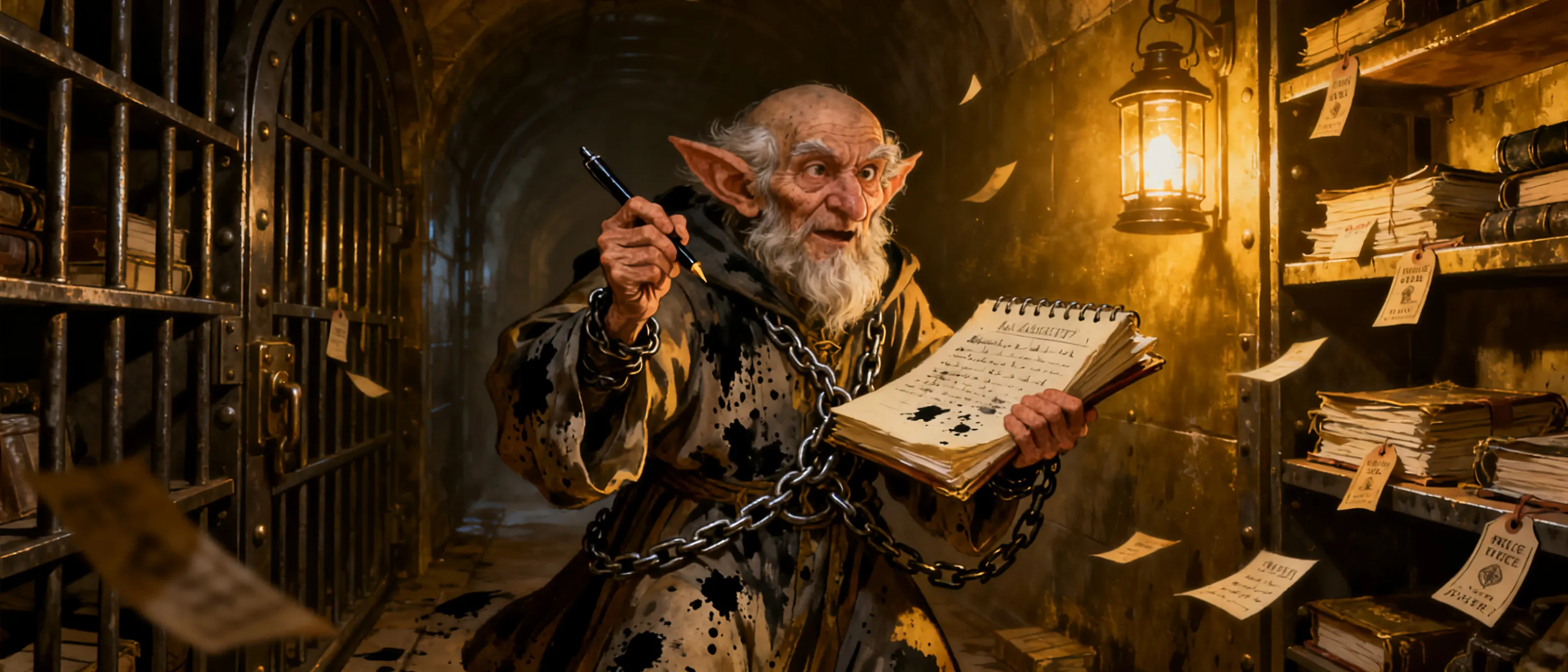
Character Background
Pell Sootglass was born in a lantern-bright gnome quarter where every family kept a spare ledger, a spare key, and an opinion about who had borrowed what. From the beginning, he was the sort of child who sorted buttons by color and remembered which neighbor had promised to return a ladder two winters later. His family thought he would become a clerk, and in a practical sense they were right. What they did not understand was that Pell did not love bookkeeping because it was tidy. He loved it because bookkeeping was how people proved that promises mattered.
As a child, Pell once watched a long-running dispute end not with a shout, but with a receipt. A borrowed tool, a damaged hinge, a signed promise to repair the hinge, and a witness who remembered the date. The problem was not solved by force. It was solved because someone had kept a record long enough for fairness to become possible. That memory shaped Pell’s entire life. He apprenticed early, learned to read old scripts, and developed a talent for finding what other people had intentionally buried under layers of paperwork. He was bright, patient, and almost pathologically cautious. He never wanted to be the loudest voice in a room. He wanted to be the voice that could prove what had actually been said.
That temperament brought him to the market long before the current crisis. The Bazaar of Misplaced Things, the Gnome Depot, and the Kobold Swap Meet needed someone who could keep track of the market’s oldest debts, its most dangerous returns, and the many sealed bargains that held the place together. Pell was not the only one qualified, but he was one of the few willing to take the job and remain there year after year. He learned the archive chains, the bell sequences, and the old notation systems used to mark goods that were too valuable, too cursed, or too politically sensitive to leave untracked. He also learned the personalities behind the records: gnome fixers who would rather patch a ward than admit it had failed, kobold wardens who respected a clean ledger more than a dramatic speech, and opportunists who treated the whole market as a machine that could be bent if enough invoices were forged.
The older Pell became, the more he began to understand that the archive was not neutral. It was a weapon in the hands of anyone who controlled the entries. That knowledge made him better at his work and worse at sleep. When inventory started disappearing and black iron tags began moving through the underworks, Pell noticed the pattern before many others did. But he hesitated. He assumed someone else had already reported it. He assumed the gnome quartermasters or kobold wardens had the matter under control. He assumed that because he was the archivist, not the guard captain, he should keep filing and wait for proof.
That hesitation now weighs on him like chains. He is deeply ashamed that the market’s compromise grew worse while he was still trying to be polite about it. Yet that shame has not turned him into a martyr or a saint. It has made him stern. Pell does not tolerate careless lies, sloppy records, or anyone who thinks the archive is just a room full of paper. He is more courageous than he looks, but that courage is not theatrical. It shows up in the way he stands his ground when the archive shakes, in the way he keeps speaking when his voice trembles, and in the way he continues to protect the truth even after admitting that the truth may also indict him.
He is loyal to the market, but not blindly. Pell knows the Gnome Depot and the Kobold Swap Meet survive because they trust each other just enough to keep the lights on. He also knows that trust is fragile and that the market’s enemies have been exploiting every gap in procedure. He fears the final vault, not because of the monsters sealed beneath it, but because he suspects the records there will confirm that the whole system has been feeding on bad bargains for years. If so, the market’s greatest defense may also be the very thing that could destroy public confidence in it.
That is where the party comes in. Pell will not simply hand over the bond-breaking secret to strangers. He wants them to protect the archive, recover the missing folios, and prove that they understand the difference between opening a lock and preserving what the lock was meant to save. If they earn his trust, he becomes one of their most valuable allies: a source of lore, a warding caster, and an unglamorous but unshakable defender of the truth. If they fail him, he will still try to help, but he will do so with the bleak resignation of someone who believes he waited too long to matter.
Deep down, Pell’s ideal is simple. He wants a world where records are not tools for the powerful, but shields for the vulnerable. His flaw is equally simple: he sometimes confuses caution with virtue, and procedure with justice. His arc is the painful but necessary lesson that a thing can be carefully preserved and still be deeply wrong. At the campaign’s climax, Pell must decide whether he is merely the man who keeps the books or the man who will stand in front of the books and refuse to let them be rewritten by greed.