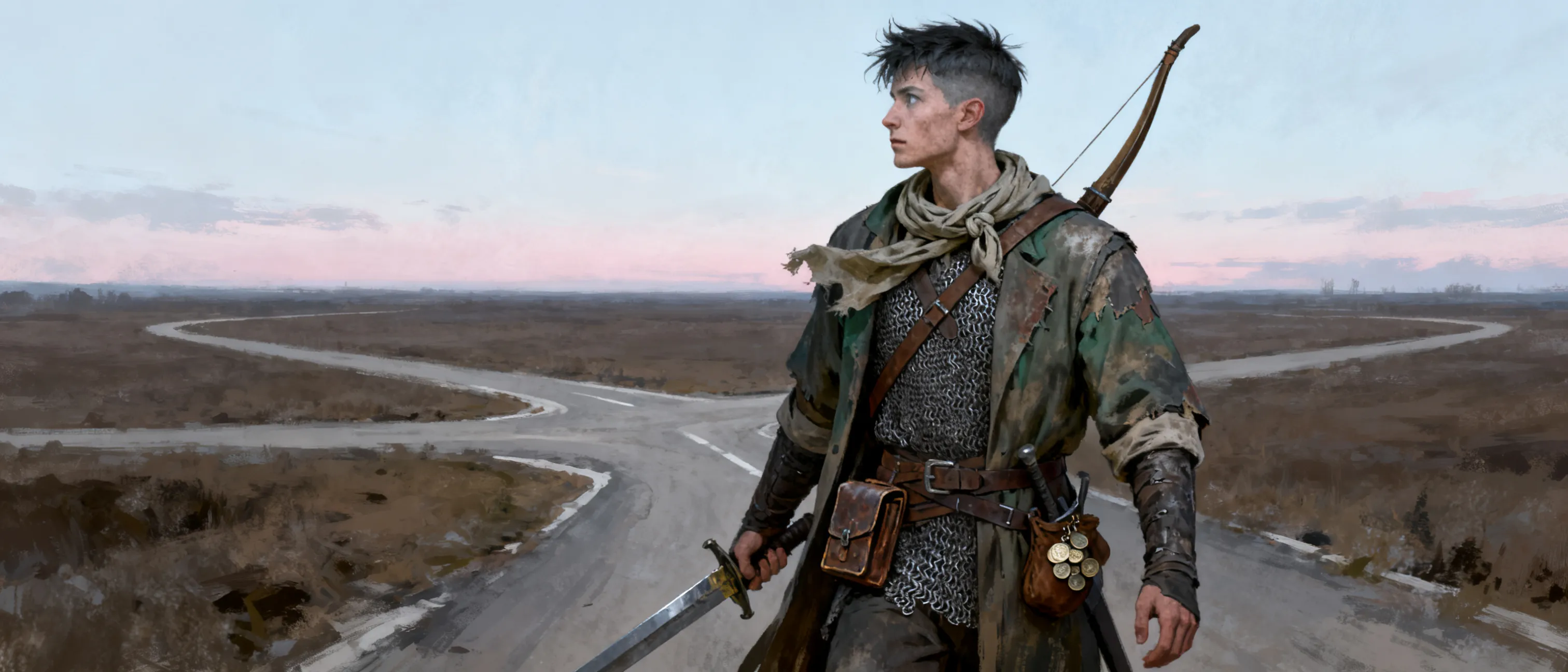
Kaelen Dratch does not know his mother's face, only her absence and the scarf. He was found as an infant wrapped in that faded cloth on the steps of a wayhouse at a nameless crossroads, and the wayhouse keeper — a hard, practical woman named Bress — gave him her surname and little else. She fed him, worked him, and taught him that nothing in the world arrives free. He grew up hauling water, minding stables, and watching the endless procession of travelers who came through the crossroads: merchants, pilgrims, soldiers, and the ones who watched too long before moving on.
From them he learned to read posture, cargo, and intent, and from the road itself he learned that every route has a rhythm — where beggars gather, where the watch turns a blind eye, where the inns water the ale.
At fifteen he left. Bress gave him the scarf, told him his mother had left nothing else worth keeping, and did not say goodbye. What she did not tell him — what he pieced together years later from a drunk caravan guard's loose tongue — was that the woman who left him had been running, and that someone had come asking after her within the year. Whether she is alive, dead, or something worse, Kaelen does not know. He tells himself he has stopped looking. He has not.
The years since have been a long apprenticeship in survival. He earned coin as a caravan guard, a debt collector's runner, a bounty chaser's tracker, and — for one bad winter — a thief, until a job went wrong in the town of Marren's Ford and he left ahead of the constable with a scar on his ribs and a lasting respect for locked doors. Each trade taught him something: how to hold a line against wolves, how to talk his way past a gate, how to move quietly and count coins that aren't his. None of them taught him how to stay anywhere. He has slept in a hundred barns and owned nothing he couldn't carry.
He took up the sword seriously in the service of a grizzled ex-soldier named Hult, who hired him to guard a wool shipment and kept him on for two years out of something like pity. Hult drilled him in the boring fundamentals — footwork, shield angle, the patience to let an enemy tire first — and told him once, the closest thing to affection the old man ever offered, that he fought like a man with no one behind him, and that someday he'd meet someone worth standing in front of.
Now Kaelen walks alone again, working his way across the country with odd jobs and sharp eyes, drawn half-deliberately along the faint trail of a woman who left a scarf behind twenty years ago. He is not a hero in his own estimation. He is a journeyman — competent, unclaimed, and motherless — headed down whatever road seems least likely to betray him, waiting for a reason to stop moving.