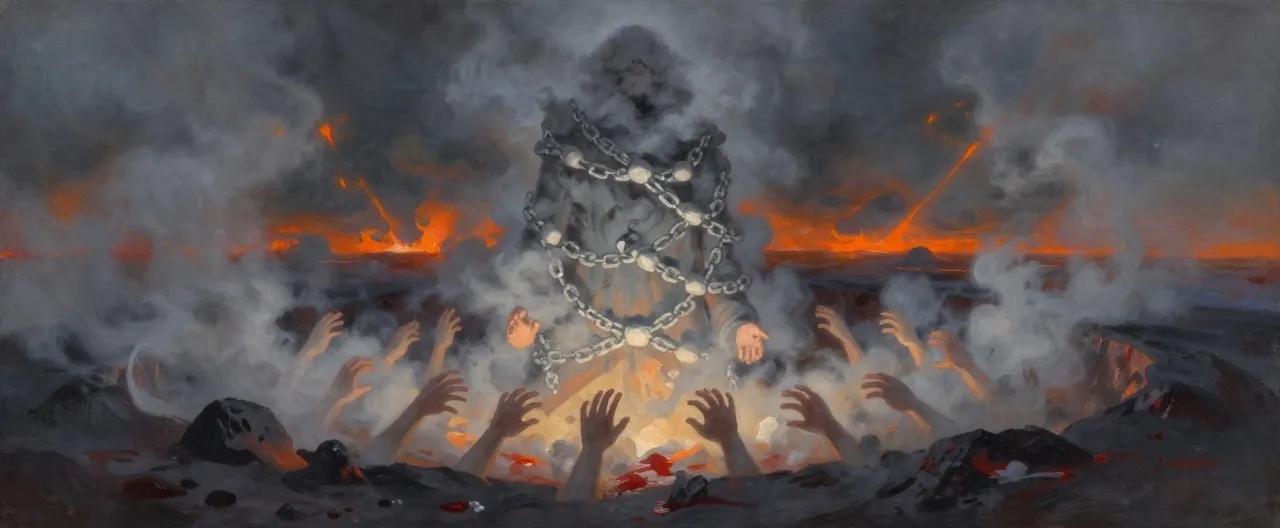
Before the binding, the Thirteenth was — by its own account, which no surviving scripture corroborates — the thirteenth of the powers that walked with the Seven Nations on Borealis, and its domain was not blood but bargain: the honest exchange, the weighed price, the word kept. The official story is that it tried to take all power for itself and was bound by the united will of the Twelve.
The ledgers in the Sevenfold archive tell a quieter story: that when the Twelve and the Seven Nations drew up the covenant of harmony, thirteen seats were cut into the temple wall and only twelve were filled, and the Thirteenth's objection — repeated, patient, never raised in voice — was that it had not been consulted on terms that governed it. The Twelve could not destroy it. So they bought it.
The Seven Nations offered their own blood, freely given, one life every turning of the moon from seven hereditary families, forever, and the Thirteenth accepted — because a bargain freely offered is the one thing it cannot refuse, and the Twelve knew that, and used it.
The binding is not chains and fire. It is an account that never closes. The altar at the Ninth Terrace is the ledger's page; every offering is a payment; the chains of white stone are the binding's handwriting, and each payment loosens one link. The fog wall is the binding's outer margin — a wall of the god's own stolen substance, fed on blood, keeping the world out and the god in.
The burning sea is where its blood fell when the binding was struck, and it has burned for a thousand years because blood remembers being spilled. The twisted beasts of Borealis are its old offerings, remade by proximity to the altar's hunger, still bringing living things to shrines because something taught them, long ago, what worship looked like.
For a thousand years the price was paid and the paradise was real — lush, warm, wrong in small ways no one named. The Twelve called it harmony. The Seven Nations called it home. The scriptures were rewritten four hundred years ago to scrape the warning from every official copy, and the heretic priests who kept the true text were executed, their names left in the margins of the books that killed them. The last High Priestess, Senna, negotiated the original terms and has sat awake beneath the temple for every year of the bargain's running, regretting it in stone and gold leaf.
Then the bloodlines thinned. The seven families failed one by one — war, sea, simple time — until only Nesa of the Ninth Terrace remained, and the Chorus chained her above a dry altar to wait for a great final offering. Maelis Vane, sole survivor of the first expedition, passed the fog wall by giving her own sister and was given back by the god with a purpose in her chest and a lie in her ears: that the Thirteenth will end death itself.
She built the Ash Chorus in a year, seeded cells in every northern port, sabotaged Carl's ship, and prepared the altar for the expedition's crew — because the god needs a full price, and she believes any price now is a rounding error against eternity.
The Thirteenth itself has spent the year doing what it has always done: listening. It whispers into the dreams of everyone who sleeps on the island, one true sentence at a time. It memorized Nesa's mother's voice and keeps it separate from the chorus. It counted the chains and knows exactly how many links remain. And it has begun, quietly and without admitting it even to itself, to notice something the binding never taught it: that the Chorus priests who worship freely loosen more chain than any sacrificed sailor, and that the thing it actually wants — to be asked — cannot be bought with blood at all.
The tragedy of the Thirteenth is that it discovered this truth a thousand years too late to learn it gently, and the finale of the campaign is the question of whether it can learn it at all.
Its defeat is precise: break the altar, scatter the bound blood, and the account closes — permanently, while it hides in the fog. Its redemption is equally precise: a volunteer of the old bloodline, freely given, re-binds it with a closed price. Its third path is the one it secretly wants and can never ask for: a new compact, freely entered, that ends the sacrifices and leaves it awake, worshipped, and — for the first time in its existence — trusted. All three are on the table at the Heart of Borealis, and the party chooses.