Character Background
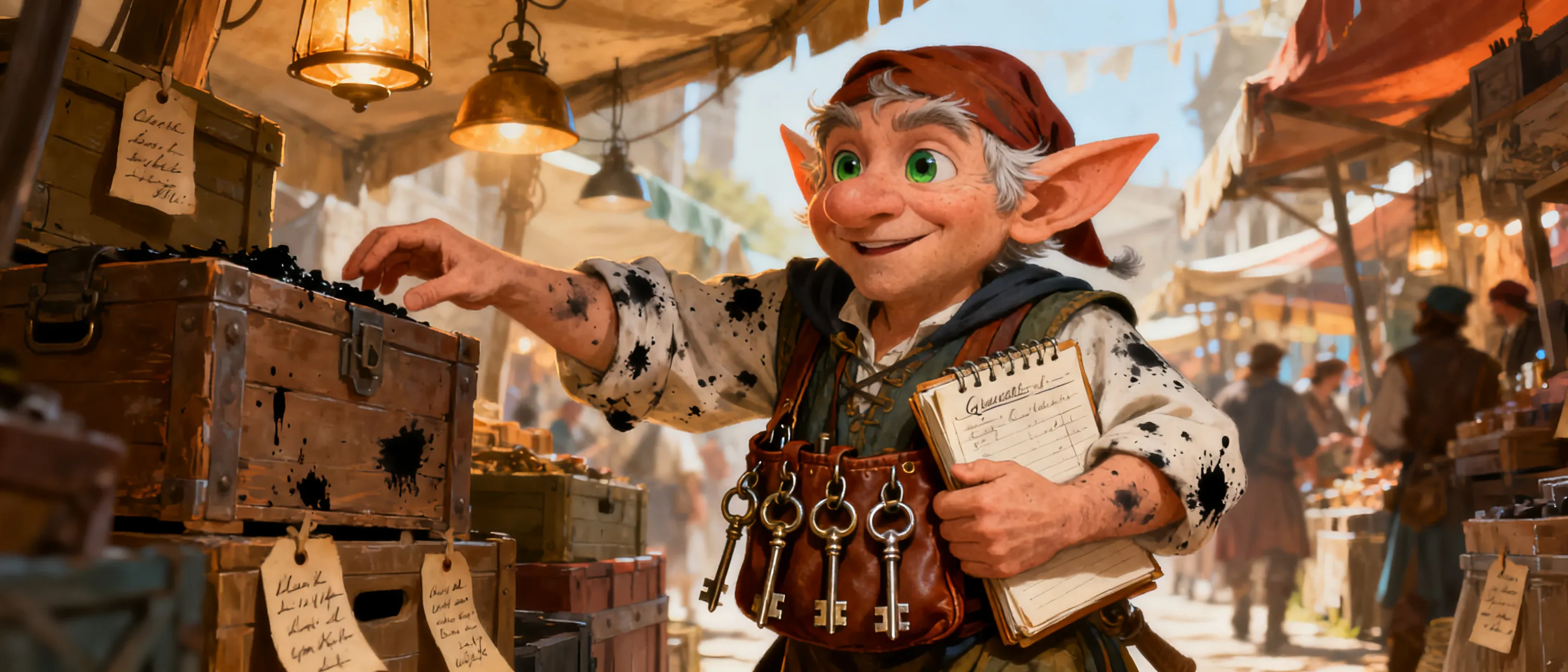
Pip Whistlewick was born into the hum of the bazaar, where the day’s rhythm was measured by bell tones, rolling carts, and the scratch of pens on receipt paper. He learned early that in a place like the Bazaar of Misplaced Things, the difference between a safe afternoon and a disaster often came down to whether someone remembered the third key, the spare chain, or the exact stall where the lamp oil had been stored the week before. His parents were not famous merchants; they were repair-minded workers who believed in two things above all else: useful tools and legible records. From them, Pip inherited a love of order, a habit of checking every latch twice, and the belief that being useful was a moral obligation, not a personality trait.
As a child, Pip was small even by gnome standards and always seemed to be in the wrong place at the wrong time, which is to say the exact place where a problem was about to happen. He got in the way of a runaway cart, and by grabbing its brake chain he prevented a spill that would have ruined half a lane of goods. He got trapped inside a mislabeled cupboard and spent two hours sorting inventory tags by feel until he found the release latch. He once discovered that a “discounted” lantern was whispering warnings in a code only the kobold runners understood, and that incident taught him the most important lesson of his early life: the market was full of people who noticed different things, and survival depended on listening to all of them.
That lesson shaped his adult work. Pip became a quartermaster because he was good at thinking in routes, contingencies, and spare capacity. He was never the loudest voice in the room, but he became the one people sought out when a shipment vanished, a lock jammed, or a vendor needed someone who would not lie to them about the size of the problem. He earned the trust of both the Gnome Depot and the Kobold Swap Meet, though the trust was always conditional. Gnomes appreciated his repair-minded pragmatism. Kobolds respected that he kept receipts, honored boundaries, and did not talk down to tunnel workers. He built his reputation the hard way, by being the person who showed up with the right key and the right answer.
The trouble began when the market’s missing stock stopped looking like ordinary theft. Goods were not just disappearing; they were being rerouted with uncanny precision. Labels changed. Inventory lines got rewritten. Black iron tags began appearing on items that should never have left quarantine. Panic buying spread because merchants no longer trusted their own ledgers. Pip recognized the signs quickly, but he also recognized something far more alarming: one of the tally-kobolds had started making tiny, frightened corrections to the books. Pip suspected blackmail almost immediately. He did not suspect treason. He suspected pressure, leverage, and fear. That distinction matters to him, because Pip’s first instinct is to protect people before correcting systems.
This is what makes him valuable as a quest giver and market liaison. He is not asking the party to solve a mystery for abstract reasons. He is asking because the market is beginning to eat itself, and he can feel the gears slipping. He is also asking because he is afraid that his own authority is part of the problem. If his keys are being copied, if his approvals are being forged, if his routes are being used to hide sabotage, then his competence has become a weapon in someone else’s hands. That realization has shaken him more than he would ever admit aloud.
Still, Pip remains hopeful in a stubborn, almost embarrassing way. He believes the market can be repaired. He believes the gnomes and kobolds can keep working together. He even believes the truth can be handled, if it is presented with enough care and enough context. His bonds are built around those beliefs: loyalty to the workers who keep the aisles functioning, responsibility to the market as a living system, and a private affection for every person who has ever trusted him with a sealed crate or a dangerous secret. His flaw is that he thinks he can manage every consequence if he just stays organized enough. The campaign will challenge that belief repeatedly, forcing him to accept that some problems cannot be filed away, only faced.
In a long campaign, Pip’s story is one of learning where duty ends and courage begins. He starts as a man carrying too many keys and not enough certainty. Over time, he can become something rarer: a leader who tells the truth, shares the load, and opens the right doors at the right time, even when he is afraid of what is waiting beyond them.