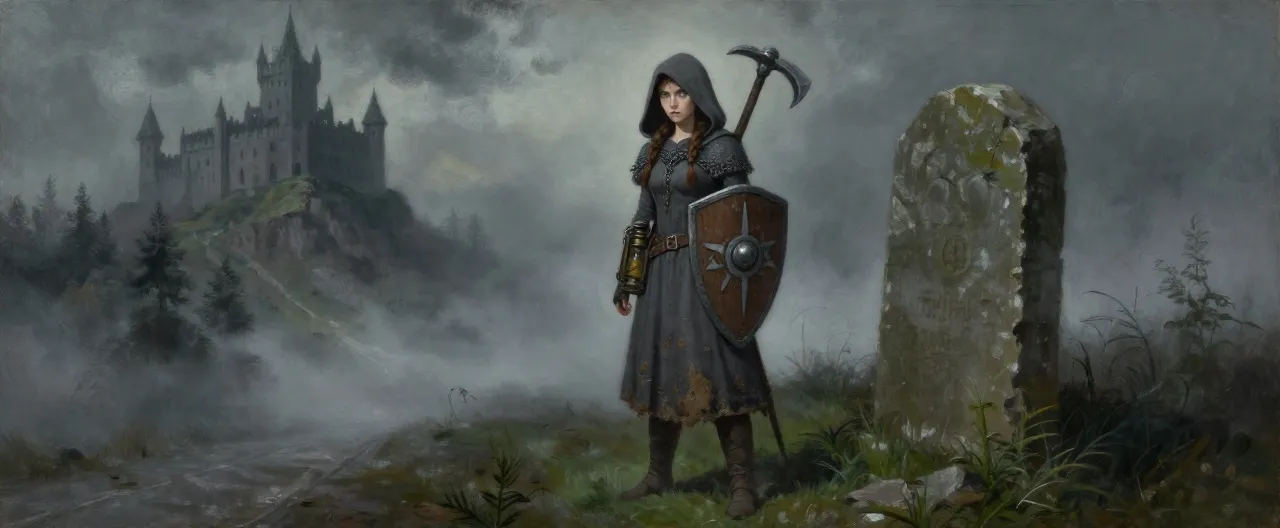
Martha Hale was born in a river town on the Moonshae-adjacent trade routes of the Sword Coast, the fourth child of a cooper and a laundress, and the only one who did not die young. Fever took two brothers before she could walk; a fever nearly took her at six. Her mother, a devout follower of Kelemvor, made a bargain of the sort the Lord of the Dead respects: if the girl lived, she would serve the dead. Martha grew up half-believing the fever had left a claim on her.
At fourteen she was apprenticed to the Mortuary Temple of Kelemvor in a larger city upriver — a gray-stone house where the dying were tended, the dead were prepared, and the grieving were fed. Kelemvor's faith is practical and unsentimental: death is fair, death is honest, and no one — rich or poor, kind or cruel — escapes it. The priests taught her to wash bodies, close eyes, keep records, sit vigils, and speak the Lament for the Dead without a shaking voice.
They also taught her that the worst heresy is not necromancy but indifference: the cleric who stops seeing each corpse as a person. She watched it happen to a senior priest, Father Aldous, who after thirty years of plague work began referring to the dead as 'stock.' He was not cruel. He was just finished. Martha has never forgiven the gods for letting that happen to a good man, and she has never stopped checking herself for the same rot.
She took her vows at twenty-two and was sent out as a lay rector — a traveling death-tender for communities too small to keep their own priest. She walked the coast roads for five years: burying shipwreck sailors, sitting with plague houses, arbitrating inheritance disputes with a ledger and a level voice, and learning Dwarvish from a clan of stonemasons whose elders she tended through their last winters. She learned that most people do not fear death; they fear dying alone, and being forgotten. Her work was mostly about remembering.
Her order kept loose ties with other lawful faiths and occasionally crossed paths with the Order of the Gauntlet on campaign roads, where she patched soldiers the battle-priests had written off. She learned that a mace and a shield are sometimes the only funeral rite you can offer — keeping the living alive long enough to die old.
Then came the road through the mountains, a shortcut a caravan master swore by, and the fog. It rolled in between one bend and the next, thick and silent and wrong, and when it thinned, the road behind her was gone and the pines ahead were strangers. Martha does not know what god or devil moved her — Kelemvor teaches that fate is a ledger, and something in this valley has been running up debts.
She found a dying man against a milestone with a crossbow bolt in his back, and everything in her training said the same thing: this one is yours now. Sit with him. Hear his last words. Take up his errand.
The letter in his satchel begs for help against a devil haunting a burgomaster's house. Martha has buried enough victims of monsters to know the shape of what's coming, and enough faith to walk toward it anyway. In Barovia, where the church bells ring for a Morninglord and the dead do not always rest, a priest of the Lord of the Dead may be exactly what the valley is owed.