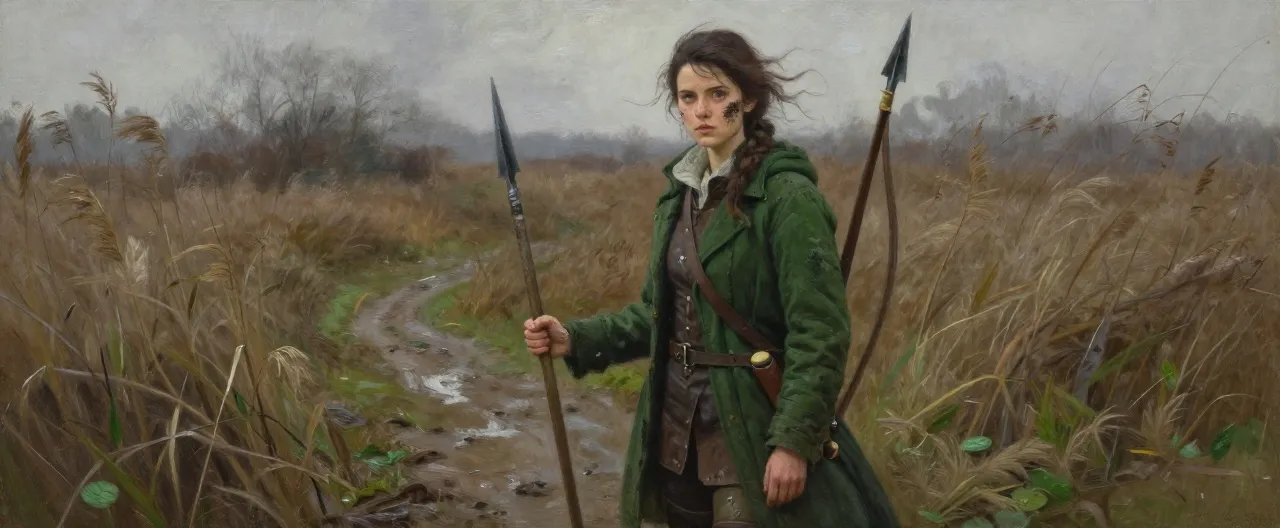
Kate Turner was born in a reed-cutter's hovel on the western edge of Lowland Fen, the third of five children and the only one who stayed past her sixteenth winter. Her father cut reeds the way his father had, working the flooded beds with a boar spear slung across his back — not for boar, mostly, but because the fen has wolves and worse things, and a reed-cutter alone in the deep beds is meat.
He taught her the trade the fen teaches everything: read the water, read the mist, read the mud, and never assume the path you used yesterday is still there. Her mother sold cut reed to the thatchers at Four Corners and traded eel for salt, and both parents taught her the arithmetic of survival — every arrow spent is an arrow you must fletch, every word spoken is a word you might owe.
Her father died three winters back, drowned in a channel that shifted overnight where the old maps said it was solid ground. The fen folk burned a lamp for him at the fen edge and went back to work the next morning, because that is what the fen does with grief: it buries it in wet ground and keeps cutting. Kate took his spear and did the same. She made her own short bow from fen ash, fletched her own arrows, and taught herself to shoot at reed-wrens and the occasional marsh beast until she could put a shaft through a moving target at forty paces without wasting a second one.
A hedge-priestess of Chauntea wintered in the fen two years ago, an old woman of the Earthmother's faith who traded healing for firewood. Kate watched her work and learned what she could — a touch of the goddess's green magic, enough to knit a wound or read tomorrow's weather in the mist. She is no devotee, but she leaves a coin on the standing stone at Milestone like everyone else, and she does not mock those who pray. The fen is too big and too old to be casual about such things.
Three days ago, everything changed. Fen wolves came bold out of the east — not hunting the way fen wolves hunt, but pushed, driven, herded toward the village of Milestone like a weapon someone was testing. Kate knows every path through this fen, and that knowledge told her immediately that those wolves were not from here. She did what her father would have done: she took up the spear, found the trail, and followed it.
For three days she has been tracking a band of fen toughs — hired muscle moving west along the Old Coast Road, men with a wagon, men who answered to a soft-handed priest with a brass censer. She has watched them camp, counted their fires, marked their habits the hard way, and learned their route better than they know it themselves.
Then, this morning, the trail doubled back on her. The toughs turned around, and now they are behind her instead of ahead, and the wolves they pushed west are circling toward Milestone. She met the party in the first fight against those wolves, and whatever she thinks of soft-handed strangers — and she thinks little of them until proven useful — she knows three things worth more than trust: the wolves were pushed, the pushers are paid, and the paymaster is heading east along the Old Coast Road with a wagon and a brass pot.
She has been living on smoked eel and rainwater for three days, she has not slept properly since the trail turned, and she is running low on arrows. She will say all of this in under a minute, without a single wasted word, and then she will ask what the party intends to do about it — because the fen is hers, the trail is hers, and she does not intend to lose it twice.