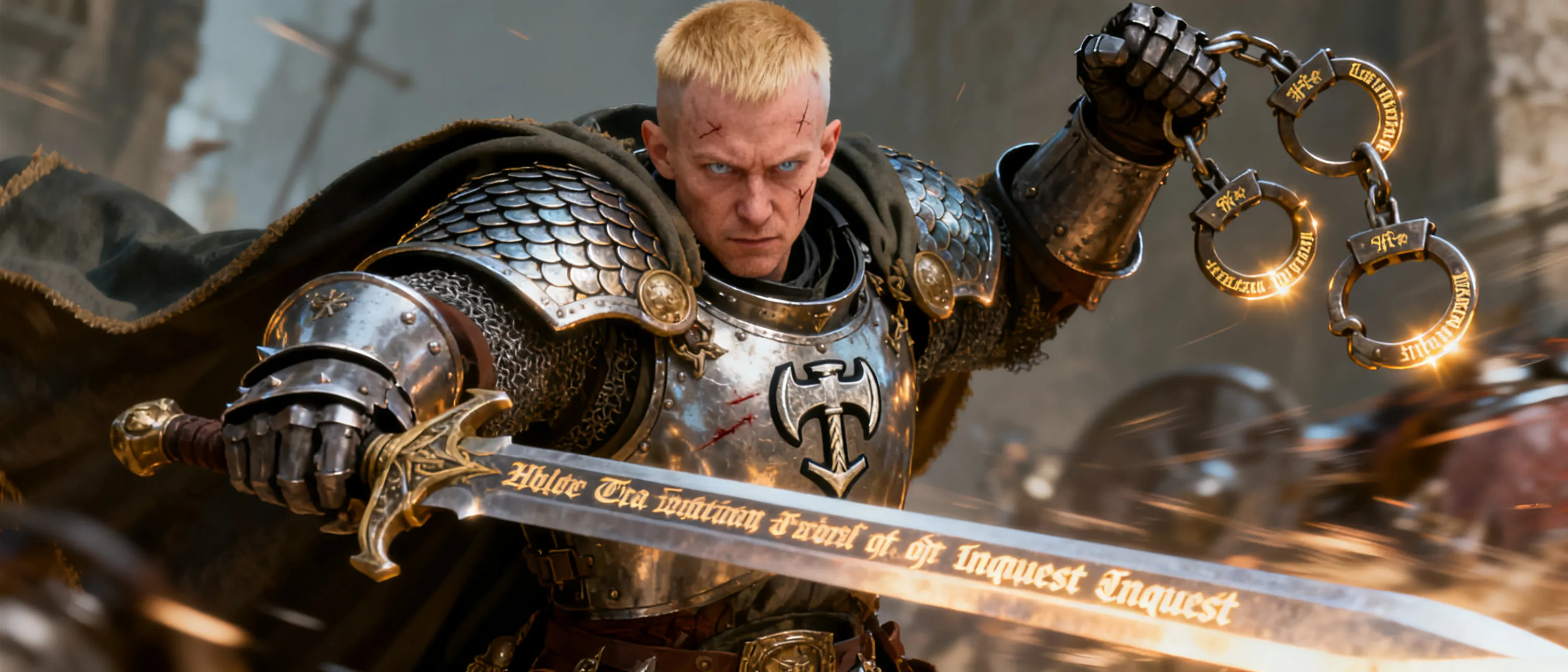
Rochus Keitel was born the third son of a minor noble house in Amn, a family whose fortune rested on trade monopolies, mercenary contracts, and an unbroken record of choosing the winning side of every political conflict. As a child he was sickly, small for his age, and overshadowed by two robust elder brothers who tormented him with the casual cruelty of boys who know their parents prefer the strong.
His father, Lord Aldemar Keitel, valued appearances above affection, and Rochus learned early that love in his house was a currency spent on usefulness. He learned to be useful — quiet, precise, watchful. While his brothers trained with sword and lance, Rochus memorized genealogies, ledgers, and scripture, discovering in the temple's teachings a framework that explained his suffering: the world was fallen, people were weak, and order was a sacred duty.
At fourteen he was sent to a monastic academy, where an Inquisitor of the war-god Tyr noticed the boy's cold precision and recruited him into the Inquest, a fanatical sect claiming the god's authority to root out arcane corruption. Rochus took to the work with unsettling aptitude. His first trial was the interrogation of a village cunning-woman accused of blighting crops; she was almost certainly innocent, and he knew it, but he extracted a confession anyway, because his superiors required one and because some part of him relished the power.
The woman burned. Rochus recorded the details in a ledger he has kept ever since. He tells himself the doctrine demands such sacrifice; the truth is that the doctrine gives him permission. Over the next fifteen years he rose through the Inquest's ranks, earning a reputation as a hunter who never abandoned a trail. He tracked renegade battle-mages across borders, dismantled a hedge-coven in the foothills, and once spent eight months infiltrating a merchant guild to expose a single court wizard.
His methods are procedural and merciless: he files warrants, gathers testimony, isolates targets from their allies, and then closes the trap with legalistic finality. He does not torture in rage — he does it in silence, with notes. His misanthropy has calcified into doctrine: he avoids crowds, dines alone, and speaks of 'the herd' with clinical disdain. His family, embarrassed by his fanaticism, has quietly distanced itself, which suits him; he considers them corrupt like everyone else, merely better at hiding it.
Now in his early thirties, Rochus carries a longsword blessed in the Inquest's rites and a set of manacles he has never once had to replace. He serves Tyr as he understands him — not as a god of justice, but of judgment, and judgment, in Rochus's theology, is indistinguishable from fear. He is hunting still, and the ledger grows longer every year.