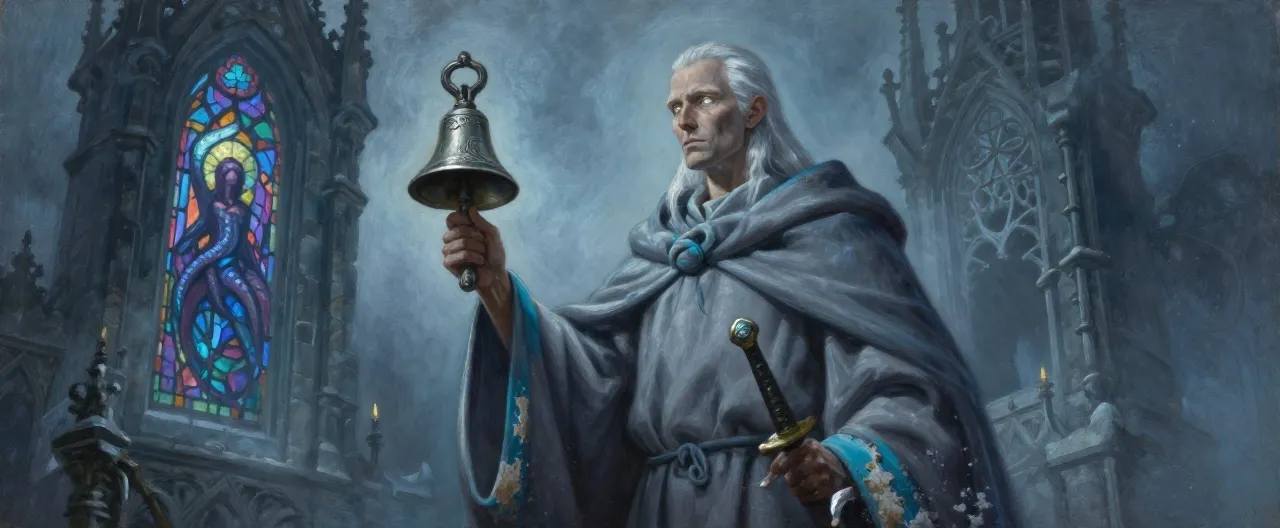
Malachar was born in Fogmoor fifty-eight years ago, a fisherman's son, one of twins. He and his brother Merrick were inseparable until the summer they turned nine, when, on a dare among the shallows, Malachar held his brother under the water to see how long he could go — and panicked, and let go too late. The village called it an accident; the sea took many children. But Malachar never forgave himself, and Fogmoor never quite forgot the way he stopped speaking for a year afterward.
He was sent to the seminary at Saltmere as much for his silence as for his piety, and there he met Aldric, a boy who talked enough for both of them. They studied together, prayed together, and when Malachar returned to Fogmoor as its deacon at twenty-two, Aldric followed. For twenty years Malachar was a genuinely good priest — he buried the drowned, comforted the widowed, rebuilt the church after the storm of his fortieth year. He was beloved, quiet, and hollow, carrying Merrick's death like a stone in his chest.
The change came at forty-six. Merrick began appearing in his dreams — not as a boy, but as a grey figure standing in a black pool, ringed by tentacles, beckoning. The dreams became instructions. Malachar, half mad with guilt and half desperate with hope that his brother's spirit might still be reached, followed them to the Sunken Maw, where he found the black pool and heard, for the first time, the voice he would spend the rest of his life serving.
He believed it was the Drowned God, ancient and hungry, and that Merrick was its herald. He believed, and still believes, that the voice promised to spare Fogmoor if the town gave it tithes of souls. It was, in truth, the Drowned King — a far older and vaster thing in a distant sea — and it found in Malachar's guilt a hook that has never slipped free.
He founded the Choir of the Deep within the year. Sister Vaela was his first true convert, a woman who had drowned her own children and needed a theology that could hold her; others followed, the grieving and the desperate. He learned that the well could be salted with sedatives to keep the town docile, that the bell — recovered from the crypt of the old church, its original purpose long forgotten — could toll warnings and signals through the fog, and that a minor demon of the deep shadows, drawn by the rituals' residue, would bargain. He thought he was negotiating from strength. He was not.
Now, at fifty-eight, Malachar stands at the height of his power and the edge of his ruin. The disappearances accelerate with each new moon because the demon's tithe grows; the Drowned King's whispers increasingly speak to Vaela and the monks instead of him; and the ledger of names he keeps in the bell tower — every soul he has given, annotated with the 'signs' he saw before each taking — has grown heavier than any scripture.
He has begun copying the demon's demands in secret, telling himself it is devotion, knowing it is evidence. He dreams of Merrick more often now, and the dreams have changed: his brother no longer beckons. He watches, and waits, and his drowned eyes seem, lately, to be full of pity.
Malachar's tragedy is that his delusion is functional. Fogmoor is quieter, more obedient, and — by his arithmetic — safer than it would be without him. He has an answer for every atrocity, and the answer is always the same soft word: necessary. The party's arrival, the ledger's missing page, and the truth of the Drowned King's manipulation are the three forces converging on him, and which breaks first — his faith, his body, or his silence — will decide whether Fogmoor gets a martyr, a monster, or a penitent.