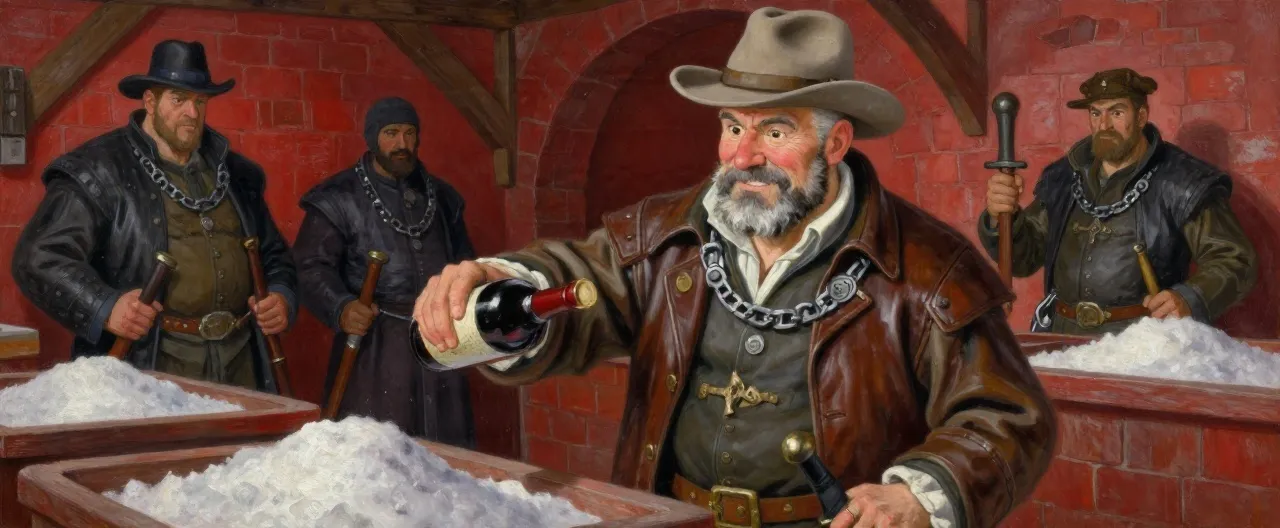
Gresh Kettle was born in a Saltport salt pan, the son of an indentured salt-harvester whose name exists in exactly one document: a factor's contract of indenture, held for forty years by the man who worked her to death. He was six when the factor's ledger recorded his mother as 'written off — grain spoiled, salt burned', and he remembers that phrase. He has spent the forty years since making sure no one ever looks at him the way they looked at her — and he built the Kettle Chain to do it.
He started as a runner for the old Chain-Master, a man named Hobbs, tallying captives at a smaller market upriver. Gresh was good at it. He remembered names, faces, prices; he could charm a warden, calm a captive, and explain a price to a buyer without either realizing they had been managed. Hobbs died — badly, the way the badlands kill men who get rich slowly — and Gresh took the Chain at thirty, rebuilt it, and gave it his name.
Under Kettle the Chain became a business instead of a gang: tally-sticks stamped with a sun-disc, wardens on the payroll from Valleyford to Eastwatch, a harbormaster in his pocket, and a rule he has never broken — never sell a captive the Choir has marked. The rule is not mercy. It is arithmetic. The Chain that sells the Choir's marked ones first becomes the Choir's vendor; the Chain that keeps the marked ones out of the market stays a vendor and not a victim, and Gresh has spent twenty years on the narrow ledge between those two words.
The Choir's contract pays double, and Gresh keeps it for two reasons: the money, and the fear. He met Ottiline Marsh once, twenty years ago, and she walked the cages at his elbow in her warm nurse's voice, explaining the arithmetic of blood and mercy, and showed him what the forge's bleeding left of the ones who were 'not sound'. He understood in one hour that the Kettle Chain was not her supplier but her stockyard, and that he was alive because he was useful.
He has been useful ever since, and he keeps a copied ledger page — naming the Almonry, Castillo, Deacon A. Warren as buyer — as the single piece of insurance he holds against the day the arithmetic ends with him in a cage.
He is careful, and the carefulness is the cruelty: villages pay in wool and grain to be spared, and it works until it does not; collectors carry nets and cold-iron shackles and tally-sticks; the Chain Market runs every nine days under Saltport's arcades with the harbormaster blind and the buyers bidding. Gresh never fights alone and never fights fair — two toughs within arm's reach, a thrown net, a shouted order, captives as cover, the market crowd as a shield.
When cornered he offers everything he owns, and he means it, and he will try to buy his way free again at the first opportunity. He wants to die rich and respected: a title, a house inside the walls of Castillo, a seat at the table. He wants, above all, to be remembered as a Kettle who was never owned. And in the last weeks of the story, in Nell Draper's soup kitchen and the arcade afterward and the second ledger he begins in his own hand, he comes closer to that than any title or house could ever bring him — though whether he knows it, or can bear it, is the question the road to Castillo finally puts to the Chain-Master at the burning of his own market.