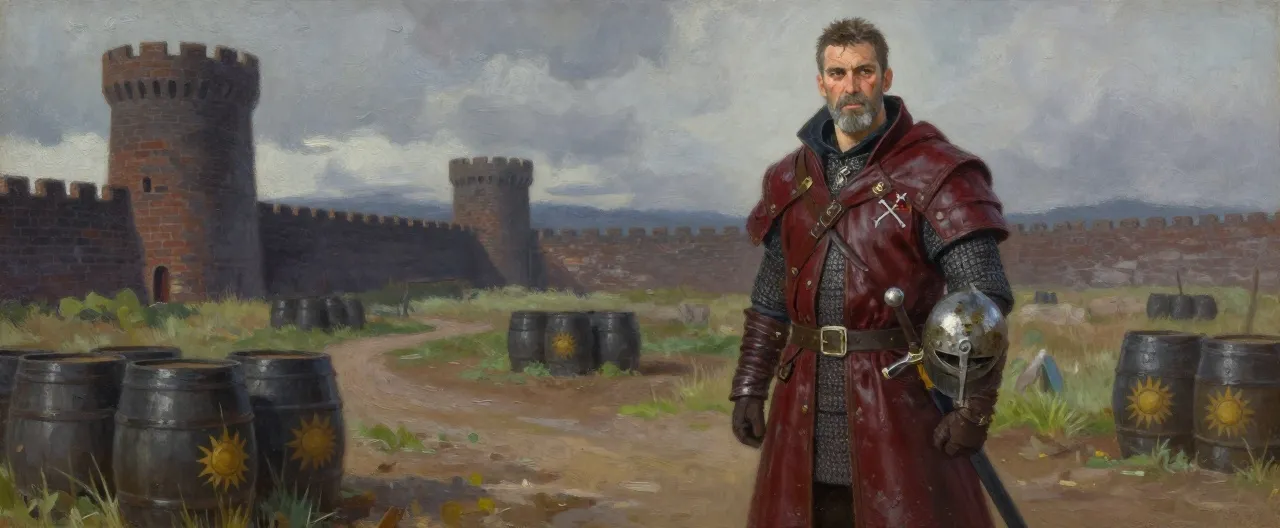
Karl Westbrook was born in the river country, third son of a miller with no land to leave him, and took the king's — then the Order's, then nobody's — coin at sixteen. He served nine winters on the Verge wall under a captain named Harrow, who taught him drill, ledgers, and the creed he still repeats: walls, wells and honest ledgers are the only three things worth defending. Harrow also taught him, without meaning to, the other lesson of his life — that the man who teaches you everything can be the man who sells everything, because Harrow had been selling the wall's watch schedule to the Chain for a decade when the court-martial finally came.
Westbrook was the one who found the tally-sticks. He was also the one who burned them, because Harrow had a family and the Chain's retaliation was certain, and he has spent the thirty years since telling himself that was mercy rather than cowardice. He does not believe it on bad nights.
Eastwatch was his reward for keeping quiet. A dark brick hillfort on the last ridge before the Broad Marsh, built to hold a road and never quite managing it, with a caravan yard, a customs shed, and a garrison of two dozen spears. For its first eight years the Order of the Lamp paid honestly, and Westbrook rebuilt the towers, deepened the well, and made the customs ledger the cleanest document between the Verge and Castillo.
Then the payments stopped — not cut, just stopped, the way a river stops — and Westbrook learned that a holy city's money can reroute itself through an Almonry without anyone lying out loud. He stayed. He always stays. That is the whole of his character.
What followed were three years of slow compromise he can recite like a confession. The caravan tolls could not cover payroll. The Covenant sent wool and grain, not coin. And then a factor nobody would name began sending a purse, monthly and punctual, through accounts Westbrook could trace with one hand tied — and traced them, and took the money, and told himself that a paid garrison holds a wall better than an honest one that has deserted.
Two of his senior sergeants, Dara Vane chief among them, are on the same purse. Vane believes he is feeding men who would otherwise starve. Westbrook cannot prove him wrong, and that is the thing that has put the short chain on his temper: rage needs certainty, and Westbrook has none.
His private discipline is his ledger — a second book, in Dwarvish cipher, recording every barrel, every seal, every palm he has watched take silver with his eyes open. He tells himself it is a case file. He knows it might be a coward's confession. The daughter he adores, Bess, sleeps behind the fort wall in a tower whose weaknesses Vane could recite, and Westbrook checks her window bar himself every night, which is either devotion or dread, depending on the hour.
Into this equilibrium walk the party, carrying a tally-book that names the buyer, and asking to open barrels stamped DYE. Westbrook's choice at the yard — back his sergeants or back his own nose — is the hinge his remaining story swings on. If he backs them, he spends the campaign a compromised man protecting a rot he cannot name. If he backs the party, he loses half his payroll, gains a garrison that is truly his, and discovers the thing he has been for eleven years without the paperwork to prove it: a captain.
He rides to Northwatch on a word, breaks the Red Vigil under his own banner, and stands at the High Altar at dawn with a wall of candle-flame between a woman in red and a thousand pilgrims — a badlands man with no standing in any Basilica, speaking for the road. Walls, wells, honest ledgers. He has defended two of the three all his life. The campaign is the third.