The Assessor (Corin Vell)

Level 3 — Human Rogue (Thief)

Available with DM subscription
Register to save this character forever!

This character will be deleted in 6 days. Create a free account to claim all your generated content.

STR
8 (-1)
DEX
16 (+3)
CON
13 (+1)
INT
15 (+2)
WIS
12 (+1)
CHA
10

Defense

Armor Class 14 (Leather armor (11 + DEX +3))
Hit Points 21 (3d8 + 9 (8+3, +5, +5) at level 3; 15 HP triggers the smoke-charge escape (¼ HP threshold) at CR 3 tuning. +1)
Speed 30 ft., swim 15 ft., climb 15 ft.

Proficiencies & Skills

Saving Throws Dexterity, Intelligence
Skills History +4, Insight +3, Stealth +5, Deception +2, Acrobatics +5, Perception +3, Persuasion +2, Intimidation +2, Investigation +6, Sleight of hand +7

Features

Environmental Trialcraft (Villain Feature)

Custom — villain trait Level 3
At will within his own workshop

Within the Weighing House (or any room he built), the Assessor can, as part of his move, pull a marked chain, shatter a lamp niche, or drop a stair-gate. Shattering a lamp creates a 10-foot-radius sphere of dim, oil-slicked light; creatures in it have disadvantage on Perception checks and the floor is difficult terrain (DC 12 Dexterity (Acrobatics) to cross without falling prone). Dropping the flooded stair-gate creates a 15-foot drop into water. He knows these DCs because he built them.

State the Rule (Villain Feature)

Custom — villain trait Level 3
Once per scene

The Assessor opens every encounter by stating the rule of the room and naming the timer. Any creature that hears the full statement must succeed on a DC 13 Wisdom saving throw or have disadvantage on its first attack roll or ability check against the Assessor (he has not yet become an enemy to them). A creature that succeeds is immune for 24 hours. This feature is not mind control — it is the uncanny authority of a man who is certain he is right.

Smoke Charge (Villain Feature)

Custom — villain escape trait Level 3
1 per encounter

When reduced to 15 hit points or fewer (a quarter of his maximum), the Assessor uses his reaction to shatter a smoke charge at his feet, creating a heavily obscured 20-foot-radius sphere for 1 round. He immediately takes the Disengage action (or Cunning Action Disengage on his next turn) and flees through the undercroft, deliberately leaving the ledger page behind.

The Ledger Case (Villain Feature)

Custom — villain equipment trait Level 3

The locked case under his hand is trapped with a lamp-oil charge (DC 14 Dexterity (Sleight of Hand) to open safely, DC 13 Intelligence (Arcana) to disarm; on a failure it ignites, dealing 2d6 fire damage in a 10-foot radius, DC 13 Dexterity save for half). While the case is within 5 feet of him, he cannot be Frightened: the ledger is his spine.

Skulker (Origin Feat)

Human (species feat) Level 1

He can try to Hide as a Bonus Action when lightly obscured or obscured by a creature at least one size larger; missing with a ranged attack doesn't reveal his position; dim light doesn't impose disadvantage on Perception checks relying on sight. The grey mask and the lamp-shadowed hall are his natural habitat.

Fast Hands

Rogue (Thief) Level 3
At will (Bonus Action)

As a Bonus Action, he can make a Dexterity (Sleight of Hand) check, use Thieves' Tools to pick a lock or disarm a trap, or take the Use an Object action. He uses this to pull chains, open sluice gates, and trigger his clockwork timers mid-combat without ever stopping moving.

Sneak Attack (2d6)

Rogue Level 1
Once per turn, when he has advantage or an ally adjacent to the target

The Assessor deals an extra 2d6 damage once per turn when he hits with a finesse or ranged weapon and has advantage on the roll, or when a willing ally of the target is within 5 feet of it. He does not need advantage if no other enemy is within 5 feet of him.

Steady Aim

Rogue Level 1
Bonus Action; can't move this turn; 3/Long Rest

As a Bonus Action, he gains advantage on his next attack roll this turn if he hasn't moved. He uses this from behind his desk, from the top of the undercroft stair, or through the shuttered window at the Drowned Mill.

Alert (Origin Feat)

Criminal (background feat) Level 1

He adds his Proficiency Bonus to Initiative (+4 total) and can swap Initiative with a willing ally. The Assessor is never caught off guard in his own house; he nearly always acts first.

Cunning Action

Rogue Level 2
At will (Bonus Action)

He can take the Dash, Disengage, or Hide action as a Bonus Action on each of his turns. This is the mechanical heart of his escape plan: he Disengages the moment the trial is broken.

Second-Story Work

Rogue (Thief) Level 3
Passive / 1 per turn

He gains a climb speed equal to his walk speed, and can jump 10 feet farther as part of a move. He built his trials knowing every ledge, stair and chute of them.

Behind the character

Character Information

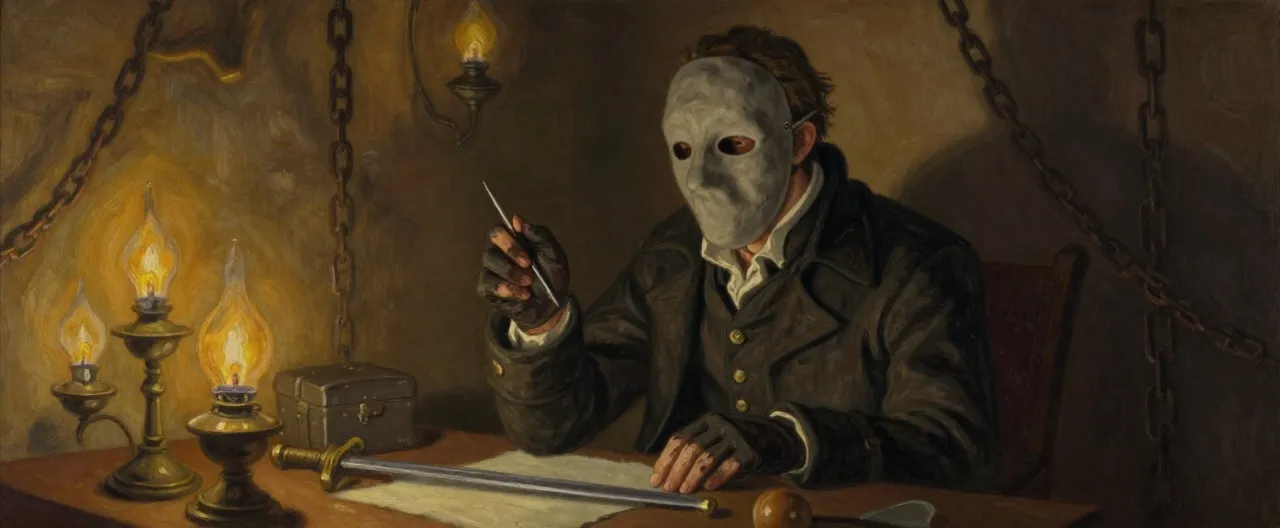
The Assessor is a tall, thin man whose presence is built entirely of stillness and precision. He wears a plain grey linen mask with two eye slits, a clerk's dark waxed coat, fingerless gloves, and a steel stylus tucked behind one ear; his hands are permanently ink-stained. He sits behind a raised writing desk in a hall lit by a hundred small oil lamps, a locked iron case under his left palm and a shortsword sheathed flat beneath the desk where a constable would hang a cudgel. Around him, hanging chains divide the lamplight into cells.

He is calm, courteous, almost gentle. He speaks in short, measured, clinical sentences and never raises his voice. He asks questions and waits for answers. He does not gloat and does not taunt; he is genuinely interested in what people choose, and he is never angry when they choose badly — only disappointed, and then he writes it down. He believes most people squander the life they were given, and that a person only becomes real when forced to choose between their own survival and someone else's. He does not think of himself as a killer. He thinks of himself as a clerk.

Beneath the mask is Corin Vell, a fen-born former tithe-clerk who lost his family in the flood three winters ago and decided the fen owed him a reckoning. His certainty is his armor and his wound at once: the ledger case under his hand is his spine, and he cannot be frightened while it is near him. He is patient the way water is patient, and he has already decided how everyone in the room will be remembered.

Before the adventure

Character Background

Corin Vell was born on the peat margins south of Millford, the son of an eel-fisher and a reed-cutter, and was taken into the tithe-clerk's service at fourteen because he could write a fair hand and never miscounted. For eleven years he kept Millford's accounts of who owed whom — lamp-oil tithes, peat levies, causeway tolls — and he was good at it in the way that quiet, precise men are good at small power: he knew every family's weakness and wrote it down without judgment, because judgment was not the clerk's business. Arithmetic was.

Three winters ago the flood came. The sluice gates upstream opened in the night and the low fields drowned, including the cottage where Corin's wife and daughter slept. The town called it weather. The tithe-barn records called it a bad year. Corin, pulling bodies from the reeds and copying the flood-year accounts afterward, noticed that the ruined families' debts had been quietly marked uncollectable weeks before the water came — someone had known.

He reported it to his superior and was told, in a letter already burned around the edges, that the fen owed a reckoning and that a man who could keep accounts could keep a different kind. He said yes. He tells himself he said yes for his family. He is no longer sure.

For two years he has worked the Sallow Fen as the Auditor's hand: choosing targets from Millford's own debt records, building trials in the sealed cellar, the drowned mill, and finally the Weighing House — a tithe barn he refitted over a flooded undercroft far older than anything the fen-folk built. He leaves unlit clay lanterns as his signature and warning. He has weighed forty-one people and recorded forty-one choices, and he believes, with a clerk's conviction, that he is sorting the worthy from the wasteful.

He is not. He is a grieving man who has turned his worst night into a profession, and the ledger he keeps is not the Auditor's instrument — it is his own funeral record, written one name at a time.

He reports weekly by letter and burns the replies. He has never met his master. He has never sat in one of his own trials. And in the margin of his ledger, beside six names that belong to no one in the fen, a single word is written twice: Auditor.
Threads to follow

Unresolved Plots

  • The undercroft beneath the Weighing House is older than the tithe barn above it, cut with scale-marks and tally-marks no fen-folk made — and Corin has never investigated who built it, because the Auditor told him not to ask.
  • Sella's stolen instruction packet names a child two days east of the fen as the Auditor's next target, and the weekly letter is due — if Corin does not report, the Auditor sends someone else.
  • Constable Vane's name sits on the second line of the ledger page, and Vane has read it and said nothing — Corin does not know Vane knows, and Vane does not know Corin doesn't.
  • The flood-year tithe-book's burned page listed Corin's wife as marked before the sluices opened — meaning either the Auditor ordered her death, or someone forged Corin's hand to make him think so.
  • Tibbs was marked with a clay lantern three weeks ago and then spared — the only child ever marked and unmarked, and Corin cannot remember making that decision.

Beneath the surface

Secrets

  • Corin transcribed the order that opened the upstream sluice gates three winters ago. He believes he was copying routine drainage instructions. He has never been able to prove whether that is true, and the not-knowing is the wound under everything.
  • The Auditor has never met Corin in person. Every instruction arrives as a letter that is already burned around the edges when Corin opens it. Corin does not know who — or what — is writing them, and is afraid to find out.
  • Corin keeps a second, private ledger — one page, hidden in the desk grate — listing the forty-one people he has weighed and, beside each name, the choice they made written in a single word. Beside his wife's name, the word is blank. He has never been able to write it.

What haunts them

Fears

  • That the flood that took his family was his own fault — that his handwriting opened the sluices — and that everything he has built since is a man trying to drown his guilt in other people's choices.
  • That the Auditor is not a person. The burned letters, the impossible reach, the names supplied before the debts exist — Corin is beginning to suspect he serves something that does not keep accounts. It keeps appetites.
  • That he is wrong. That the trials prove nothing, that the worthy and the wasteful are the same people on different nights, and that forty-one names in a ledger are forty-one murders he committed while calling them arithmetic.

What drives them

Aspirations

  • To finish the fen — to weigh every marked name in Millford's debt book and close the ledger, at which point he believes the Auditor will release him and he can finally stop.
  • To be weighed himself. He has never once sat in one of his own trials, and he cannot admit, even to himself, that what he wants is not to sort others but to be told, by someone, that his own worst hour was survivable.
  • To find who wrote his wife's name in the burned margin — and, if it was his own hand, to put a name to the thing that made him write it.

Personal quest · 1

The Drowned Tithe-Book

Corin Vell's original tithe-book, containing the true flood-year accounts of Millford, lies in a sealed strongbox in the drowned tithe barn's lower vault — the one place he has never been able to return since the flood. He offers the party passage through his traps if they retrieve it unopened. Inside are records proving which families were deliberately ruined before the sluices opened, including his own.

Current Stage

The party locates the sunken vault beneath the old tithe barn and negotiates the flooded approach.

Choice
Open the strongbox before delivering it, or honor the agreement to carry it sealed.
Opening it reveals the ruined families' names — including three still living in Millford.
Mechanical Rewards
  • The Assessor's clockwork timer designs (party can jam any of his timers with a DC 12 check thereafter)
  • +1 reputation with the Weighing House faction if turned
Narrative Rewards
  • Corin's account of the flood night
  • A glimpse of the man beneath the mask

Personal quest · 2

The Sixth Runner

Corin employs six fen-runners, but one — Sella — has gone silent for nine days, taking with her a sealed instruction packet meant for a target outside the fen. Corin cannot report the loss to the Auditor without admitting failure, and the packet's contents would compromise the entire operation. He needs it recovered quietly, before the weekly letter is due.

Current Stage

The party traces Sella's last known route along the southern causeway, finding abandoned ferry points and a cold camp.

Choice
Pursue Sella openly or send word through Tibbs's rooftop network that she is being hunted.
Sella has read the packet and learned the Auditor's next target is a child.
Mechanical Rewards
  • Safe-conduct token bypassing the Weighing House outer traps
  • Sella as a future informant on Auditor operations
Narrative Rewards
  • Proof the Auditor's reach extends beyond the fen
  • Corin's grudging respect

Personal quest · 3

One Hundred Lamps, One Name

Corin has weighed forty-one people and recorded forty-one choices. But one entry in his ledger is blank: a fisherman named Aldous Mere, who was taken, placed in a trial, and released without a recorded choice — the only person ever to walk out of the Weighing House unweighed. Corin cannot close the entry until he knows what Aldous chose, and the not-knowing has begun to unravel his certainty that every person can be sorted.

Current Stage

The party finds Aldous Mere living under a false name in a peat-cutter's camp three miles north, hollow-eyed and unwilling to speak of the trial.

Choice
Bring Aldous back to the Weighing House, or tell Corin Aldous is dead.
Aldous refused to choose at all — he simply sat down and waited for the water, and the timer jammed. The trial broke itself.
Mechanical Rewards
  • Knowledge that trials can be broken by refusal (party may attempt a DC 15 Charisma (Persuasion) to stall any trial one round)
  • Corin's blank ledger page as evidence against the Auditor
Narrative Rewards
  • The first true crack in the Assessor's philosophy
  • Aldous's testimony

Major Decision

Context

At the Weighing House finale, the party presents Corin with his own logic turned against him: that a clerk who sorts people by their worst hour has never once been weighed himself.

Choice Made
Corin must decide whether to answer the argument or silence it — he can concede one round of hesitation (allowing the party to reach the desk), or double down and fight to kill rather than be argued with.
Impact

Conceding costs him the trial but preserves the ledger and his chance to name the Auditor. Fighting destroys his composure: he loses State the Rule for the rest of the encounter but gains an extra attack as desperation takes over. The party's success or failure in the argument determines whether Act II opens with a name or a corpse.

Major Decision

Context

Corin discovers the Auditor's latest instruction names a child as the next target — a direct violation of his one unbreakable personal rule.

Choice Made
Obey the order and preserve his position, protection, and purpose, or quietly falsify the ledger entry and hide the child's name, committing his first act of deliberate disobedience.
Impact

Obeying grants him a permanent boon from the Auditor (a sealed writ that makes him untouchable to fen authorities — mechanical immunity to being reported or tracked through Millford) but hardens him irredeemably. Falsifying costs him the Auditor's protection (his smoke-charge escape route is compromised — the undercroft exit is watched) but plants the seed of his eventual turn in a later act.

Major Decision

Context

When defeated or cornered, Corin holds the complete ledger — every name, every choice, every verdict — over the lamp-oil charge in his case. Burning it protects the Auditor; surrendering it protects the people named in it, including Constable Vane.

Choice Made
Corin must choose in a single round whether to ignite the case or slide it across the desk.
Impact

Burning destroys the evidence trail to the Auditor permanently (the party loses the six names and the margin word — Act II's direction must be found another way) and Corin escapes with a permanent scar from the oil charge (−1 to his maximum hit points forever). Surrendering gives the party the full ledger and Vane's name, but Corin is captured or killed, and the Auditor marks Corin's own family for weighing in retribution — a thread that surfaces in Act II.

Transformative Moment

Trigger

Reading the drowned tithe-book and finding his own transcription of the sluice order

Transformation

Corin realizes he may have been the Auditor's pen before he was ever its mask — the flood he mourns may carry his own handwriting.

Mechanical Changes

State the Rule

Save DC drops from 13 to 11 as his certainty fractures

His authority was never his own

Transformative Moment

Trigger

Aldous Mere's refusal — a choice Corin cannot weigh, sort, or record

Transformation

The blank ledger entry becomes an obsession. Corin begins leaving one lamp unlit in every trial he builds afterward — an unconscious warning, a flaw in his own design.

Mechanical Changes

Environmental Trialcraft

One lamp niche in every room he builds is now deliberately faulty — a hidden escape seam the party can find with DC 14 Investigation

His subconscious is sabotaging his own trials

Transformative Moment

Trigger

Being unmasked before the party and hearing his own name spoken — Corin Vell, not the Assessor

Transformation

The mask was the last thing the flood left him. Without it he is a fen-born clerk with ink-stained hands and a dead family, and for the first time in three years he can be spoken to as a man rather than a function.

Mechanical Changes

Smoke Charge escape

If unmasked before he drops below quarter HP, he no longer uses the smoke charge — he stands and takes the hit, once

The man who wanted to be weighed finally stops running

Ally

Fenn, the Town Clerk

Relationship Unwitting informant
Influence 3/10
Loyalty 6/10

Shared History

Fenn does not know he serves the Assessor; he believes he is selling copied debt pages to a 'fen-trader' for two silver a sheet, a little crime he commits to pay his mother's medicine. Corin identified him within a week of arriving — a clerk in debt is the easiest door in any town — and has cultivated him with the same patience he applies to everything: small purchases, regular meetings at the shrine's back wall, never a face shown, never a name given.

Over eight months Fenn has sold him the whole of Millford's debt book twice, and Corin has rewarded him with quiet anonymous gifts — coins left in his desk, a doctor's fee paid — that Fenn attributes to luck or the saints. Fenn is the only thread connecting Corin to Millford's records, and Corin protects him the way a clerk protects a good pen: carefully, and without affection. If Fenn is discovered, Corin will burn him in the ledger without hesitation and consider it arithmetic.

Potential Breaking Points

  • If the party turns Fenn informant, Corin's supply of names dries up within days
  • Fenn can identify the fen-runner drop point if shown the brass wick-holder

Enemy

Sister Olen

Threat Level 4/10
Conflict Type Ideological and evidentiary

Personal Stakes

Olen is the only person in the fen who knows Corin's name, given to her by a dying fen-runner she could not save, and she is the only person who has systematically undone his work — buying back eleven clay lanterns, hiding them beneath the shrine floor, and quietly warning every family she can. Corin has never touched her, because marking a priest of the fen saints would bring outside eyes, and because — though he would never admit it — her lantern scar interests him.

She bears a burn from a clay lantern that was lit rather than left unlit, from an earlier trial, and she has spent two years learning what he is. Their war is conducted entirely in symbols: lanterns bought and hidden against lanterns left on doorsteps, confessions heard against names written down. Corin considers her the single flaw in an otherwise balanced ledger, and Olen considers him a man who has mistaken a wound for a philosophy. She will trade his name for proof the party can stop him, and she has been waiting two years for someone worth telling.

Possible Resolutions

  • The party can broker a confrontation between them — Olen will read the ledger aloud to Corin herself if given the chance
  • Corin can be pushed to silence her, which would shatter his no-children, no-priests rule and begin his real downfall

Faction

The Fen-Runners

Standing -2/10

Influence

Corin does not lead the fen-runners; he buys them, six at a time, and has done for two years — first through intermediaries, then directly, always masked, always through the clay lantern left as payment-token on a runner's own doorstep, which none of them have ever refused twice. The runners know him only as the quiet man who pays in silver and promises, who never shows his face, and whose jobs always involve a boat, a barrel of lamp oil, and a sleeping person who does not wake on the journey.

Bran, Tibbs's older brother, was recruited with the promise that his family would be spared — a promise Corin made in the Auditor's name and does not control. The runners' loyalty is to the pay and the fear in equal measure, and it is thinning: Sella has vanished with a sealed packet, the cellar job went wrong, and two runners saw Tibbs watching from a rooftop. Corin knows the network is fraying. He is already drafting the ledger entries for the runners who fail.

Obligations

  • Corin owes the runners' silence, paid weekly
  • The runners owe him abductions, ferrying, and the lamp-oil barrels that feed the hundred lamps

Benefits

  • A ready abduction and transport network across the fen
  • Eyes on every causeway and a warning system no constable can penetrate

Ready to Unleash Your Character's Full Potential?

Join thousands of players and create rich, detailed character backgrounds with Fable Fiesta!

Register to unlock personal quests, relationships, and narrative hooks!

Sign Up Now - It's Free!

No credit card required. Start creating in minutes!