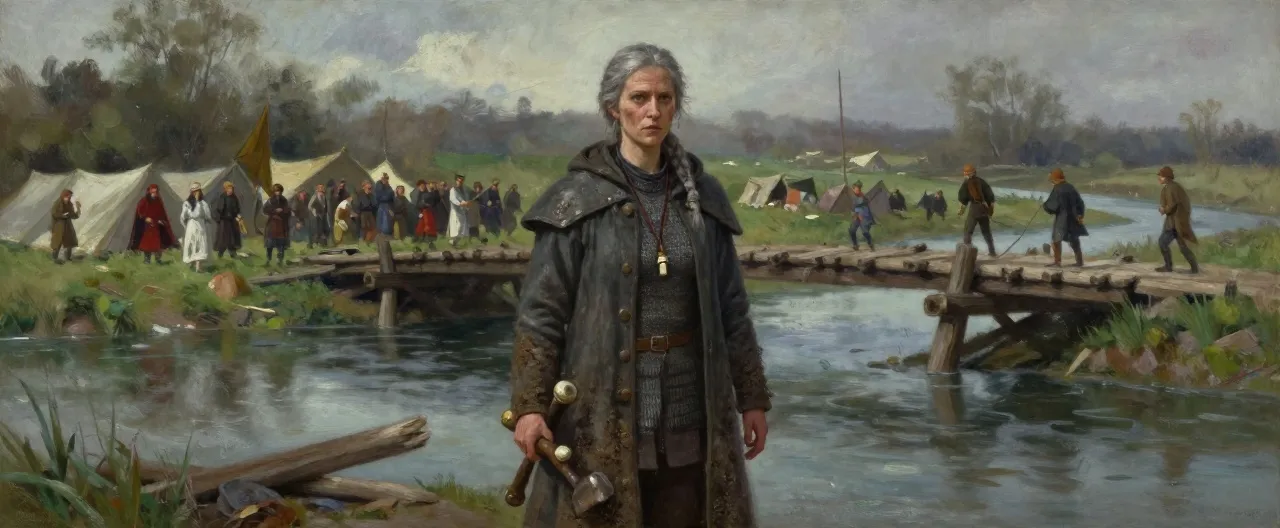
Laura Briarwood was born in a waystation town on the southern pilgrim road, the daughter of a farrier and a toll-keeper, and she grew up counting: carts, coins, heads, days between wagons. At eighteen she took the Lantern Watch's coin and served six years on the road detachments — escort work, waystation garrison, the unglamorous business of keeping pilgrims alive between villages. She was good at it in the way that matters: she learned every water hole, every blind bend, every place a press-gang likes to wait, and she learned to count a pilgrim train the way a shepherd counts sheep, by name.
She left the Watch's direct service twelve years ago, after the night that defines her: a double shift at a southern waystation, a nap she swore was only minutes, and a Ledger press-gang that took a family of four from the pilgrims sheltering there. She filed the report herself. A Watch captain marked it 'regrettable, not culpable' and the family's names went into a cabinet. Laura took the Northbridge wardenship the following spring and has carried an unsigned Watch commission in her coat pocket ever since — a promise she has never felt entitled to make.
Nine years as bridge-warden made her the fixed point of Northbridge's life. She settled disputes at the ford, kept the toll-house honest, walked the span twice a day in every weather, and learned the town the way she learned pilgrim trains: by name. The temple of Waukeen blessed her whistle; the drovers' Compact signalled her from the bank; Agnes Rook poured her a cup every evening and counted crossings with her every morning.
It was, by the standards of the badlands, a good posting — until eleven days ago, when the center span was cut clean as a joiner's work, from below, by three men in a flat-bottomed boat with ash on their sleeves.
Since then she has been holding a town together with a whistle and a cudgel. A hundred pilgrims stranded on the south bank. A ferryman profiting from the cut. A toll-house tripling its rates. Two pilgrims drowned at the ford. Forty-one townsfolk gone over two years and told, by the Choir's forgeries, that they emigrated. Laura has arrested what she could prove, counted what she could not, and slept in her coat in the toll-house with the whistle in her hand.
She has worked out most of the truth on her own — that the cut was deliberate, that Simon Petty ferried the saboteurs, that the ford racket and the bridge are one operation — but proof is another matter, and she is one woman.
What she needs is hands. What she offers is the thing she has never used: a Watch commission, worn soft at the folds, that makes whoever she deputises lawful on the pilgrim road. She will give it to the party within an hour of meeting them if they are worth it, because she has done the arithmetic and the arithmetic says she cannot do this alone — and because some part of her has been waiting two years for a reason to hand the commission to someone she believes in.
Her fears are specific: another Aldermark, a town that breaks from the inside, an institution not worth her oath. Her aspirations are specific too: a rebuilt span walked at dawn, the Aldermark names said out loud on the record, and a Northbridge that does not need her. She fights like a warden, not a soldier — cudgel, shield, commanding voice, positioning her people where they hold — and she will follow the party to Castillo if they earn it, because the road that took her family runs to the same place, and she has twelve years of unfinished business at the end of it.