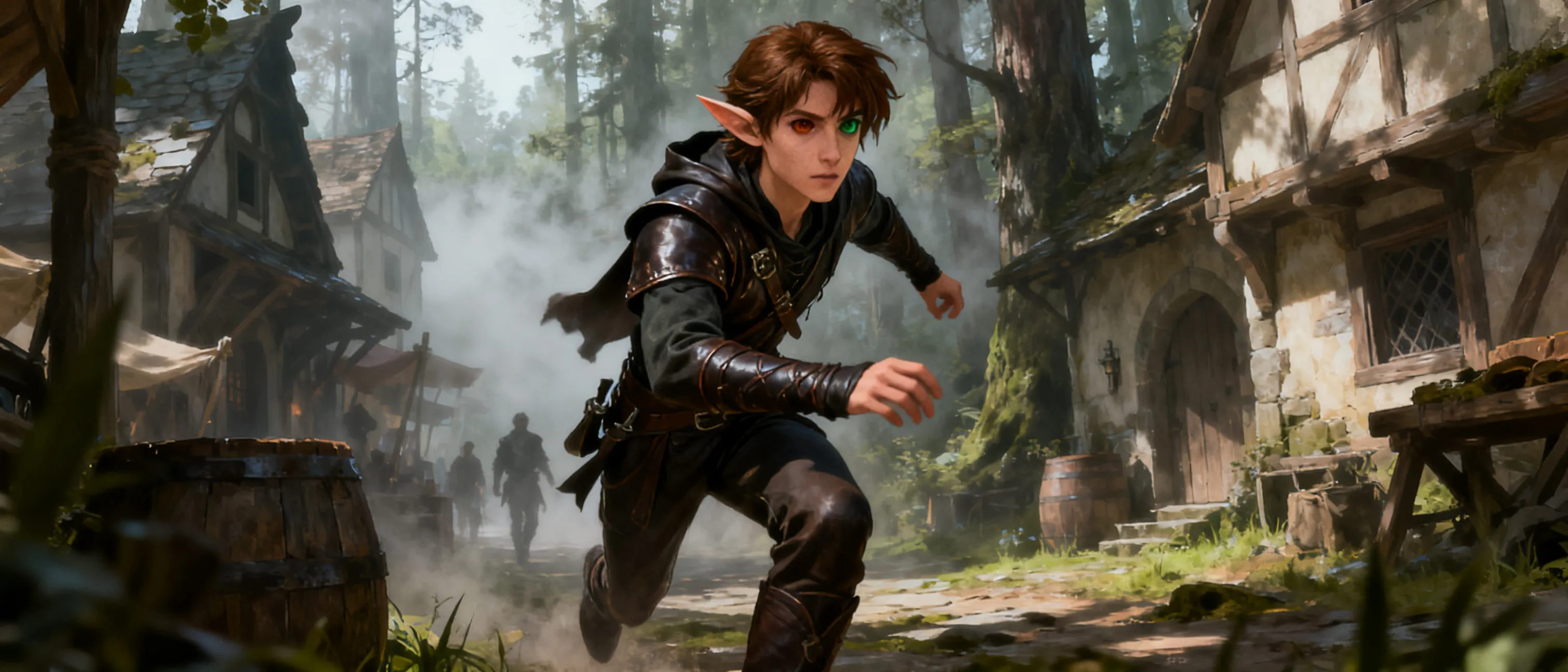
Character Background
Therion Vale was born on the edge of two traditions and grew up hearing both of them in the same house. His father, a practical human laborer and occasional courier, believed in hard work, straight answers, and never owing anyone more than necessary. His mother, a wood elf with a patient gaze and a gift for noticing what others missed, believed in restraint, memory, and the long consequences of small choices. Their home was modest but warm, filled with old herbs drying near the rafters, half-repaired tools, and the quiet rhythm of two people who had learned to love without needing a crowd to witness it.
Therion was the older child, and from an early age he was the one who followed his mother into the trees and his father into town. His mother taught him how to walk without snapping branches, how to look for what was absent as often as for what was present, and how to listen before he spoke. His father taught him practical lessons: how to tie a knot that would hold, how to spot a bad deal, how to keep his temper when the world was unfair. Those lessons took root in him deeply. Even before tragedy, Therion was becoming a boy who watched first and acted later.
His younger brother, Albion, arrived later and changed everything. Therion remembers the first time he held him—tiny, red-faced, loud, and somehow already important. Therion was old enough to understand responsibility, and young enough to be scared of it. He became protective in the instinctive way older siblings do, but with the steady discipline of someone who genuinely believed the world could be made safer by effort. Albion followed him everywhere, and Therion did not mind. He liked being admired. He liked being needed.
That fragile stability ended when Therion was still young. Both parents died, leaving the brothers to relatives and temporary arrangements that never felt like home. The details of the loss still sit in Therion like a splinter he cannot pull free. He became the one who negotiated, lied, borrowed, stole, and worked whatever jobs he could find. Hunger was a better teacher than comfort. It taught him to take risks, to keep his expression calm, and to put Albion’s needs ahead of his own every single time.
The criminal organization found him in that vulnerable stretch. At first they offered money for courier work and quiet deliveries. Then came thefts, surveillance, and messages passed through hidden hands. Therion proved good at it—too good, perhaps. He could move through crowded rooms without drawing attention, read tension in a room before anyone spoke, and remember faces with unsettling accuracy. The organization noticed. They began giving him assignments that were harder to explain and easier to deny. He learned to break into places, to slip away after the deed was done, and to keep his mouth shut when he returned.
Eventually, their interest turned clinical. The experiments were justified to him as an improvement, a means to make him faster, quieter, more obedient, more valuable. Pain followed. So did strange lapses in sleep, moments where his heart seemed to steady unnaturally, and an awareness of danger that felt sharpened beyond reason. He survived the procedures because survival was the one thing he would not surrender. If they wanted a weapon, they would have to keep him alive to use it. That knowledge gave him a cold sort of power, even when he had none.
Therion’s current life is a double bind. To the organization, he is useful because he can carry out assassinations and tasks that would ruin more visible agents. To himself, he is only buying time. Every coin he earns goes toward Albion—food, medicine, clothing, rent, and the small comforts that make a life feel human. He keeps Albion away from the organization as much as possible, making excuses, changing routes, and watching for anyone who asks too many questions. He never fully relaxes, because he knows how quickly people disappear when they are convenient to sacrifice.
His personality is a knot of contradictions. He is careful but not meek, loyal but not trusting, and more compassionate than his reputation suggests. He dislikes unnecessary cruelty and has a particular hatred for those who prey on the helpless. He lies easily, but he prefers the truth when it can be safely spoken. He is fond of small routines: sharpening blades, counting coin, checking locks, and making sure Albion has eaten. He tends to stand with one shoulder turned toward exits, a habit he cannot quite shake.
Therion’s bonds are simple and absolute: Albion first, then survival, then whatever remains of his own soul. His ideals are equally straightforward. Family matters more than institutions. Safety matters more than pride. A person can be redeemed by what they protect, even if the methods they use are ugly. His flaws, however, are equally clear. He is secretive to the point of isolation, overprotective to the point of recklessness, and willing to shoulder guilt that should not belong to him. He measures his worth by how much suffering he can absorb without letting it touch Albion.
In the end, Therion is a man trying to outlive the worst thing that ever happened to him. He is not seeking glory, and he does not dream of greatness. He wants one honest life for his brother, one safe door to lock at night, and one future where his hands are used for something other than murder. Whether he ever reaches that future depends on how long he can keep walking the line between the criminal world that owns his skills and the family that still owns his heart.