Character Background
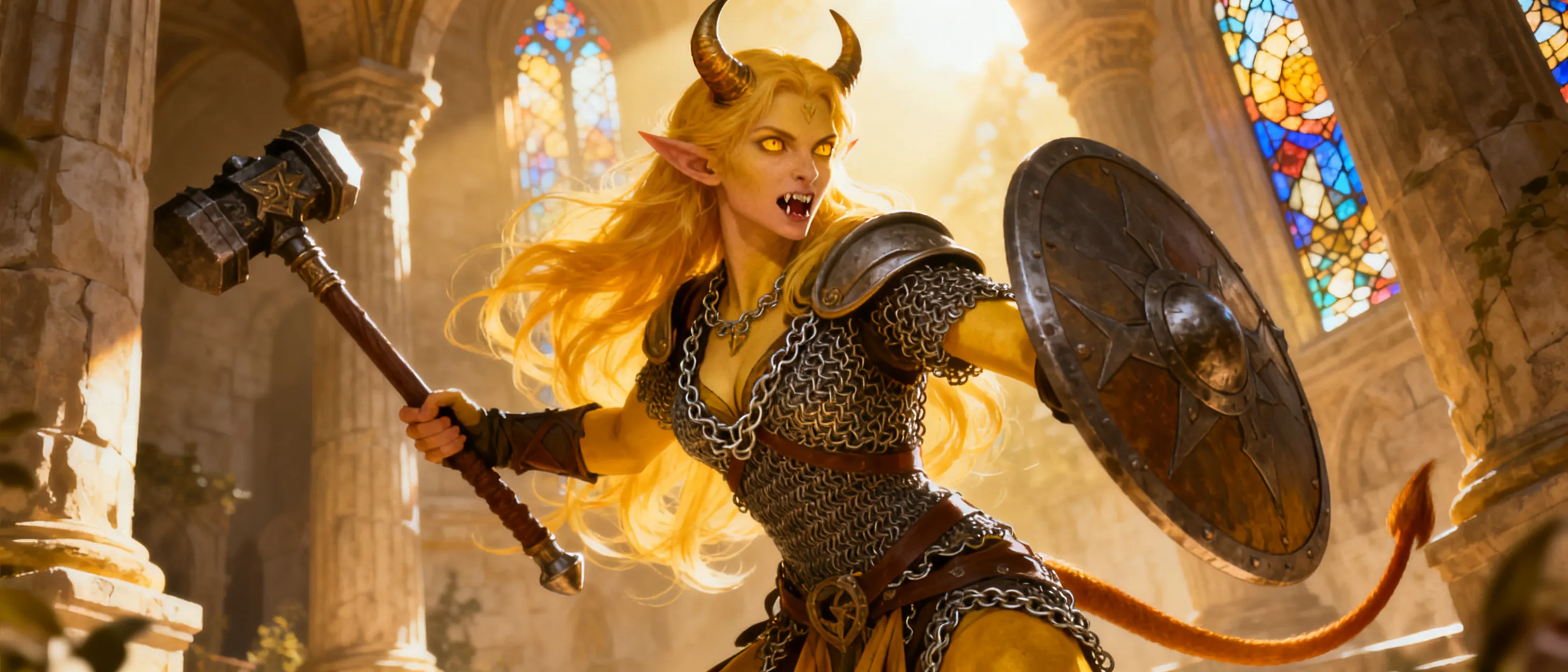
Seraphae Dawnfire was born under complicated omens. The midwife who delivered her later swore the candles in the room burned taller the moment the child drew her first breath. Her mother, a humble temple attendant, took that as a sign of divine testing rather than doom. Her father, however, was another matter. He was charming, learned, and possessed of a smile that seemed too sharp to belong to any mortal man. In the years that followed, Seraphae came to understand that her father was bound to infernal pride, and that his legacy in her blood was not merely symbolic. He visited rarely, but when he did, he brought with him a sense of pressure and expectation that made the air feel too tight to breathe.
Her mother raised her in a temple devoted to Lathander, where the faithful believed that every day was a chance for redemption. That belief saved Seraphae more than once. As a child she was curious, serious, and unusually sensitive to the moods of adults. She noticed quickly that people treated her differently from other children. Some avoided her because of her horns and tail. Others tried too hard to be kind, as if being gentle toward a tiefling would prove something about their own virtue. Seraphae learned early that love could be sincere, pity could be humiliating, and fear could wear the mask of caution.
She found refuge in the temple’s routines. She liked the order of dawn prayers, the warmth of incense, the clean polish of brass, and the certainty that the sun would rise no matter how badly the night had gone. The priests taught her to read sacred texts, copy prayers, and maintain the temple’s records. She also learned practical acts of service: binding wounds, brewing soothing draughts, and tending the sick after festival crowds or winter illness. She was not the most beloved child in the temple, but she was useful, attentive, and difficult to intimidate.
As she grew older, the tension between her bloodline and her faith became more pronounced. Her father’s influence surfaced in moments of anger, especially when someone mocked her appearance or called her “devil-blood” as if it were an accusation instead of ancestry. She discovered that she had a frightening talent for standing very still and saying exactly the wrong thing with perfect calm. That skill could have turned her bitter, but her devotion to Lathander gave her a different path. She began to see that goodness was not the absence of darkness; it was the repeated decision to step toward light anyway.
Her temple still does not fully trust her. Some of the older clergy consider her presence a test for the faithful. A few would prefer she serve out of sight, hidden behind the shelves or in the infirmary where strangers rarely ask questions. Seraphae has endured this with a quiet dignity that many mistake for submission. In truth, it is discipline. She knows that open conflict would only confirm the worst assumptions of those around her. So she smiles, prays, studies, and serves with patience sharp enough to cut.
She has few friends, but the ones she does have are fiercely valued. One is a grave-robed archivist who taught her how to navigate gossip without drowning in it. Another is an old gardener who never once asked why her skin glowed so warmly in the morning sun. These rare friendships taught her that trust need not be blind; it can be built from repeated acts of care.
Seraphae’s motivations are shaped by that history. She wants to prove that a tiefling can be a true servant of dawn, not because she needs to erase what she is, but because she refuses to let evil define her. She wants to protect the vulnerable, especially those who are judged for how they look or where they were born. She wants, in her heart of hearts, to confront her father someday and tell him that his blood did not win. The better part of her did.
Her ideals are simple and difficult: mercy should be active, justice should be tempered with wisdom, and no soul is too stained to seek renewal. Her bond is to the temple that sheltered her, even when it hesitated to do so fully. Her flaw is that she trusts slowly and forgives herself even more slowly. When she feels rejected, the old infernal whisper still tempts her toward coldness, pride, and the fantasy of hurting others before they can hurt her. That whisper has not won. Not yet.
At level 1, Seraphae stands at the beginning of her calling, armored in chain and faith, with a mace at her side and a shield ready to deflect more than steel. She is not yet the great champion of dawn she hopes to become, but she is already something rarer: a person who has looked into the shadow of her own inheritance and still chosen to serve the light.