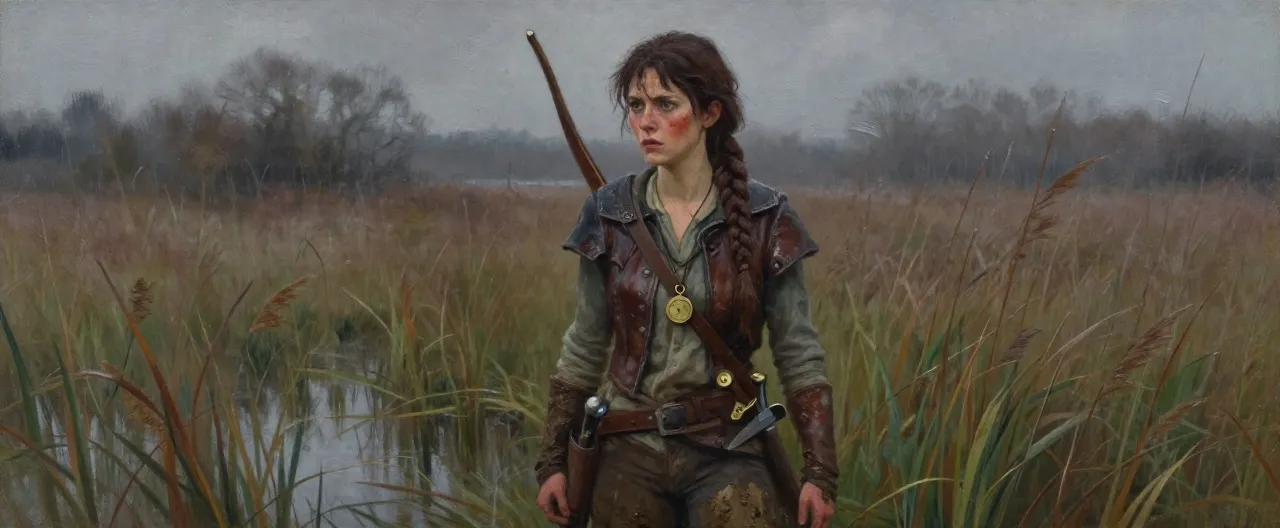
Klara Fen was born on the marsh edge of Fenwick, in a leaning timber house that flooded every spring and dried out every summer. Her father was a ferryman on the Redwater, a quiet man who could read water the way clerics read scripture, and her mother died of marsh fever when Klara was six. Her father raised her on the boat after that. By ten she could pole a flat-bottomed skiff through the reed beds blind; by twelve she could name every channel, every drowned willow, every patch of ground that would hold a cart's weight and every patch that would swallow it whole.
He drowned in the Redwater floods when she was fourteen — a bad spring, a loaded ferry, a channel that had shifted in the night. The town called it an accident. Klara has never fully believed that, and she has never said so out loud either.
She stayed on the marsh because the marsh was what she had. The eel-fishers and reed-cutters took her in the way marsh folk do — gruffly, without ceremony, trading meals for errands. An old herbalist woman down the eastern channels, a devotee of Eldath who kept a quiet shrine of still water and reeds among the willows, taught her the plants and the patience, and it was from her that Klara learned the handful of druidic craft she carries: the small prayers to bend weather, the goodberries that keep a cart crew fed through a wet night, the whispered guidance that has saved her neck more than once.
Klara doesn't think of herself as religious. She thinks of it as knowing who to ask. She has more time for Eldath's silence than for Waukeen's coin-counting, though she'd never say that loud in Fenwick's market square, where the salt trade is close to scripture.
At fourteen, the year her father drowned, she started guiding salt carts along the ford road — first as a runner, then as an outrider, riding ahead of the wagons to check the staked track through Owl Creek Marsh and put an arrow into anything that looked like trouble. She can track a loaded wagon through standing water and put a shaft through a reed stem at forty paces. Six years of it made her the best guide on the marsh and gave her a professional habit: she counts. Carts out, carts back, sacks loaded, sacks delivered. It was how her father kept his ferry honest, and she kept the habit after him.
Six weeks ago the numbers stopped making sense. Carts left Fenwick heavy and came back light. Weigh-house tallies said full loads; her own eyes said half. She started keeping a private tally — the brass counter at her throat, beads clicked for every discrepancy — and when she had six weeks of it, she took it to the weigh-house to be witnessed. Two days later, armed men she'd never seen before came asking after the girl who'd been counting.
She was in the marsh when they came to her house, which is the only reason she's alive. Now she moves between eel-fisher camps and the hollow willow, watching the cart track, waiting for the courier she's spotted riding south every third night, and trusting exactly nobody who wears a clean coat.
She met the party in the first fight — her arrows from the reeds, their blades in the mud — and decided in the space of ten words that they were worth the risk. She is not a joiner by nature, but the Quiet Auction took salt from her town and sleep from her neighbours, and Klara Fen keeps a ledger of debts too. The beads on her counter have stopped clicking. That means she's about to say something she means.