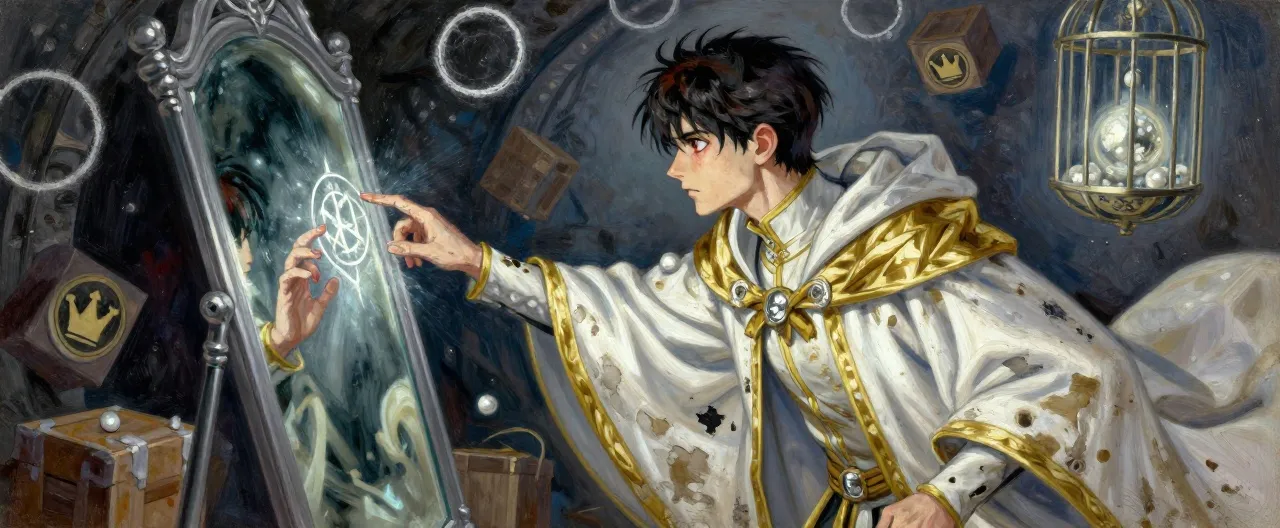
Corvin Thale was born in Lumenhal's lower terraces, the son of a lantern-glass blower and a scribe, in a household that valued steady work over brilliant promises. He showed early magical talent — precisely the wrong kind: an affinity for enchantment and charm, the subtle art of bending wills, which Edória's enchanters' guild regards with polite suspicion compared to the prestigious wards and evocations that light the city. He tested into the White Archive's apprentice program on sheer examination scores and spent six years there as a junior enchanter, maintaining reliquary wards, calibrating festival enchantments, and copying out sequences for apprentices whose noble surnames opened doors his talent could not.
The work was vital and invisible. Corvin knew the royal enchantment sequence — the private sigil chain that seals the reliquary — better than anyone except the Master of Wards, because he was the one who maintained it, night after night, while others took the credit. He watched lesser enchanters receive commendations from Princess Aelira's court for work he had quietly corrected. His resentment was not loud; it was corrosive, the slow kind that curdles precision into bitterness.
The debts began as an attempt to buy belonging. Corvin gambled — modestly at first, then desperately — trying to win enough platinum to patronize the right dinners, wear the right robes, be seen. Vaskel Morn, a moneylender with quiet undercity connections, advanced him four hundred platinum against his salary. When Corvin could not pay, Morn's collectors broke his workshop door and humiliated him before the Archive staff. The Master of Wards reprimanded him not for the gambling but for the noise. That night, a note appeared inside Corvin's locked spellbook: an offer, written in ink that shimmered like silver, signed with a hollow crown.
The Hollow Crown gave him three things: platinum that erased his debts, training in mirror-gate magic — forbidden, elegant, and entirely outside the Archive's curriculum — and, most intoxicating of all, attention. The voice on the other side of the silver called him 'the one who sees clearly.' Corvin told himself the pearl theft was an administrative transfer, a relic moved from one vault to a safer one. He prepared the ritual with the same meticulous care he had once given the reliquary wards, hired lookouts in the Lantern Market with stolen palace silver, and told himself that no one would be hurt.
Then the pearl was in his hands, warm and heavier than it should have been, and the mirror messages grew sharper, more demanding, and Corvin understood with dawning horror that he was not a partner in this conspiracy but an instrument of it — one that would be used and discarded. The Gilded Voice's true identity is withheld even from him. He knows only that the Hollow Crown is older than Edoría, that the pearl is one of seven keys to something called the Hollow Crown vault, and that the ritual mirror in the Sunken Vault bears engravings no living kingdom's script can claim.
Now Corvin hides in the half-flooded Sunken Vault beneath the Lantern Market, performing a ritual he no longer believes in, guarded by thugs he paid too much and a cultist he does not trust, watched by a spy he has secretly turned, and counting the hours until midnight — when the city's enchantments are weakest, the gate will open, and he will learn whether the Gilded Voice intends to reward him or erase him.
His only plans are escape plans. His only leverage is knowledge no one knows he has. And in every mirror he passes, his reflection lags a half-second behind — a detail he has told no one, because saying it aloud would make it real.