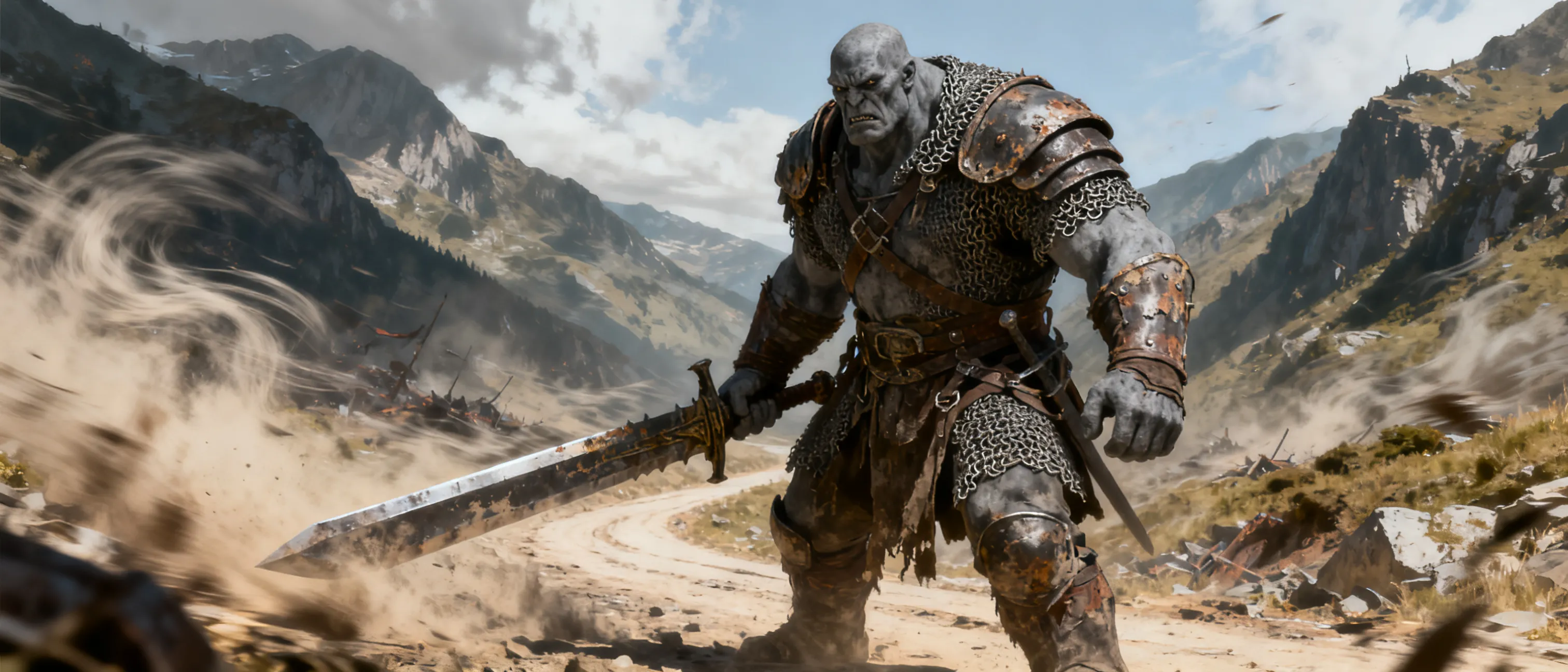
Character Background
Everest Stone was born high in the cold reaches of a mountain pass settlement, in a place where the weather was as unforgiving as the people and where every season demanded hard labor. His clan was not rich in the way lowland merchants measured wealth. They owned no sprawling halls, no treasure vaults, no songs that bards traveled leagues to sing. What they had was endurance. They knew how to cut stone, stack timber against winter winds, hunt when the herds grew scarce, and keep one another alive long enough to see spring. Everest grew up among those lessons, a broad-shouldered child with hands too large for ordinary tools and a temperament that was already suspicious of nonsense.
As a boy, he learned that being a goliath meant being noticed, whether he wanted it or not. The adults expected strength from him early, and when he did not yet have strength, they expected him to compensate with labor. By the time he was old enough to carry serious loads, he had already spent years hauling water, moving stone, repairing rope bridges, and helping elders who were too frail to do the heavy work themselves. He learned the shape of work before he learned the shape of dreams. He also learned that people were often kinder when they needed help than when they were simply comfortable.
The first time Everest was paid for his labor, he understood something important: coin was cleaner than gratitude. Gratitude faded. Promises drifted. A full purse, on the other hand, could be held in the hand, counted, hidden, or spent. He never became greedy exactly, but he became practical in a way that made others mistake him for indifferent. If a task required effort, he would do it. If that task paid, all the better. If it did not pay, he would still consider it, but only if the work was simple, immediate, and likely to keep him alive.
When Everest was young, a harsh winter closed the mountain paths and cut his settlement off from several expected trade routes. Food ran low. Tempers rose. That season taught him that survival could turn strangers into partners and neighbors into competitors with very little warning. A local caravan master hired Everest and a handful of others to escort goods over a dangerous ridge trail in exchange for grain, salt, and silver. The job was brutal, but it opened a door to a different life. Everest discovered that his size, steadiness, and willingness to get bruised made him useful beyond the quarry. Caravans, miners, foremen, gamblers, smugglers, and even traveling magistrates all had some use for a man who could lift, fight, threaten, or endure without asking too many questions.
He moved from one employ to another. Some jobs were honest. Some were not. He told himself that he did not care about the difference as long as the wages were fair and the victims, if there had to be any, were not children or the helpless. That line was never grand or noble, but it gave him enough of a conscience to sleep at night. He became a hired blade in the simplest sense: not a cutthroat, not a knight, not a zealot, just a man with a weapon and an agreement. Over time, he picked up the practical habits of a professional fighter. He learned to read the stance of a brawler before the first punch landed, to hold ground in armor, to conserve breath at altitude, and to strike only when an opening was worth the risk.
His goliath ancestry shaped him in quiet ways. Everest found that cold never quite bothered him the way it bothered others. He could sleep under harsher conditions, carry more than his frame suggested, and endure exertion that would leave smaller folk winded. More importantly, he inherited a certain mountain patience. Everest does not rush unless the situation demands it. When threatened, he can be shockingly sudden, moving with the force of an avalanche despite his broad, deliberate build. He has little use for games of status, but he understands physical presence as a language. People tend to listen when he speaks, and they listen faster when he stands up.
He ended up taking the Criminal background not because he thinks of himself as a villain, but because he has worked too many jobs at the edges of legality to pretend otherwise. He knows how to keep quiet, how to move where he should not, and how to deal with people who prefer secrecy to honesty. He has a few contacts in that world: a fence who once paid him in silver, a smuggler who respects his reliability, and an informant who knows that Everest will not ask unnecessary questions if the job is worthwhile. Those relationships are useful, and Everest values usefulness highly.
His ideals are simple. Work should pay what it promises. Strength should be used responsibly. A person should not insult survival by pretending they are above it. His bond is to the idea that he should never again depend entirely on the mercy of others to live through winter. His flaw is equally simple: he can be bought too easily when the offer solves an immediate problem. Everest knows this about himself and is not especially ashamed of it. In his mind, everyone has a price, and the only difference is whether they are honest enough to admit it. He is still capable of loyalty, and in time he may discover that not every valuable thing can be counted in coin. But for now, Everest Stone walks the world as he has always done: heavy-footed, hard to move, and willing to take almost any job if the gold is right.